FastAPI vs Django REST Framework is a common comparison for developers choosing a Python framework for API development. FastAPI focuses on modern, high-performance API development with strong support for asynchronous programming, type hints and automatic documentation. Django REST Framework, or DRF, extends Django with tools for building APIs while giving developers access to Django’s ORM, authentication, admin panel and wider ecosystem.
The right choice depends on what you are building. FastAPI can suit API-first applications, microservices, AI applications and I/O-heavy workloads, while Django REST Framework can fit applications that already depend on Django’s database, authentication and full-stack features.
This guide compares FastAPI and Django REST Framework based on performance, async programming, scalability, databases, development experience and real-world use cases.
What is the difference between FastAPI and Django REST Framework?
The main difference between FastAPI and Django Rest Framework is that FastAPI is an API-focused framework, while Django REST Framework is an API toolkit built on Django.
FastAPI uses Python type hints for request validation and API schemas. It also generates OpenAPI documentation automatically, including interactive Swagger UI and ReDoc interfaces.
Django REST Framework works as an extension of Django. This means developers can use Django's existing features such as its ORM, authentication system, permissions, migrations and admin interface while creating APIs.
Feature | FastAPI | Django REST Framework |
Main purpose | API development | API development within Django |
Async support | Strong | Supported through Django's async capabilities |
Automatic API documentation | Yes | Requires additional configuration |
ORM | Choose a database layer | Django ORM |
Admin panel | Not built in | Django admin |
Authentication | Flexible, requires setup | Django authentication ecosystem |
Validation | Pydantic and type hints | DRF serializers |
Microservices | Well suited | Possible |
Full-stack applications | Requires additional tools | Strong fit |
Existing Django projects | More integration work | Natural fit |
The important point is that these frameworks solve slightly different problems.
If the API is the centre of the application, FastAPI can provide a focused development environment. If the API is one part of a larger Django application, DRF can provide more of the required infrastructure from the beginning.
Is FastAPI faster than Django REST Framework?
FastAPI can deliver strong performance for many I/O-heavy API workloads, but framework speed alone does not determine how fast a production API performs.
FastAPI is built around ASGI and supports asynchronous path operations. This allows applications to handle waiting periods efficiently when working with compatible asynchronous libraries.
For example, an API may need to call a payment service, retrieve information from another API and query a database before returning a response. With appropriate async code, the application can make better use of its time while waiting for I/O operations.
However, an API request involves more than the framework.
A typical request can look like this:
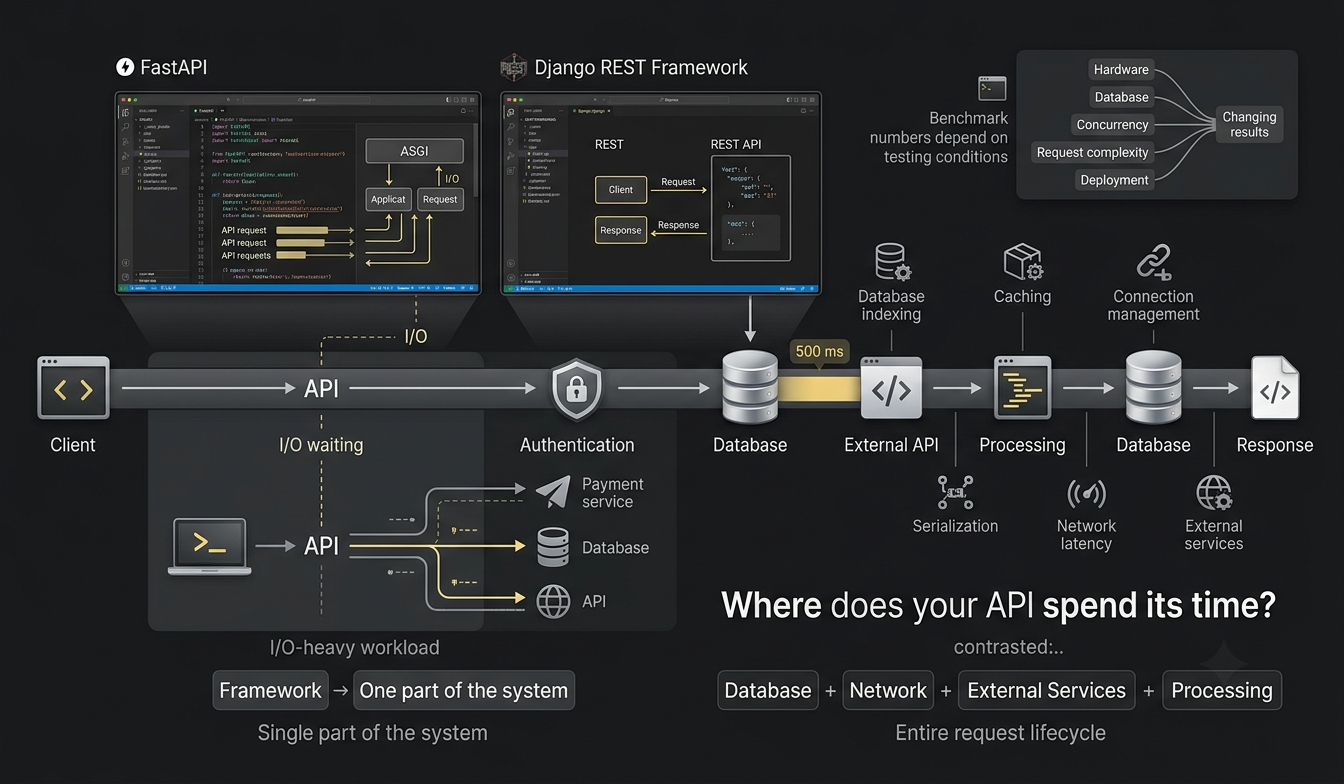
Client → API → Authentication → Database → External API → Processing → Database → Response
If a database query takes 500 milliseconds, changing the framework may not solve the main performance problem.
Database indexing, caching, connection management, serialization, network latency and external services can all affect response times.
This is why benchmark figures should be treated carefully. Results can change depending on hardware, database configuration, request complexity, concurrency and deployment architecture.
The better performance question is not simply which framework is faster. It is where your application spends most of its time.
How does async programming improve API performance?
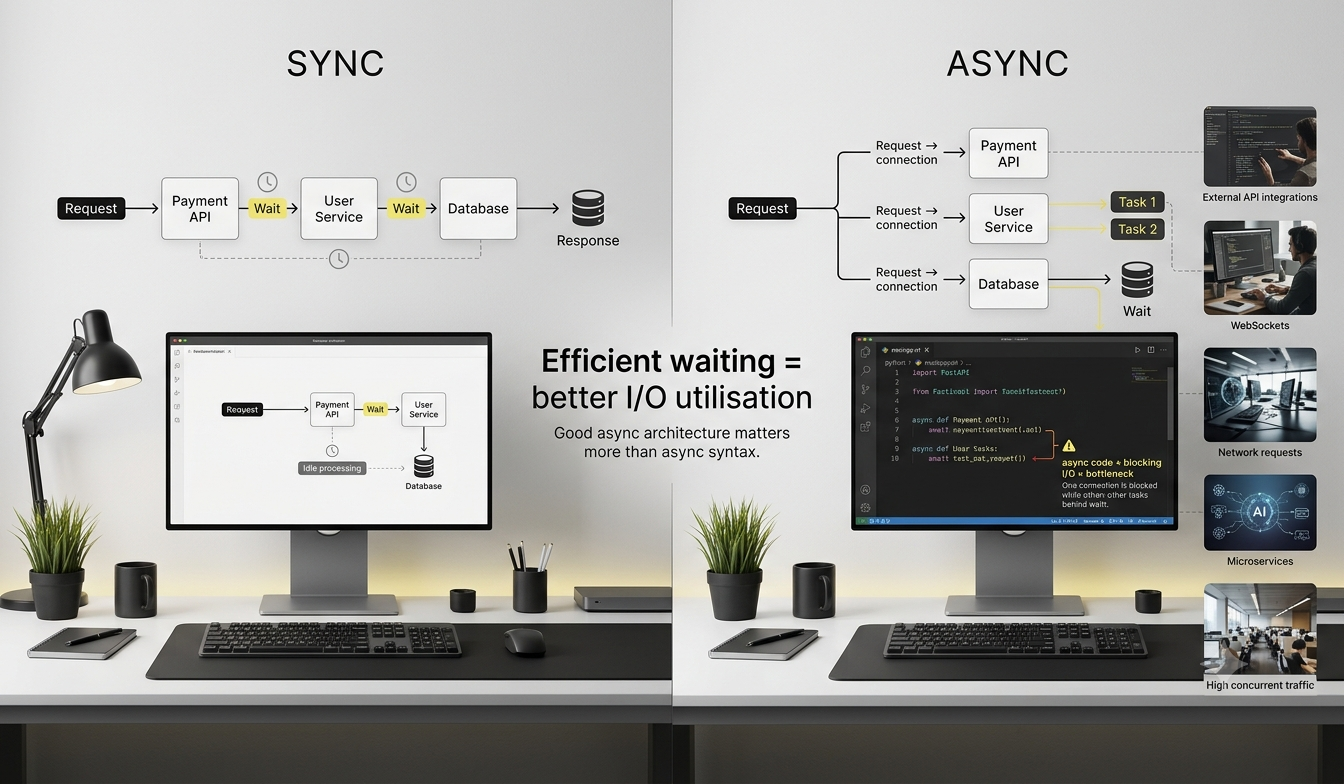
Async programming can improve API performance when an application spends considerable time waiting for I/O.
Consider an API that receives a request and needs information from three external services. A traditional synchronous approach can spend time waiting for each operation to complete.
With compatible asynchronous libraries, an application can handle other work while waiting for an I/O operation.
This is particularly useful for applications involving:
External API integrations
Real-time services
WebSockets
Network requests
AI model APIs
Microservices
High numbers of concurrent requests
FastAPI makes asynchronous programming a central part of its development model. Developers can use async def and await when the libraries they use support asynchronous operations.
However, simply adding async to a function does not automatically make an API faster.
If an endpoint uses blocking libraries inside an asynchronous workflow, the expected performance benefits may not appear.
Good async architecture matters more than simply using async syntax.
Does Django REST Framework support async programming?
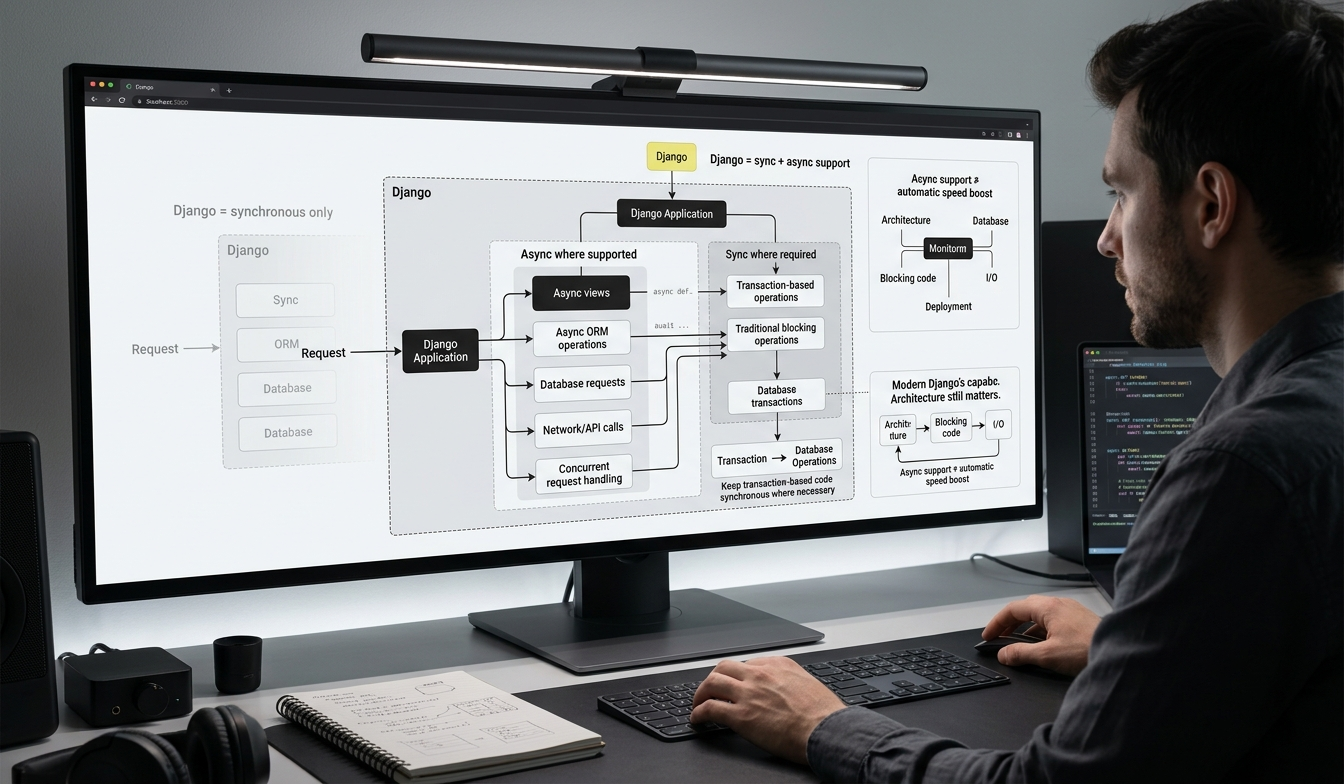
Yes. Django now has substantial asynchronous support, although developers still need to understand which parts of the stack are async-compatible.
Django supports asynchronous views and provides asynchronous versions of several ORM operations. This makes it possible to build applications that use asynchronous request handling and database operations where supported.
However, not every Django operation behaves exactly like an asynchronous API.
For example, Django's documentation notes limitations around transactions with asynchronous queries and recommends keeping transaction-based code synchronous where necessary.
This means the old idea that Django is simply a synchronous framework is outdated.
At the same time, developers should not assume that converting a Django application to async automatically produces a large performance improvement.
The application architecture still determines where the real bottlenecks are.
Which framework is easier for API development?
FastAPI can feel simpler when the project is mainly an API, while Django REST Framework can be more convenient when the project needs Django's wider application features.
FastAPI automatically creates API documentation from the endpoint definitions and data models. Type hints also make the structure of requests and responses easier to understand.
For example, a developer can define a request model with fields and data types. FastAPI uses this information for validation and documentation.
DRF uses serializers, views, routers and Django models to structure APIs.
This can involve more concepts at the beginning, but those concepts become useful when the application has complex business logic and data relationships.
So the development experience depends heavily on the type of project. For a small independent API, FastAPI can reduce unnecessary framework overhead and for a large Django application, DRF can prevent developers from rebuilding features that Django already provides.
Which framework is better for scalable API architecture?
Neither FastAPI nor Django REST Framework automatically creates a scalable application. Scalable API architecture depends on how the entire system is designed.

Important factors include:
Database performance
API design
Caching
Load balancing
Connection pooling
Background jobs
Rate limiting
Monitoring
Horizontal scaling
Service boundaries
Error handling
FastAPI can work particularly well for API-first applications and microservices.
A company may use separate FastAPI services for authentication, AI processing, payments or third-party integrations.
Django REST Framework can also support scalable systems, especially when the API is part of a larger Django application.
For example, an e-commerce platform may use Django for its product catalogue, customer accounts, administration and business logic while exposing those capabilities through DRF APIs.
The more important architectural question is: Does the API need to operate as an independent service, or is it tightly connected to a larger application?
That answer can help narrow the choice.
Which is better for database-driven applications?
Django REST Framework has a strong advantage when an application depends heavily on relational databases and Django's ORM.
Django provides an ORM that allows developers to work with database models through Python instead of writing every database operation manually. It also supports major relational database systems such as PostgreSQL, MySQL, MariaDB, SQLite and Oracle.
FastAPI does not force developers to use a particular ORM. Developers can choose tools such as SQLAlchemy or other database libraries based on the application's requirements.
That flexibility is useful for teams that want greater control over their technology stack. However, it also means more decisions during development.
Django gives developers more of the application stack upfront. FastAPI gives developers more freedom to assemble the stack themselves.
This difference becomes important when planning a scalable API architecture.
Which framework has better authentication and admin features?
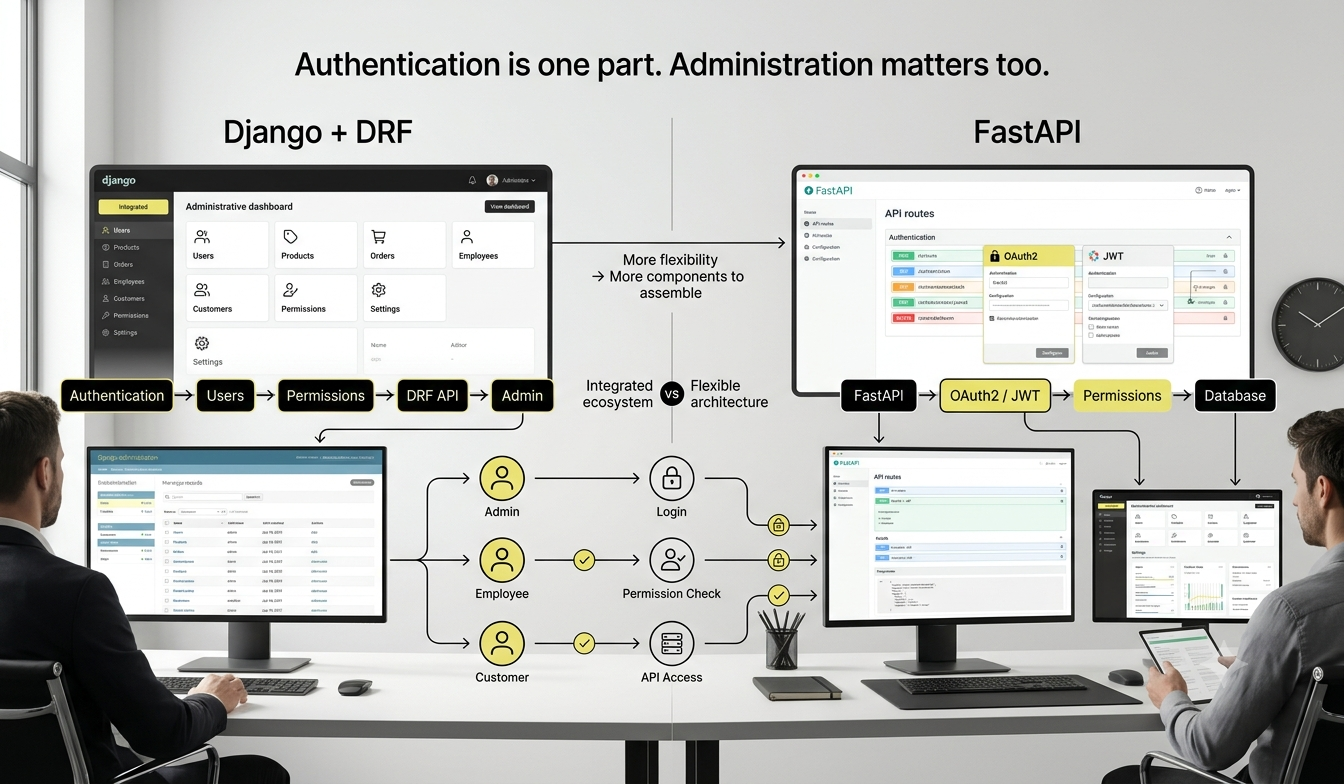
Django REST Framework can be particularly useful when an application needs authentication, permissions and administrative workflows.
Django already includes an authentication system, user management features and an admin interface. DRF can build on these features to create APIs with authentication and permission rules.
For example, a business application can have different API permissions for administrators, employees and customers while using Django's existing user and permission infrastructure.
FastAPI can also support authentication systems such as OAuth2 and JWT-based authentication.
However, developers generally have greater freedom, and therefore more responsibility, when assembling the surrounding components. The same applies to administration.
Django's admin interface can provide an internal dashboard for managing application data. FastAPI does not provide an equivalent full administration system as part of the framework itself.
For a business application with many database models, that difference can affect development effort significantly.
When should you choose FastAPI?
Choose FastAPI when the project needs a focused API framework, asynchronous programming, microservices or a flexible architecture.
FastAPI can be suitable for:
API-first applications
AI and machine learning APIs
Microservices
Real-time applications
High-concurrency I/O workloads
External API integrations
Lightweight backend services
Applications requiring automatic OpenAPI documentation
FastAPI is also a natural option for AI-powered applications where a Python backend communicates with machine learning models, vector databases or external AI services.
For example, an AI application may use FastAPI as the backend layer between a React frontend and an AI service.
Its type validation and automatic API documentation can also make collaboration easier when frontend and backend developers work on the same product.
When should you choose Django REST Framework?
Choose Django REST Framework when the API needs the wider Django ecosystem, especially its ORM, authentication, admin and established application structure.
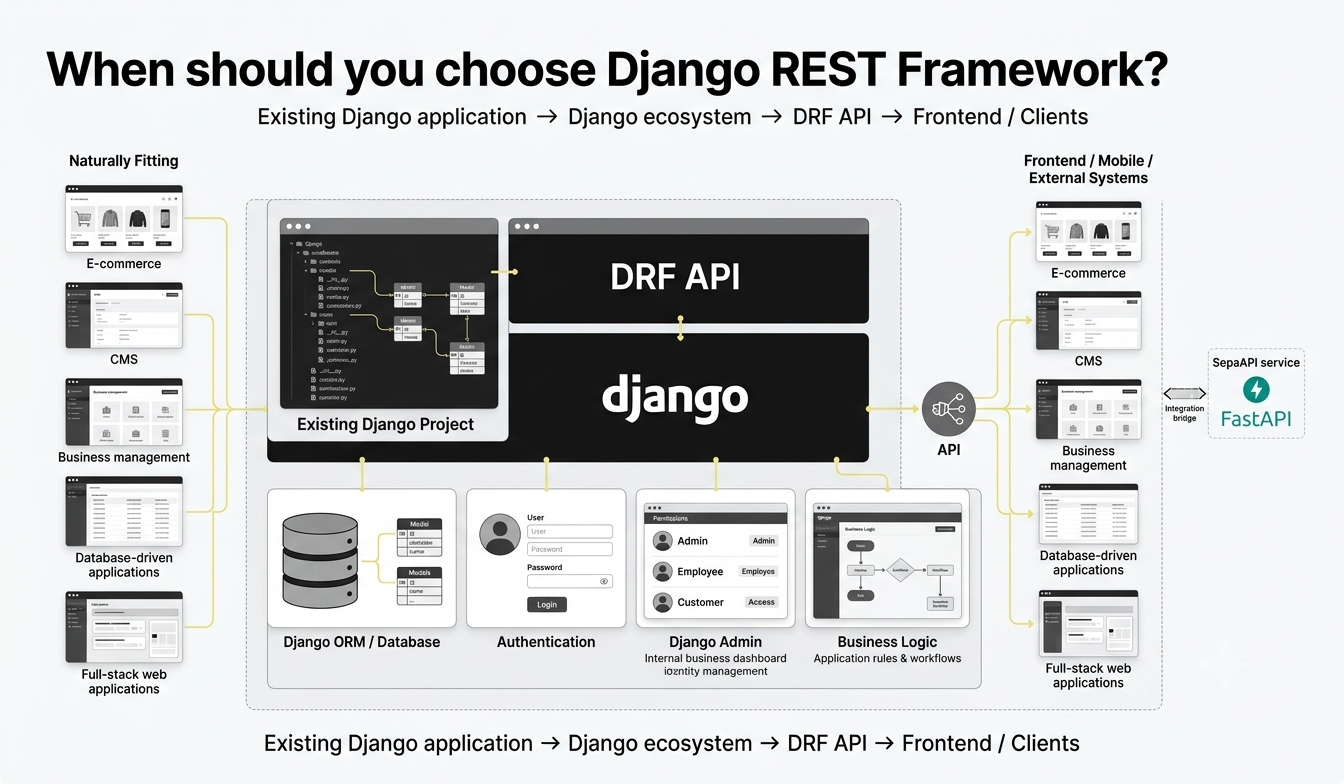
DRF can be suitable for:
Large database-driven applications
E-commerce platforms
Content management systems
Business management applications
Existing Django projects
Applications with complex permissions
Projects that need Django's admin interface
Full-stack web applications with API functionality
An existing Django project is an especially important consideration. If the application already uses Django models, authentication and business logic, introducing FastAPI may require additional integration between two separate systems.
DRF allows the team to build the API around the existing Django application instead.
Can FastAPI and Django REST Framework work together?
Yes. FastAPI and Django REST Framework can coexist when different parts of a system have different responsibilities.
For example, a business application could use:
Django + DRF: Users, administration, core business logic and relational data
FastAPI: AI processing, real-time features or high-concurrency integration services
This approach can make sense when the application has clearly separated services.
However, adding a second framework also introduces additional infrastructure, deployment and maintenance requirements.
FastAPI vs Django REST Framework: Which one should you learn?
Learning both frameworks can be useful for developers who want to work across different types of Python backend projects.
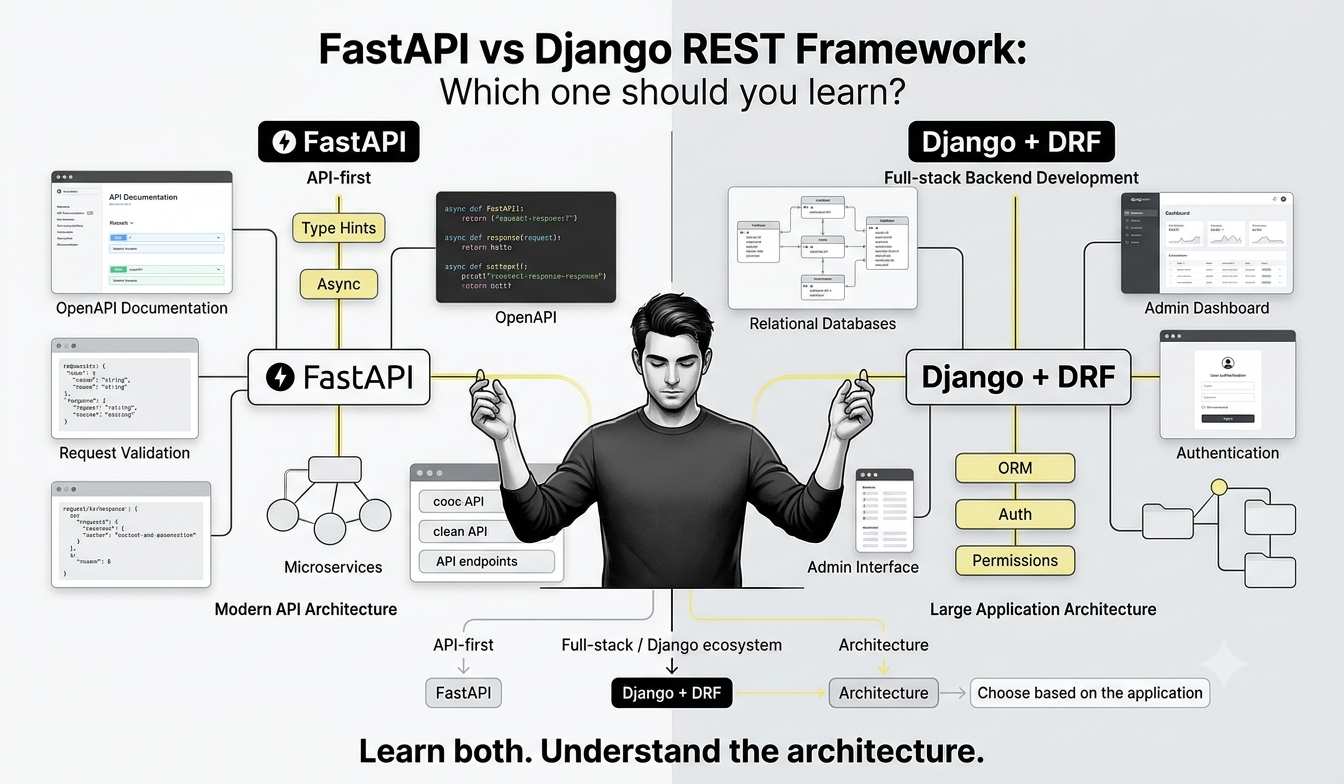
FastAPI teaches concepts such as:
API-first development
Type hints
Async programming
OpenAPI
Request validation
Microservices
Modern API architecture
Django and DRF provide experience with:
Full-stack backend development
Relational databases
ORM
Authentication
Permissions
Admin interfaces
Large application architecture
Understanding both gives developers more context when deciding how an application should be structured.
Instead of asking which framework is universally better, developers can ask which architecture fits the application.
FastAPI vs Django REST Framework: Which should you choose?
FastAPI is a strong fit for API-first, async-heavy and independently deployable services. Django REST Framework is a natural fit for applications that depend on Django's ORM, authentication, admin and wider ecosystem.
The decision ultimately depends on the application.
Your requirement | Framework to consider |
API-first application | FastAPI |
AI API or ML service | FastAPI |
Microservices | FastAPI |
Heavy external API communication | FastAPI |
Existing Django application | Django REST Framework |
Complex relational data | Django REST Framework |
Django admin required | Django REST Framework |
Django authentication ecosystem | Django REST Framework |
Full-stack Django application | Django REST Framework |
Performance should also be evaluated within the complete system.
If an API is slow because of inefficient database queries, poor indexing or blocking external requests, changing frameworks may not solve the actual problem.
A good development process starts with the application's requirements, measures performance and then chooses the architecture that fits those requirements.
Conclusion
Choosing between FastAPI and Django REST Framework comes down to what your application actually needs. FastAPI fits API-first applications, AI and machine learning APIs, microservices, real-time services and workloads that benefit from asynchronous programming. Django REST Framework fits applications that rely on Django's ORM, authentication, admin features and existing Django architecture.
Performance should not be the only factor in the decision. Database queries, caching, API design, external services, connection management and deployment architecture can all affect how an API performs. A well-designed application matters more than simply choosing a framework based on benchmark numbers.
For developers, understanding both frameworks can be valuable. FastAPI builds knowledge of modern API development, async programming and microservices, while Django and DRF provide experience with databases, authentication, permissions and full-stack backend development.
Looking to build these skills in Calicut? Explore the Python Course in Calicut by HACA Tech School and learn Python development with technologies such as Django, FastAPI, React, MySQL, REST APIs and AI.