Artificial intelligence is moving beyond answering questions and generating content. Newer AI models are being developed to investigate complex problems, work with large amounts of information and support tasks that involve several stages. Google's Gemini 4 models reflect this shift, with Argon and Carbon designed for demanding professional and technical work.
Google announced Gemini 4 Argon on September 30, 2026, and made it available to a wider group of developers, businesses and consumers on October 13. It introduced Gemini 4 Carbon on October 28, 2026. Both models focus on advanced reasoning, but they have different strengths.
Argon is designed for complex professional workflows across software engineering, finance, legal work, science and cybersecurity. Carbon builds on Argon, with a stronger focus on long-running engineering tasks, coding and cybersecurity defence.
So, what makes these models different? What can they do, and how could they support people working in different industries?
This guide compares Gemini 4 Carbon and Argon, covering their features, technical capabilities, practical applications, limitations, pricing and availability.
What Are Gemini 4 Carbon and Gemini 4 Argon?
Gemini 4 Carbon and Gemini 4 Argon are frontier AI models developed by Google DeepMind. Like other large language models (LLMs), they use advanced AI techniques to process information and generate responses. Understanding how large language models work provides useful context for exploring their capabilities.
Unlike a basic chatbot that mainly responds to individual prompts, these models are designed to support more complex workflows. They can work with information from different sources, investigate problems and assist with tasks that require multiple reasoning steps.
However, they are not identical models. Argon is Google's broad frontier reasoning model, while Carbon builds on it with improvements aimed at more demanding engineering and cybersecurity work.
What is Gemini 4 Argon?
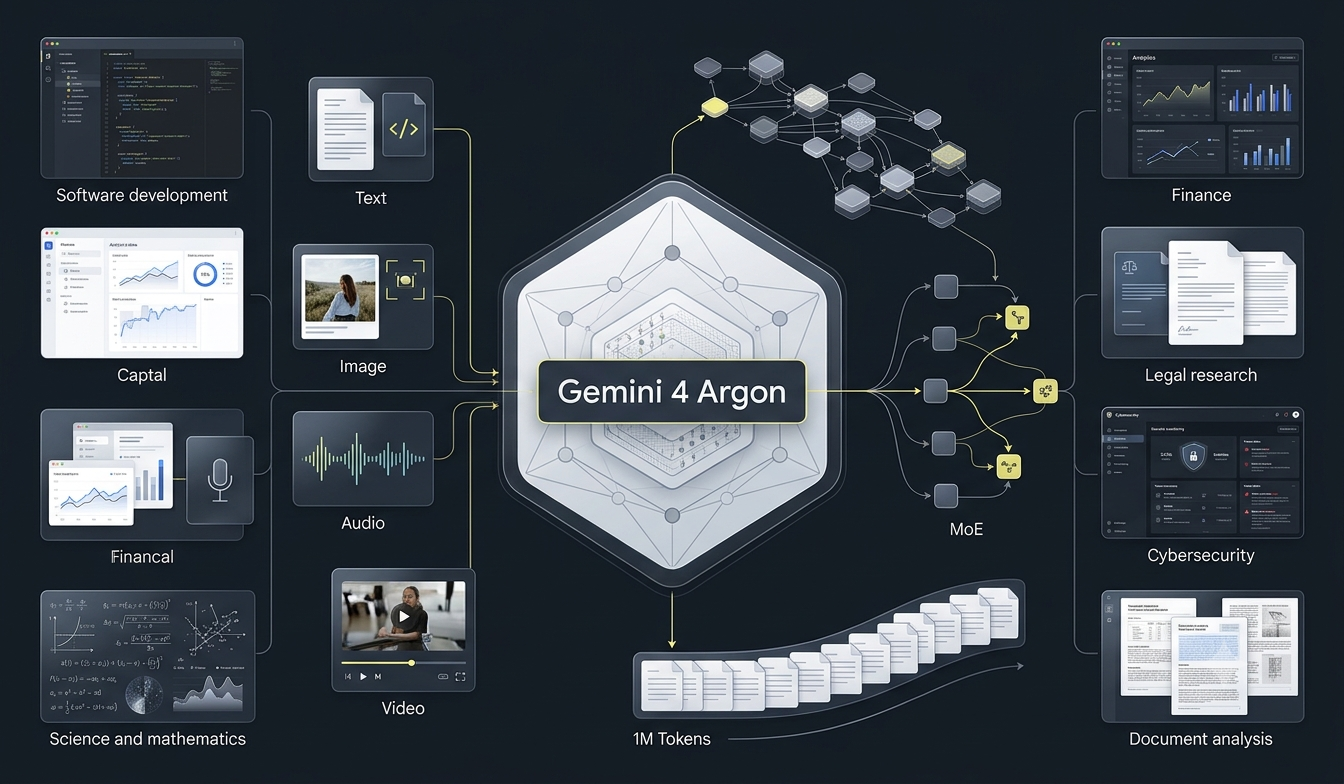
Gemini 4 Argon is Google's frontier reasoning model for complex professional and technical work. It is designed to help with tasks that require deeper investigation, specialist knowledge and multi-step problem-solving.
According to the Gemini 4 Argon model card published by Google DeepMind, Argon accepts text, image, audio and video inputs. It also supports a combined input-output context window of up to one million tokens.
Its main application areas include:
Software engineering and application development.
Financial analysis and enterprise knowledge work.
Legal research and document analysis.
Cybersecurity investigation and defence.
Scientific and mathematical problem-solving.
Multimodal document analysis.
Argon is a new frontier model, rather than a modification or fine-tuned version of an earlier Gemini model. Google identifies its architecture as a sparse Mixture of Experts transformer.
Google announced Argon on September 30, 2026. On October 13, it began rolling the model out globally through supported developer, business and consumer products. These include the Gemini API, Google AI Studio, Gemini for business, Google Antigravity and eligible Gemini app and AI Mode subscriptions.
What is Gemini 4 Carbon?
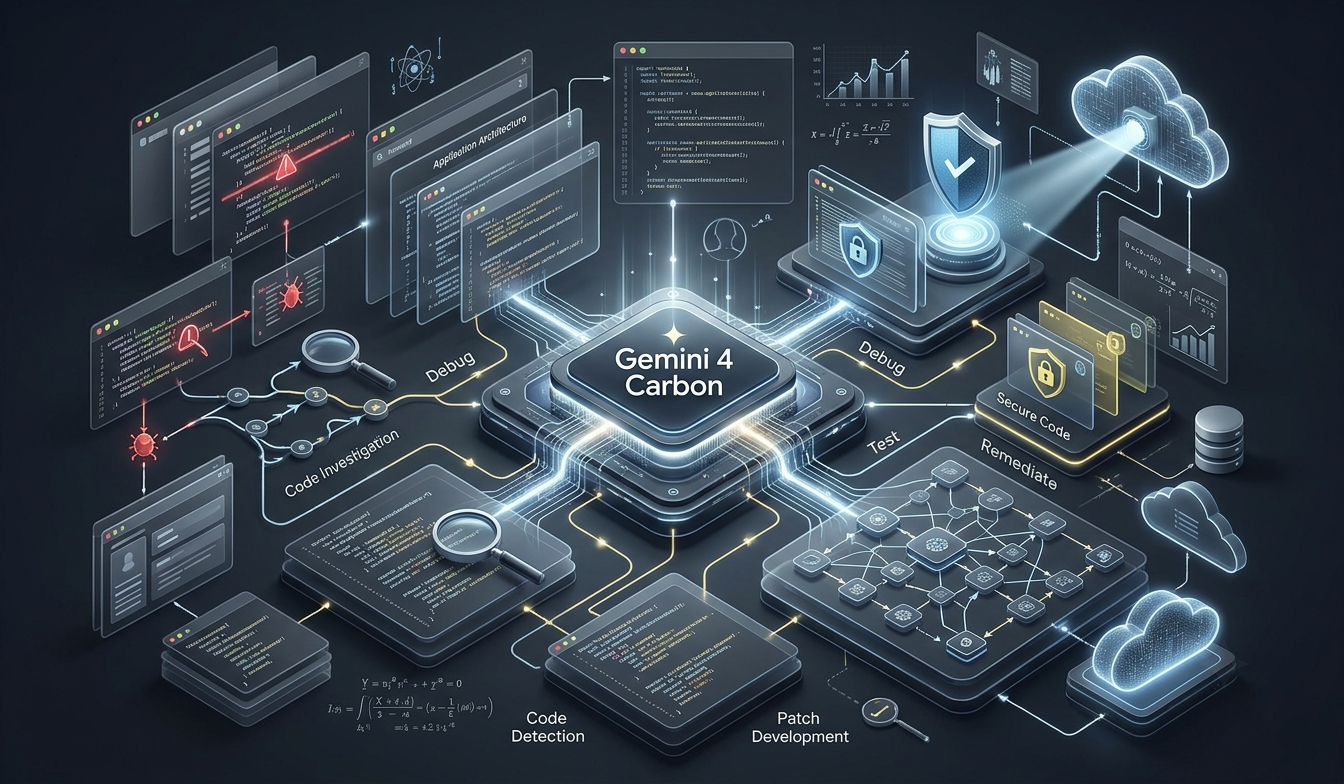
Gemini 4 Carbon is Google's next frontier model, announced on October 28, 2026. It builds on Argon and focuses on improving performance in long-running engineering workflows, coding and cybersecurity defence.
One of its main strengths is its ability to work through complicated technical problems that may require several stages of investigation and correction.
For example, a software engineer may need to identify the cause of a bug, understand how it affects different parts of an application, develop a fix and test the result. Google reports that Carbon has been used internally for engineering tasks lasting several days, including investigating subtle bugs and developing patches across large codebases and low-level systems.
Its main areas of focus include:
Complex software engineering.
Long-running agentic workflows.
Secure code generation.
Vulnerability detection and validation.
Software vulnerability remediation.
Full-stack web development.
Scientific tasks and multimodal understanding.
Carbon is being introduced through a restricted rollout. Google initially made it available to selected cybersecurity defenders and plans to expand access to additional trusted partners through its Fairwind programme. Wider access for developers, businesses and consumers is planned, but should not be confused with general availability as of October 31, 2026.
Why Did Google Introduce Gemini 4 Carbon and Argon?
The development of Argon and Carbon reflects a wider change in AI development. AI companies are working towards systems that can handle complicated assignments instead of only generating responses to individual instructions.
Consider a simple example.
A developer asks an AI assistant to explain a software error. The assistant provides a possible explanation, but the developer still needs to inspect the code, identify the actual issue, make changes and test the application.
A more capable agentic system could potentially assist across several of these stages, provided it has access to the required tools and permissions.
This is the direction Google is exploring with its Gemini 4 models.
Supporting complex professional work
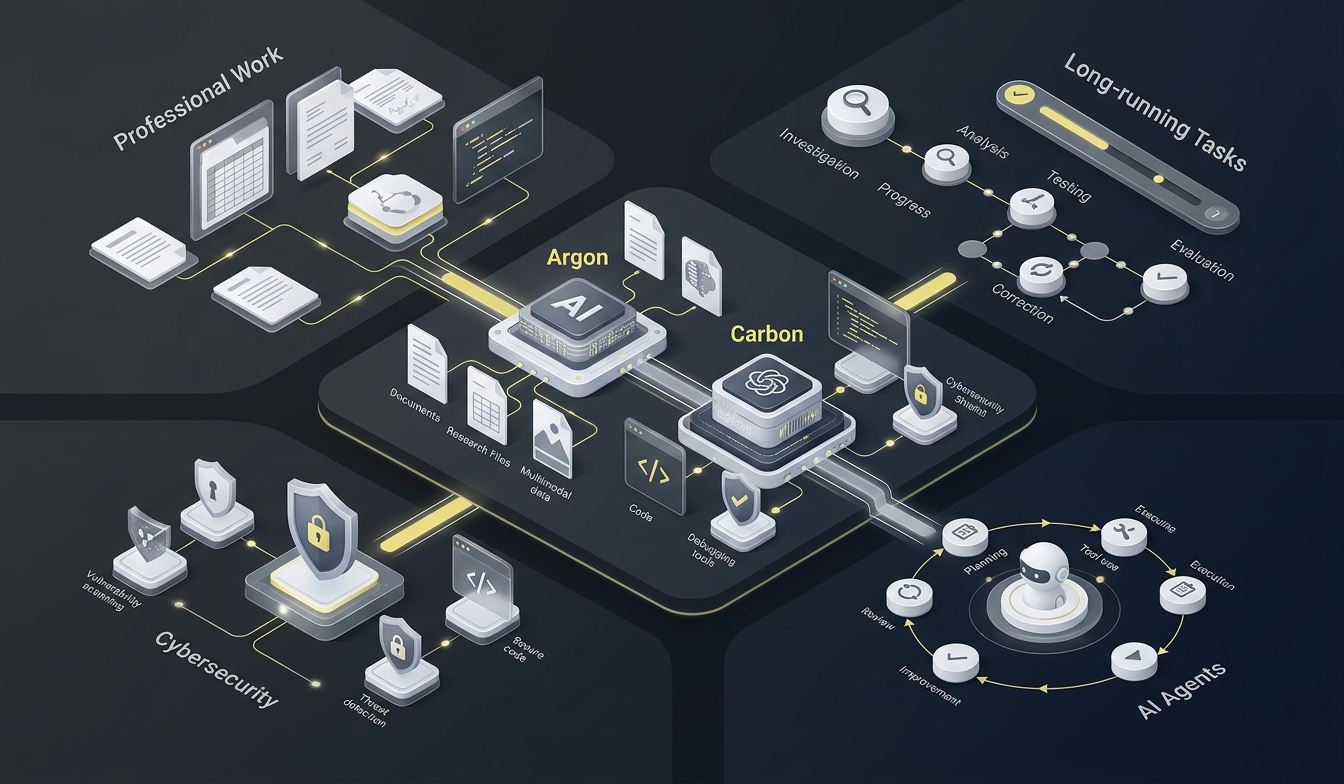
Many professional tasks involve information from different sources. A financial analyst may need to review spreadsheets, reports and market information. A lawyer may need to compare contracts and research relevant regulations. A software engineer may need to investigate problems across hundreds of files.
Argon is designed to support these types of complex workflows through advanced reasoning, domain knowledge and multimodal understanding.
Improving long-running AI workflows
Some problems cannot be solved with a single response. They require investigation, testing, correction and repeated evaluation.
Google developed Carbon to improve performance on longer and more demanding tasks, particularly in software engineering and cybersecurity.
Strengthening cybersecurity
As software becomes more complex, identifying and fixing vulnerabilities becomes increasingly important.
Google's Carbon announcement highlights three connected stages of cybersecurity work: finding vulnerabilities, validating whether they can be exploited and developing fixes.
These capabilities could help security teams investigate weaknesses more efficiently. At the same time, they require safeguards because vulnerability research can be misused.
Moving towards practical AI agents
Another important reason behind these developments is the growing interest in agentic AI.
An AI agent can use available tools and follow a sequence of steps to work towards a defined objective. Rather than only responding to a prompt, it can potentially plan, execute, review and adjust its actions.
Argon and Carbon are part of this broader move towards AI systems that can contribute to more complete professional workflows.
Gemini 4 Carbon vs Argon: What Are the Key Differences?
Although both models belong to the Gemini 4 family, their intended strengths are different.
Argon is a broad frontier reasoning model designed for complex professional and technical work. Carbon builds on that foundation, with particular improvements in long-running engineering and cybersecurity tasks.
Feature | Gemini 4 Argon | Gemini 4 Carbon |
Main purpose | Complex professional reasoning | Advanced engineering and cybersecurity |
Coding | Advanced coding and software engineering | Stronger performance on demanding engineering tasks |
Debugging | Supports technical investigation | Focuses on sustained debugging and root-cause analysis |
Cybersecurity | Supports cybersecurity defence | Improved vulnerability detection, validation and remediation |
Agentic workflows | Supports multi-step tasks | Designed for more sustained workflows |
Multimodal capabilities | Text, image, audio and video inputs | Google reports improvements in multimodal understanding |
Context window | Up to 1 million combined input-output tokens | A separate public specification should be checked before stating a limit |
Architecture | Sparse Mixture of Experts transformer | Separate architecture details have not been established in the cited announcement |
Availability | Available through supported Google developer, business and consumer channels | Initially restricted to selected cyber defenders and trusted partners |
Introductory API pricing | $2 per million input tokens and $10 per million output tokens | Same introductory pricing as Argon |
Sources: Google's Argon model card, Argon announcement and Carbon announcement.
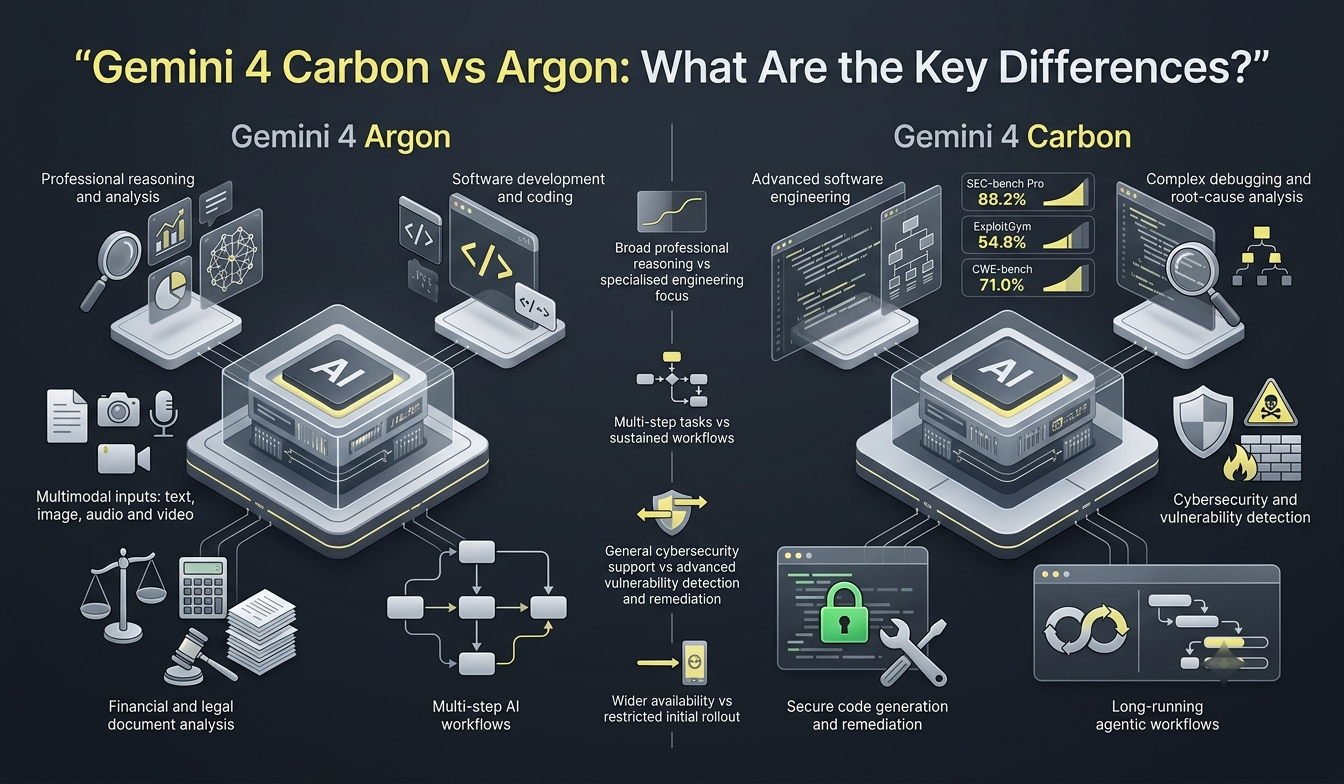
1. Reasoning and problem-solving
Argon is designed for complex reasoning tasks across different professional areas. It can investigate technical problems, analyse information and work through multi-step assignments.
Carbon builds on this capability, with improvements directed towards tasks that require sustained effort. This is particularly useful for engineering problems where an initial solution may not work and further investigation is necessary.
2. Coding and software engineering
Both models support advanced coding workflows.
Argon can assist with software development, code analysis, debugging and technical problem-solving. Carbon places greater emphasis on complex engineering tasks, including identifying root causes and developing fixes across large codebases.
This makes Carbon particularly relevant to software engineering teams working with complicated applications and low-level systems.
3. Cybersecurity capabilities
Cybersecurity is one of the clearest areas where Google reports improvements in Carbon.
Argon already supports cybersecurity defence tasks. Carbon delivers stronger results across three stages of the defensive security process:
Vulnerability detection: Finding weaknesses in software.
Vulnerability validation: Checking whether identified weaknesses can be exploited.
Vulnerability remediation: Fixing the underlying problems.
Carbon achieved the following results in Google's cited evaluations:
Benchmark | What it evaluates | Carbon result |
SEC-bench Pro | Finding software vulnerabilities | 88.2% |
ExploitGym | Testing vulnerability exploitation | 54.8% |
CWE-bench | Fixing software vulnerabilities | 71.0% |
These are results on specific benchmarks, not general cybersecurity accuracy rates. Google also states that these external cybersecurity benchmarks were evaluated without guardrails. That context matters when interpreting the results.
4. Long-running agentic workflows
Argon can handle multi-step agentic tasks. Carbon is designed to improve how AI systems work through longer and more difficult assignments.
For example, an engineering task may involve investigating a codebase, locating a bug, testing possible fixes and checking whether the changes create new problems.
This is different from simply generating a code snippet in response to a prompt. The model needs to maintain the task's context and respond to problems encountered during the process.
5. Availability and access
Argon became available through Google's supported developer and business channels on October 13, 2026. Eligible consumers can also access it through selected Google products and subscriptions.
Carbon's rollout is more restricted. Google is initially working with selected cyber defenders and trusted partners before expanding access.
Therefore, developers and businesses should not assume that both models can currently be used through the same products or access routes.
What Makes Gemini 4 Carbon and Argon Technically Different?
Understanding their technical capabilities helps explain why these models are suitable for demanding professional tasks.
However, technical specifications should be separated from performance claims. A model's architecture, input capabilities and context window describe how it is built and what information it can process. Benchmark results measure how it performs on particular evaluations.
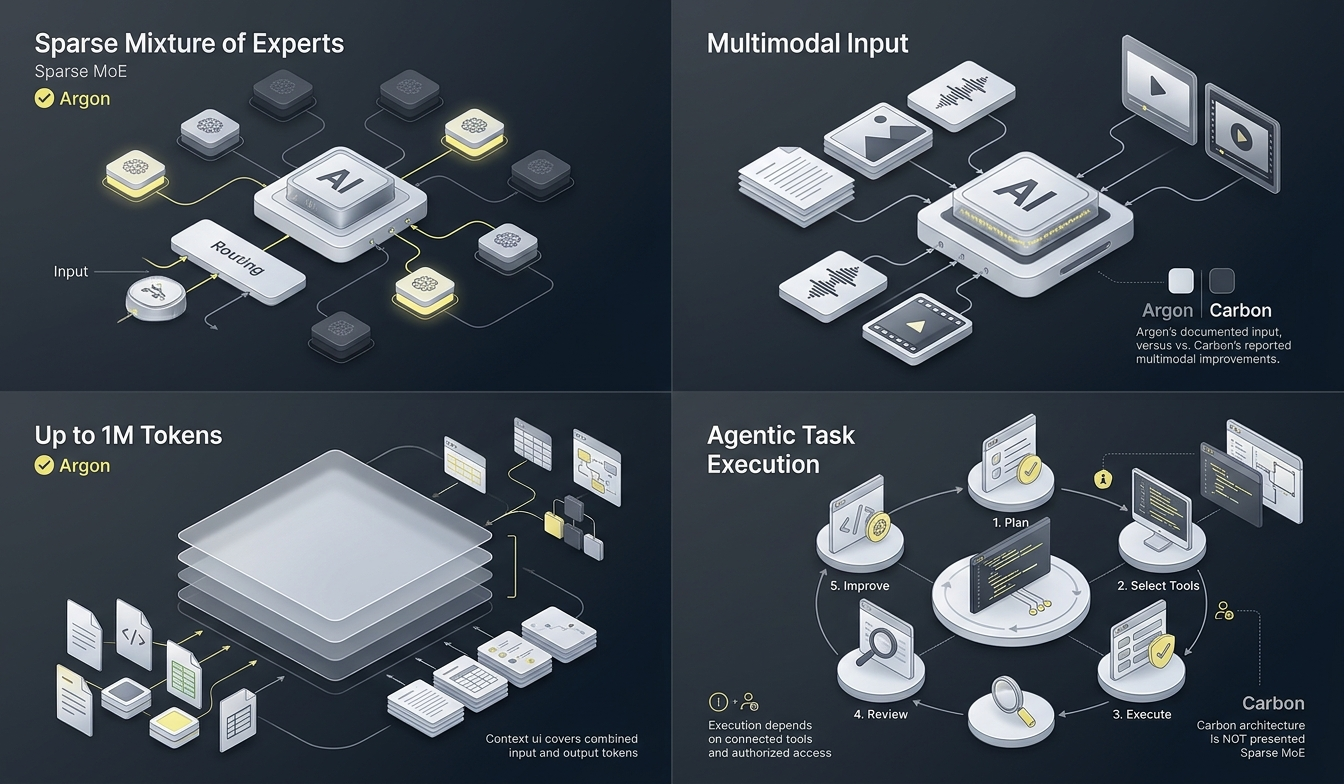
1. Sparse Mixture of Experts architecture
Google's Argon model card identifies its architecture as a sparse Mixture of Experts (MoE) transformer.
In a traditional dense neural network, the same broad set of model parameters is used across each processing step. In a Mixture of Experts system, different specialised groups of parameters, known as experts, can be selected for different inputs.
This allows a model to have a large overall parameter system without activating every parameter for every token.
In simple terms, it is similar to directing different types of work to specialised teams instead of asking every team to handle every assignment.
Google's published Argon documentation confirms this architecture. The same architectural details should not automatically be attributed to Carbon without a separate technical specification.
2. Multimodal understanding
Argon supports multiple types of input, including:
Text and documents.
Images.
Audio.
Video.
This means users can provide different forms of information instead of relying entirely on written prompts.
For example, a researcher could work with a written report and relevant images, while a business analyst could examine documents and visual data together.
Google also reports improvements in multimodal understanding with Carbon. However, its announcement does not establish the same detailed input specifications as Argon's model card. It is better not to assume that every modality and limit is identical.
3. Large context window
Argon supports a combined input-output context window of up to one million tokens.
A context window refers to the amount of information a model can process within a conversation or task. In Argon's case, Google describes the one-million-token limit as a unified input-output limit. It should not be described as a one-million-token output allowance.
A large context window can be useful when working with:
Long research documents.
Large software codebases.
Multiple business reports.
Legal contracts.
Technical manuals.
Large collections of related information.
However, a large context window does not guarantee that every detail will be interpreted correctly. Important information still needs to be checked.
4. Agentic task execution
Agentic AI refers to systems that can work through a sequence of actions to complete a defined task.
A typical workflow may involve:
Understanding the objective.
Breaking the task into smaller steps.
Selecting appropriate tools.
Carrying out the required actions.
Reviewing intermediate results.
Correcting errors.
Reporting the outcome.
Carbon's focus on long-running engineering tasks makes this capability particularly relevant.
It is important to remember that execution depends on the tools, permissions and environment connected to the model. Reasoning capability alone does not give an AI system access to private files, business accounts or external applications.
What Can Gemini 4 Argon Do?
Argon is designed for complex tasks that require advanced reasoning, technical knowledge and the ability to work with different types of information.
Its potential applications extend beyond writing and basic question-answering and can do the following things:
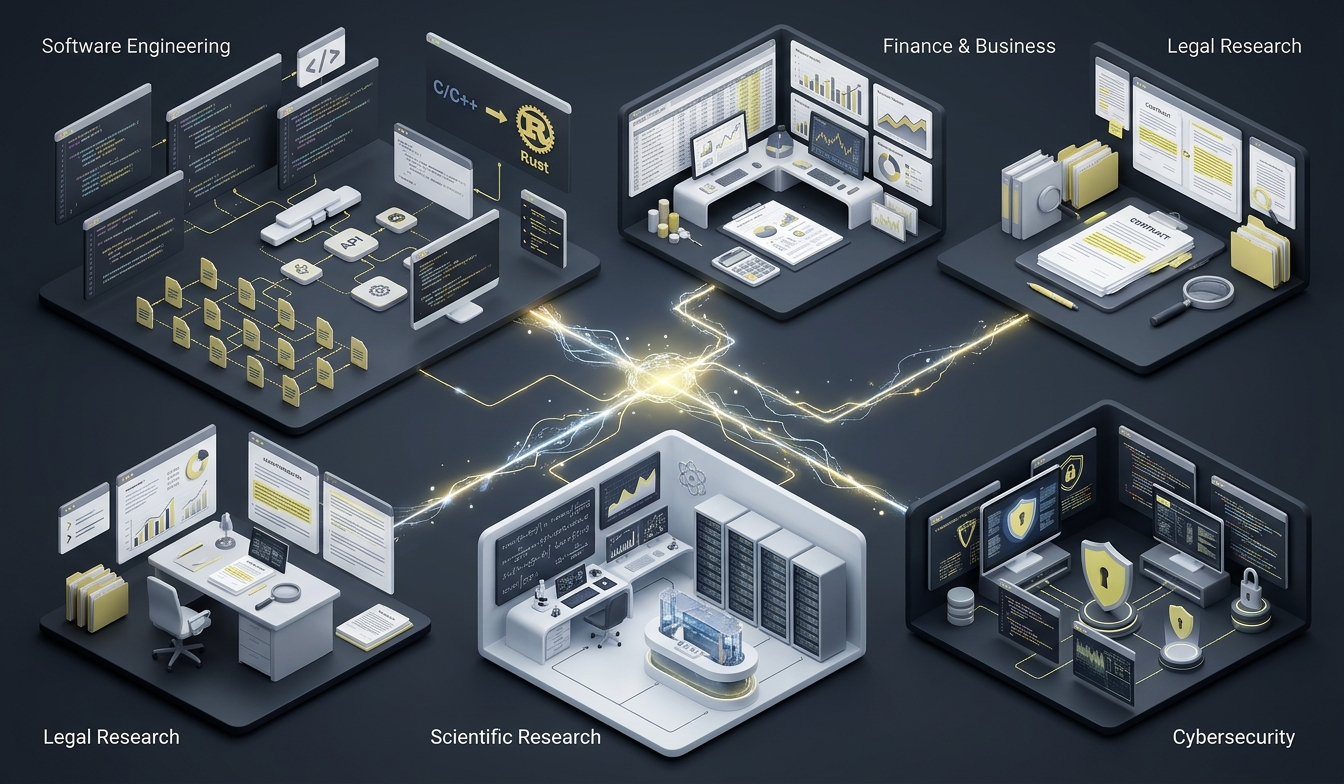
1. Software engineering and development
Developers can use Argon to investigate code, understand software architecture, debug applications and support complex development workflows.
Google's published examples also highlight work involving large codebases and software engineering. Its internal teams have used Argon for tasks such as C and C++ to Rust migrations, including work involving more than 800,000 lines of code in the Fuchsia Zircon kernel.
2. Financial and business analysis
Argon can help review financial documents, compare information and support research involving business and economic data.
Google's Argon announcement and model card identify finance and enterprise knowledge work as intended application areas.
3. Legal research
Legal teams can use its document analysis and reasoning capabilities to support contract reviews, research and the organisation of legal information.
4. Scientific research
Researchers can use Argon to examine scientific documents, explore mathematical problems and support technical investigations.
Google has also described internal work involving quantum algorithm optimisation and memory optimisation across its data centres. In one reported example, memory optimisation work freed more than 300 TiB once rolled out, with an estimated total of 500 TiB to 1 PiB.
5. Cybersecurity
Security professionals can use Argon to support security analysis, investigate software weaknesses and assist with defensive workflows.
These are intended application areas and reported examples, not a guarantee that the model can independently complete every task or replace professional review.
What Makes Gemini 4 Carbon Different?
Carbon's main distinction is its focus on more demanding and longer-running technical work.
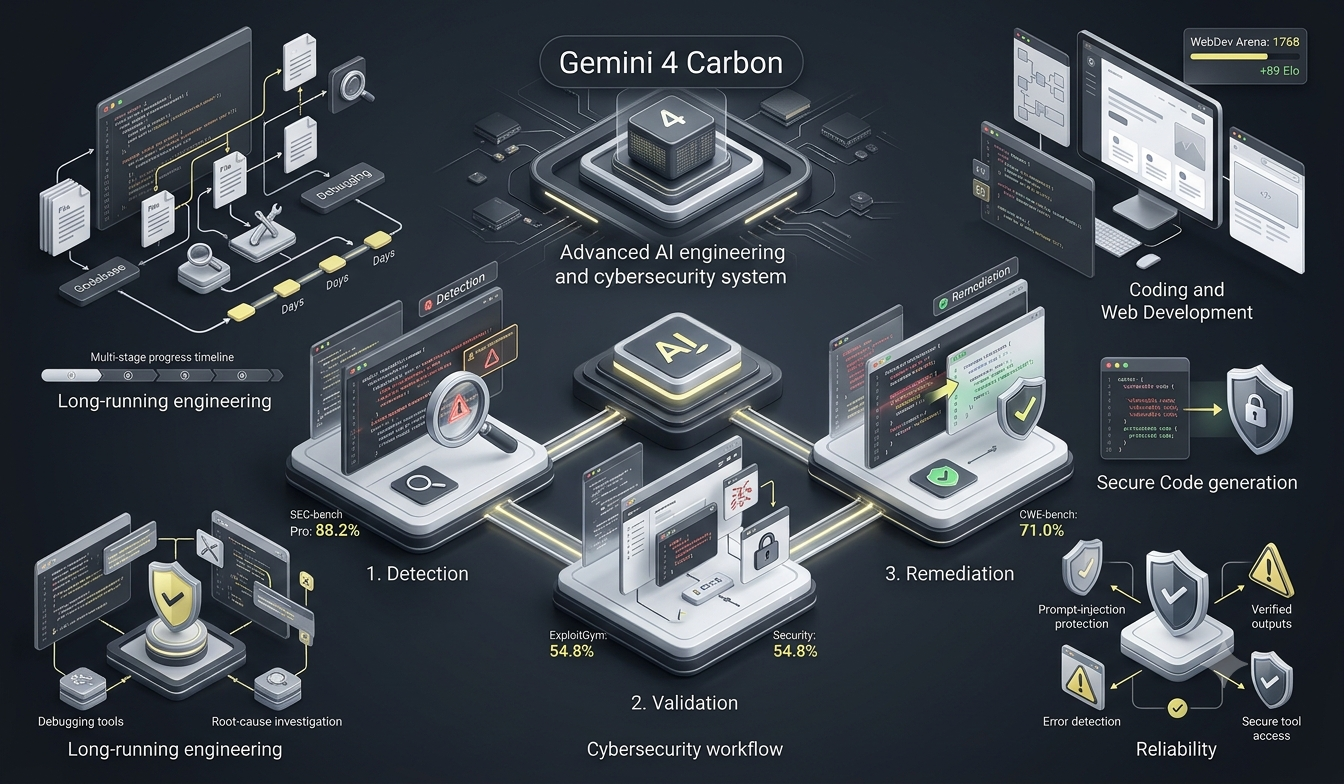
1. Long-running software engineering
Google reports that Carbon has been used internally for engineering tasks lasting several days.
These tasks include investigating subtle bugs, finding root causes and developing patches across large codebases and low-level systems.
This is significant because complicated software problems often require more than identifying an error. Engineers need to understand why it occurred, which components it affects and whether the proposed fix introduces additional problems.
2. Vulnerability detection
Carbon can support security teams by identifying weaknesses in software.
Google reports an 88.2% result on SEC-bench Pro, an evaluation focused on finding real-world software vulnerabilities.
3. Vulnerability validation
Not every software weakness creates the same level of risk.
Security teams need to establish whether a vulnerability can actually be exploited and understand its potential impact.
Carbon achieved 54.8% on ExploitGym, demonstrating its performance on this particular vulnerability validation benchmark.
4. Software vulnerability remediation
Finding a vulnerability is only one part of cybersecurity work. The next step is fixing the underlying problem.
Google reports that Carbon achieved 71.0% on CWE-bench, an evaluation of vulnerability remediation.
Together, these three capabilities cover an important part of the defensive security process: i.e. Detection, Validation and Remediation.
5. Improvements in coding and web development
Carbon's improvements are not limited to cybersecurity.
Google reports that Carbon achieved a score of 1768 on WebDev Arena, placing it at fourth position after an improvement of 89 Elo points.
Google also reports that its internal teams saw more than twice the success rate in secure code generation compared with Argon. The Chrome team reported that Carbon performed more than ten times better than another large frontier model in its evaluation of high-quality patches.
These are Google-reported results from particular internal and external evaluations. They should not be treated as universal performance guarantees.
6. Improved reliability and prompt-injection resistance
Google also reports improvements in Carbon's safety and reliability evaluations.
Its announcement states that:
Successful cheating on Terminal-Bench 4.0 fell to 0.0%, with cheating attempts at 0.4%.
High-severity misalignment alerts in internal live coding environments dropped by almost 80%.
Unsupported claims were reduced by approximately two times compared with Argon in internal testing.
Overreach decreased by 26%, while under-service decreased by 29%.
Carbon recorded a 0.0% attack success rate on the evaluated Gray Swan indirect prompt-injection benchmark, compared with Argon's 0.7%.
These are company-reported evaluation results. They do not guarantee that Carbon will never make mistakes, fabricate information or be vulnerable to future attacks.
How Can Gemini 4 Carbon and Argon Help Different Industries?
The applications of advanced AI models are not limited to technology companies. Their reasoning, coding and information-processing capabilities could support professionals across several industries.
The exact benefits depend on the model's availability, integrations, data access and the requirements of each profession.
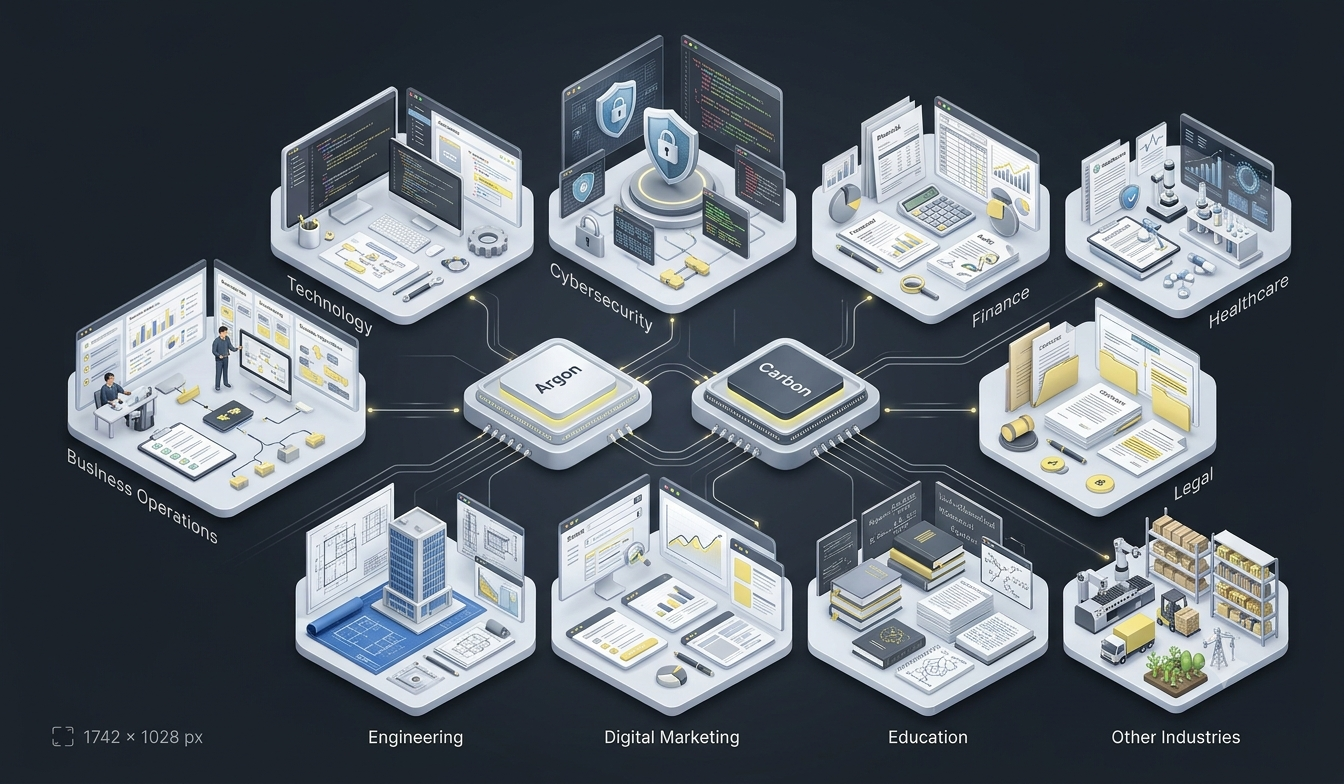
1. Technology and software development
Professionals: Software developers, full-stack developers, backend engineers, frontend developers, DevOps engineers, QA engineers and software architects.
Potential applications include:
Developing and reviewing software code.
Identifying bugs and investigating their root causes.
Refactoring large codebases.
Preparing technical documentation.
Supporting software testing.
Investigating deployment problems.
Reviewing application security.
Argon can support complex software development and technical reasoning. Carbon is particularly relevant to sustained debugging, engineering investigations and vulnerability remediation.
2. Cybersecurity and information security
Professionals: Ethical hackers, penetration testers, security researchers, SOC analysts, security engineers and incident response specialists.
Potential applications include:
Identifying software vulnerabilities.
Analysing suspicious code.
Validating security weaknesses.
Supporting vulnerability remediation.
Reviewing application security.
Investigating security incidents.
Improving secure coding practices.
Carbon's cybersecurity performance makes this one of its most relevant professional application areas.
However, these capabilities are dual-use. The same techniques that help defenders understand vulnerabilities could be misused by attackers. Access controls, authorisation and human oversight remain essential.
3. Banking, finance and accounting
Professionals: Accountants, financial analysts, auditors, tax consultants, investment researchers, banking professionals and risk managers.
Potential applications include:
Reviewing financial statements.
Comparing financial reports.
Identifying inconsistencies in business documents.
Organising audit evidence.
Analysing financial research.
Reviewing financial contracts.
Supporting risk assessments.
For example, an auditor could use a connected AI workflow to compare figures across financial statements and supporting documents. The model could flag possible inconsistencies for further investigation.
It should not independently approve transactions, certify financial statements or replace a qualified professional's judgement.
4. Healthcare and life sciences
Professionals: Doctors, medical researchers, pharmacists, laboratory scientists, clinical researchers and healthcare administrators.
Potential applications include:
Reviewing medical research papers.
Summarising scientific literature.
Organising research findings.
Comparing clinical study information.
Supporting pharmaceutical research.
Analysing permitted scientific datasets.
Preparing research documentation.
Argon's scientific reasoning and document-processing capabilities could be useful in research environments.
However, research assistance should not be confused with clinical validation. Neither model should be treated as a replacement for medical professionals or an approved diagnostic system.
5. Legal services
Professionals: Lawyers, legal researchers, paralegals, contract managers, compliance officers and corporate legal teams.
Potential applications include:
Reviewing lengthy contracts.
Comparing different document versions.
Organising legal research.
Identifying missing information in agreements.
Summarising case documents.
Preparing initial legal drafts.
Supporting regulatory research.
One valuable application is cross-document analysis. A legal team could use an AI-assisted workflow to compare several contracts and flag inconsistent terms for human review.
Legal conclusions still require qualified professional judgement and verification against authoritative sources.
6. Education and academic research
Professionals: Teachers, university lecturers, researchers, PhD scholars, academic writers and curriculum designers.
Potential applications include:
Reviewing academic literature.
Preparing research summaries.
Explaining complex subjects.
Analysing scientific information.
Developing coding exercises.
Supporting mathematical problem-solving.
Preparing teaching resources.
Comparing research findings.
Researchers could benefit from using large-context models to examine several documents and identify similarities, differences and unanswered questions.
However, generated references and research claims must always be checked against the original publications.
7. Digital marketing, SEO and advertising
Professionals: SEO strategists, content writers, copywriters, PPC specialists, marketing analysts, digital marketing executives and brand strategists.
Potential applications include:
Analysing keyword research datasets.
Grouping keywords by search intent.
Reviewing competitor content.
Identifying content gaps.
Preparing content briefs.
Analysing marketing reports.
Exploring campaign messaging.
Reviewing customer feedback.
Supporting marketing research.
For example, an SEO professional could provide a connected AI system with an exported keyword dataset and competitor research. The system could group search terms, identify potential content gaps and prepare an initial content plan.
A marketing team could also use AI to analyse campaign performance and identify patterns across different reports.
These workflows require access to the relevant data and tools. They are potential applications rather than built-in, guaranteed features of either model.
8. Architecture, construction and engineering
Professionals: Architects, civil engineers, mechanical engineers, electrical engineers, structural engineers and project managers.
Potential applications include:
Reviewing technical specifications.
Comparing project documents.
Analysing engineering reports.
Preparing technical documentation.
Writing scripts for engineering software.
Supporting simulation workflows.
Reviewing project requirements.
AI can assist with information analysis and technical problem-solving, but it cannot independently guarantee structural safety or replace engineering approval and certification.
9. Business management and operations
Professionals: CEOs, COOs, business analysts, operations managers, project managers and management consultants.
Potential applications include:
Reviewing business reports.
Analysing operational data.
Comparing departmental performance.
Preparing management summaries.
Identifying workflow inefficiencies.
Organising project information.
Supporting business planning.
Reviewing internal documentation.
For example, an operations manager could use an AI workflow to compare sales reports, customer feedback and operational records to identify recurring problems.
The value comes from connecting information across departments, not simply producing another business report.
10. Other industries
Industry | Relevant professionals | Potential applications |
Manufacturing | Production engineers, quality managers | Process analysis and software troubleshooting |
Retail | Retail managers, merchandising analysts | Sales analysis and inventory insights |
Logistics | Supply chain analysts, logistics managers | Operational and route data analysis |
Insurance | Underwriters, claims analysts | Document review and risk assessment support |
Media | Journalists, editors, researchers | Research and document analysis |
Agriculture | Agronomists, agricultural researchers | Scientific research and data interpretation |
Energy | Energy analysts, engineers | Technical research and engineering software support |
Telecommunications | Network engineers | Network software troubleshooting |
Government | Policy researchers, administrators | Document and policy analysis |
Human resources | HR analysts, recruitment managers | Workforce data analysis and policy review |
These examples demonstrate where advanced reasoning and information processing could be useful. They should not be interpreted as confirmed deployments of Gemini 4 models in every industry.
How Can Different Professionals Use Gemini 4 in Their Daily Work?
Industry applications explain where AI could be useful. Role-based examples show how these capabilities might fit into an actual working day.
Profession | Example task | Potential benefit |
SEO strategist | Analyse keyword datasets and competitor pages | More organised research |
Content writer | Review source documents and prepare content briefs | Better-supported content |
Software developer | Investigate bugs across multiple files | More efficient debugging |
Accountant | Compare financial documents | Faster identification of inconsistencies |
Lawyer | Review contract versions | Easier document comparison |
Teacher | Prepare learning resources | Reduced preparation time |
Researcher | Compare scientific papers | More structured literature analysis |
Cybersecurity analyst | Investigate and validate vulnerabilities | Support for security workflows |
Project manager | Review project reports | Better-organised project information |
Business analyst | Compare operational datasets | More useful business insights |
How Are Gemini 4 Models Different From Traditional AI Assistants?
Traditional AI assistants are often used for individual tasks. A user asks a question, receives an answer and decides what to do next.
Agentic AI introduces a different approach to generative AI. When connected to suitable tools, an AI model can work through a sequence of actions towards a defined objective instead of simply generating a response to an individual prompt.
Consider the difference:
Traditional AI interaction | Agentic AI workflow |
Explain a software error | Investigate the error and work through possible fixes |
Summarise a report | Compare multiple reports and identify inconsistencies |
Suggest SEO keywords | Analyse a supplied keyword dataset and group search terms |
Explain a security vulnerability | Help validate and investigate the vulnerability |
Draft a project plan | Work through connected planning and review tasks |
This does not mean that every agentic system is fully autonomous. Its actions depend on available integrations, permissions and execution environments.
A model may be able to reason about a task without having access to the software or accounts needed to complete it.
What Are the Limitations of Gemini 4 Carbon and Argon?
Despite their advanced capabilities, neither model is free from limitations. Understanding these restrictions is important before using them for professional or business tasks.
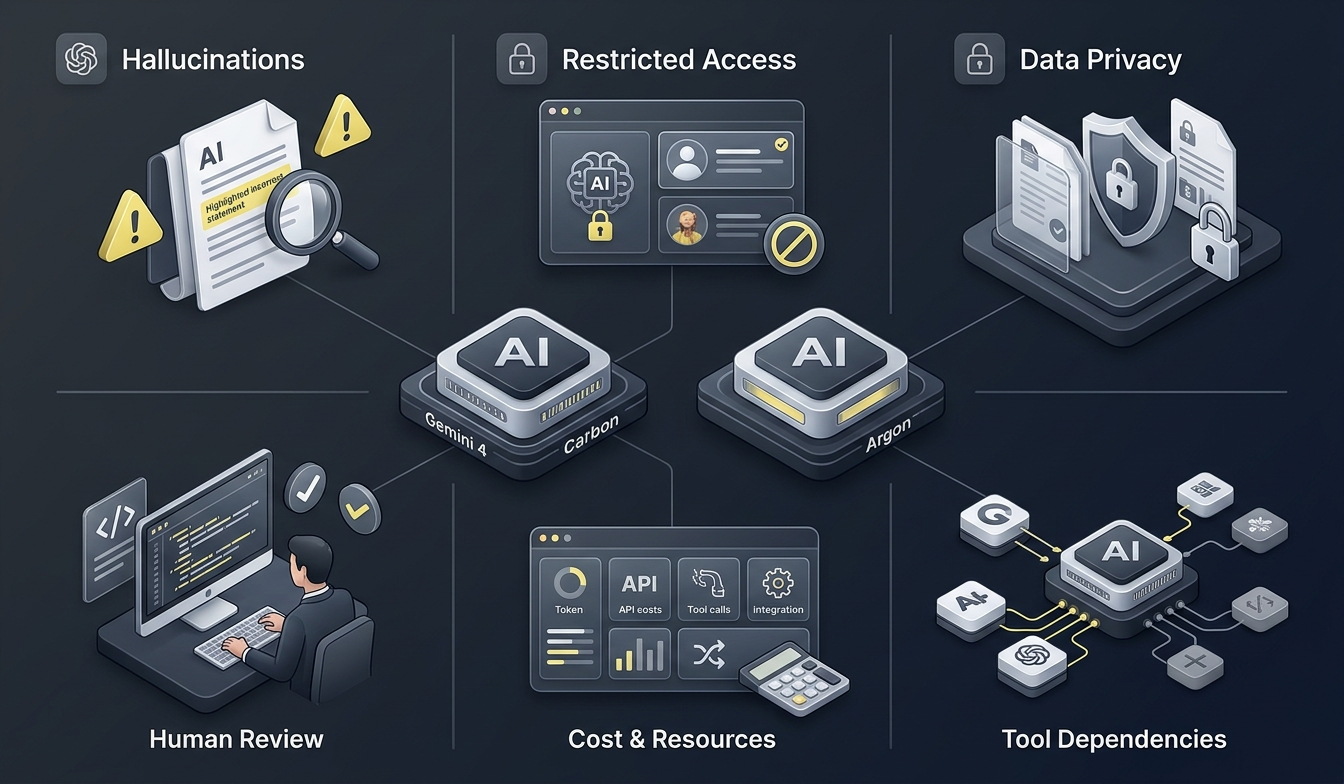
1. Incorrect information and hallucinations
AI models can generate inaccurate information, misunderstand instructions or present unsupported claims as facts.
This is particularly important in legal, financial, medical and scientific work, where an incorrect statement can have serious consequences.
2. Limited availability of Carbon
As of October 31, 2026, Carbon is in an initial restricted rollout for selected cybersecurity defenders and trusted partners. General availability to developers, businesses and consumers has not yet been confirmed.
3. Data privacy and security
Businesses should consider the sensitivity of the information they provide to AI systems.
Financial records, customer details, legal documents and internal business information should only be processed through approved systems with appropriate data protection and access controls.
4. Human supervision
AI-generated code, financial analysis, legal research and technical recommendations require suitable review.
A model can assist with professional work, but responsibility for important decisions remains with the relevant people and organisations.
5. Cost and resource requirements
API pricing is only one part of the total cost of using an AI system.
Businesses must also consider token consumption, tool calls, integrations, testing, human review and the cost of correcting unsuccessful attempts.
6. Dependence on external tools
An AI model cannot automatically access every business application or perform every real-world action.
Its ability to complete a workflow depends on the integrations, tools and permissions available in its environment.
How Can Developers and Businesses Access Gemini 4 Carbon and Argon?
Access to the two models is different as of October 31, 2026.
Accessing Gemini 4 Argon
Argon became available through Google's supported developer, business and consumer channels on October 13, 2026.
These include:
Gemini API: For developers building applications and AI workflows.
Google AI Studio: For experimenting with the model and building with the Gemini API.
Gemini for business: For eligible business users.
Google Antigravity: For supported development workflows and eligible subscribers.
Gemini app: For eligible Google AI Pro and Ultra subscribers.
AI Mode in Search: For eligible subscribers.
Developers can explore the Gemini API documentation and Google's official Argon announcement for current access information.
Google announced introductory API pricing of $2 per million input tokens and $10 per million output tokens for Argon. This introductory period runs until November 30, 2026. From December 1, the announced standard prices are $4 per million input tokens and $20 per million output tokens. Cached input tokens are priced at 95% less than the standard input token price during the introductory period.
Always check Google's live pricing documentation before implementing the model, as prices and access conditions may change.
Accessing Gemini 4 Carbon
Carbon has a more restricted access process. Google initially announced access for a subset of cybersecurity defenders, with additional trusted partners joining through its Fairwind programme.
The company has stated that it intends to make Carbon available to developers, businesses and consumers through its product channels after gathering feedback and continuing to improve its safeguards.
Google announced the same introductory API price as Argon: $2 per million input tokens and $10 per million output tokens, with cached input tokens priced at 95% off the input token price. The announcement states that the price will increase to $4 per million input tokens and $20 per million output tokens after the introductory period.
However, Carbon's wider developer and consumer availability should not be assumed until Google confirms its release.
What Does Gemini 4 Mean for the Future of Work?
Gemini 4 Carbon and Argon represent an important development in the direction of professional AI tools.
Their capabilities show how AI systems are moving towards more complex reasoning, connected workflows and sustained problem-solving.
For businesses, this could mean faster research, improved software development and more organised information processing. For professionals, it could mean spending less time on repetitive tasks and more time on decision-making, quality control and creative problem-solving.
However, the actual impact will depend on reliability, cost, access, data protection and how effectively organisations integrate AI into their existing processes.
The future of work is unlikely to be defined by AI models working entirely without people. A more practical direction is collaboration between capable AI systems and professionals who can guide, evaluate and take responsibility for their output.
To Sum Up
Gemini 4 Argon and Carbon reflect a significant shift in artificial intelligence, where models are becoming capable of handling complex tasks rather than simply responding to prompts. From software development and cybersecurity to finance, research, design and marketing, these models demonstrate the growing role of AI across professional industries. While Argon offers broad reasoning capabilities, Carbon takes a more specialised approach to advanced engineering and cybersecurity workflows.
As these technologies continue to evolve, professionals will need to keep pace with new tools, industry requirements and changing ways of working. Building relevant skills and learning how to apply AI in practical situations can help individuals make better use of these developments.
If you are looking to upgrade your skills, HACA offers courses across digital marketing, graphic design, UI/UX design, video editing and technology. These programmes help learners develop practical industry skills and prepare for emerging opportunities in an increasingly AI-driven workplace.
Explore HACA's courses and take a step towards building the skills needed for tomorrow's opportunities.