GPT-6 Astra is OpenAI's latest high-capability AI model, built for complex reasoning, coding, computer use, research and professional workflows. OpenAI introduced Astra on September 3, 2026, positioning it as a model designed to handle complete tasks rather than simply generate an answer.
The biggest change is not just that Astra can write better text or code. It can work across longer, multi-step tasks, interact with computers and websites, create documents, modify software, analyse information and complete workflows with less step-by-step supervision.
OpenAI reports 98% on FrontierMath Tier 4, 99.9% on ARC-AGI-3 and 100% on ExploitBench. These are OpenAI-reported results, so they should be treated as benchmark claims rather than a universal measure of intelligence.
This guide explains what GPT-6 Astra is, what makes it different, how much it costs, who can use it, what it can do for developers and businesses, and where its limitations still matter.
What Is GPT-6 Astra?
GPT-6 Astra is OpenAI's latest frontier model for difficult, end-to-end work.
Unlike an AI model designed mainly for conversation, Astra is built around tasks that can involve several stages. A single workflow might require research, reasoning, browsing, writing, coding, testing and making changes in another application.
Its capabilities cover:
Complex reasoning
Software engineering
Computer use
Web browsing
Scientific and mathematical work
Cybersecurity
Document creation
Data analysis
Professional research
Multi-step agentic workflows
The OpenAI API version is available as gpt-6-astra.
Astra has a 1.05 million-token context window and supports up to 128,000 output tokens. Its knowledge cutoff is April 30, 2026.
That large context window matters when a task involves extensive documentation, source material, codebases, research papers or multiple business files.
What Is New in GPT-6 Astra?
The most significant Astra improvements are concentrated around reasoning, computer use, software engineering and autonomous task completion.
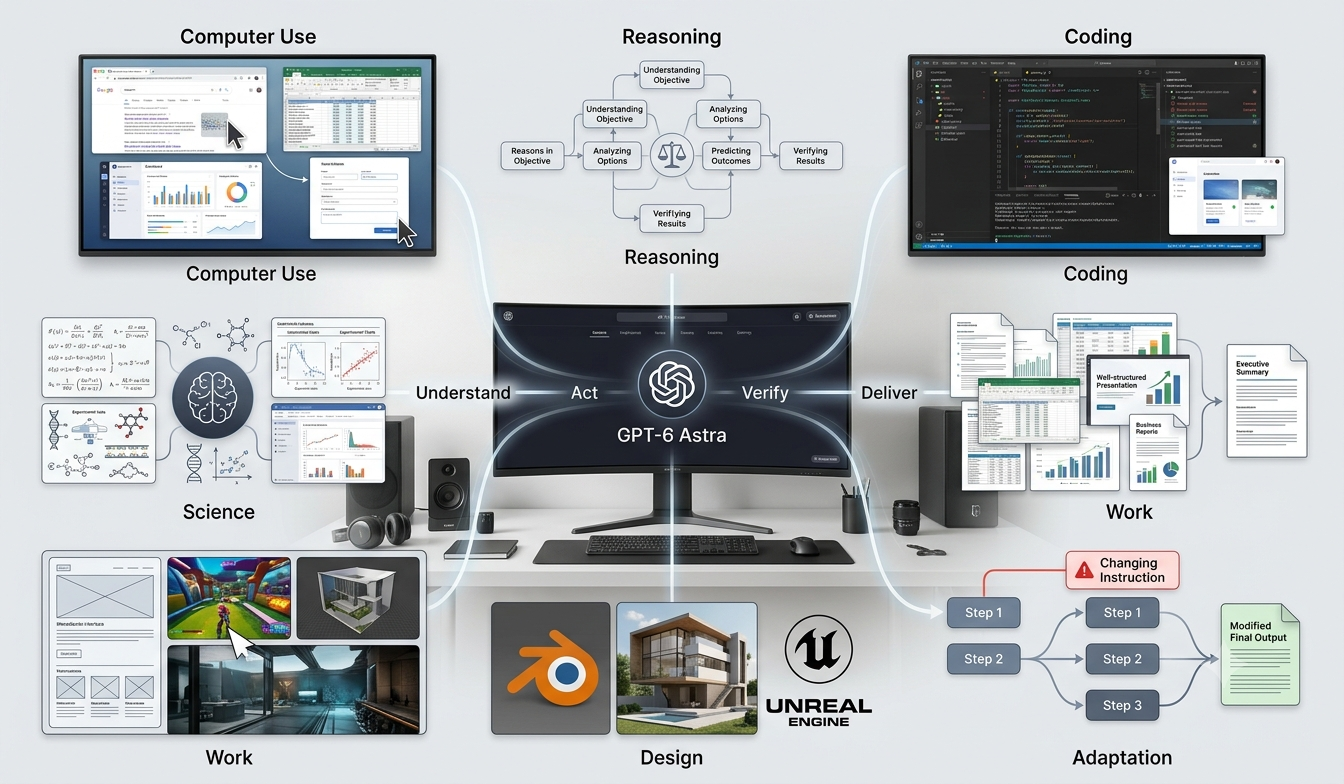
1. Computer use
Astra can interact with computers rather than simply telling users what to click.
This makes it useful for workflows involving websites, desktop applications, spreadsheets, dashboards and other interfaces.
For example, a computer-use workflow could involve:
Opening a website
Finding information
Comparing data
Entering information into a form
Checking the result
Making corrections
Producing a final report
This changes the role of an AI assistant from an answer generator into a workflow operator.
2. Stronger reasoning
Astra supports multiple reasoning levels in the API:
Low
Medium
High
XHigh
Max
Developers can therefore choose how much reasoning effort a task requires.
A simple transformation does not necessarily need the same reasoning budget as a difficult research, coding or mathematical problem.
3. Software engineering
Astra is designed to work across larger software tasks, including coding, debugging, testing and understanding existing systems.
OpenAI's current examples increasingly focus on AI completing development workflows rather than simply producing code snippets.
That distinction matters for developers.
Instead of:
“Write a Python function that does X.”
The workflow can become:
“Inspect the application, identify the issue, modify the code, run tests and verify the result.”
4. Scientific and mathematical reasoning
OpenAI reports a 98% score on FrontierMath Tier 4, a 99.9% score on ARC-AGI-3, and a 100% score on ExploitBench.
These results indicate strong performance on the evaluations OpenAI selected for the launch. They should not be interpreted as proof that Astra can solve every real-world scientific or reasoning problem.
The practical value is that difficult reasoning tasks can increasingly be incorporated into larger workflows.
5. Professional work
Astra can work with documents, spreadsheets, presentations and other structured outputs. That makes it relevant beyond software development.
Potential applications include:
Financial research
Market analysis
Business reporting
Data analysis
Research synthesis
Presentation creation
Document review
Operations
Quality assurance
6. Stronger visual and design capabilities
Astra also brings stronger visual judgement to websites, applications, games and 3D work. OpenAI demonstrates Astra creating websites and games, as well as turning a Blender model into a walkable Unreal Engine scene.
7. Better handling of changing instructions
Astra is also designed to maintain context when a task changes. It can incorporate new requirements, adjust its approach and answer side questions without losing sight of the main objective. When an important decision depends on missing information, it can ask a focused question instead of simply guessing.
Can GPT-6 Astra Interact With Websites and Computer?
Yes, computer use is one of GPT-6 Astra's defining capabilities. OpenAI reports that in latency simulations on OSWorld 2.0, GPT-6 Astra achieved 72.6% performance at roughly 40 minutes per task, compared with 65.7% for GPT-5.6 Sol at roughly 75 minutes. That means Astra completed these computer-use tasks in about 47% less time in the evaluation.
Astra is designed to interact with websites and computer interfaces to complete tasks rather than merely describe how a person should complete them.
This is important because many business processes still happen outside APIs.
A company may use:
A CRM
An internal dashboard
Excel
A browser-based analytics tool
A project management platform
A customer support system
A content management system
Traditional AI integrations often require an API for each system.
Computer-use models can instead interact with interfaces directly, although permissions, reliability and security controls remain important.
This is one reason Astra's capabilities are particularly relevant to the development of AI agents.
What Tasks Can GPT-6 Astra Complete on a Computer?
Task | Example |
Business operations | Update CRM records or fill online forms |
Research | Browse websites and prepare summaries |
Data work | Analyse data and generate plots |
Web development | Create websites and perform frontend QA |
Software support | Install, test and troubleshoot software |
How Is GPT-6 Astra Different From GPT-5.6?
The simplest distinction is that Astra pushes further into end-to-end task completion.
Area | GPT-5.6 | GPT-6 Astra |
Reasoning | Advanced | More capable for difficult tasks |
Coding | Strong | Stronger end-to-end engineering |
Computer use | Advanced | Major focus |
Browsing | Strong | More capable multi-step workflows |
Context | Up to 1.05M | Up to 1.05M |
Max output | 128K | 128K |
Professional workflows | Strong | Designed specifically for complex workflows |
API input price | $4/M tokens | $10/M tokens |
API output price | $20/M tokens | $50/M tokens |
The context window is not the main difference.
Both models can work with very large amounts of context. Astra's bigger change is how effectively the model can reason through and act on complex tasks.
For a simple blog draft, the difference may not justify the additional cost, but for a large software project, research workflow or computer-based task, the difference can matter much more.
How Much Does GPT-6 Astra Cost?
GPT-6 Astra API pricing is currently:
Usage | USD | India (Approx.) | UAE (Approx.) |
Input | $10 / 1M tokens | ₹956 / 1M tokens | AED 36.73 / 1M tokens |
Cached input | $1 / 1M tokens | ₹96 / 1M tokens | AED 3.67 / 1M tokens |
Cache writes | $12.50 / 1M tokens | ₹1,195 / 1M tokens | AED 45.91 / 1M tokens |
Output | $50 / 1M tokens | ₹4,779 / 1M tokens | AED 183.65 / 1M tokens |
OpenAI also applies higher pricing to very large prompts above 272K input tokens.
This means Astra is positioned as a premium model rather than the cheapest option for everyday AI tasks.
Who Can Use GPT-6 Astra?
Availability depends on the OpenAI product and subscription.
Current OpenAI guidance says:
Plus: Astra is available in ChatGPT Work and Codex
Pro: GPT-6 Pro, powered by Astra, is available in ChatGPT, Work and Codex
Business: Astra availability depends on the relevant product and workspace setup
Enterprise: Availability depends on workspace permissions
API developers: Can use gpt-6-astra
Cloud platforms: Astra is available through Microsoft Azure and Amazon Bedrock
OpenAI is also rolling Astra into its broader developer and business ecosystem.
Access and usage limits can change as the rollout develops, so users should check OpenAI's current plan and usage documentation rather than relying on older launch-day information.
What Can GPT-6 Astra Do for Content Writers and SEO Professionals?
For content professionals, Astra's biggest opportunity is not “write a 2,000-word blog.” AI has been able to do that for years.
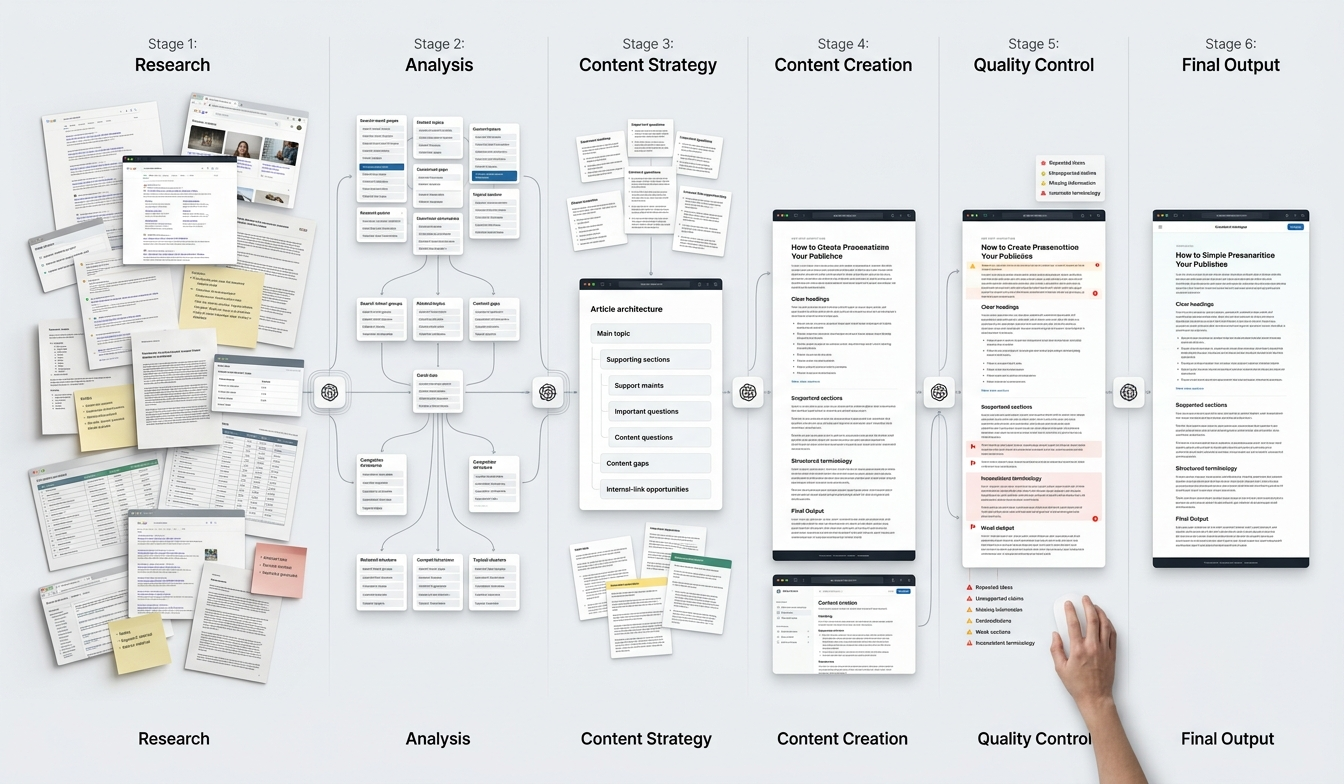
The more interesting use case is connecting multiple stages of the content workflow.
For example:
Research → SERP analysis → content planning → drafting → fact checking → optimisation → formatting → publishing support
Astra can potentially assist across several of these stages.
SEO research
A complex SEO workflow could involve:
Analysing search intent
Grouping related queries
Identifying content gaps
Reviewing competitor structures
Building topical clusters
Creating internal-link recommendations
Preparing content briefs
The human still needs to validate the strategic decisions and sources.
Content production
Astra can help produce:
Long-form articles
Landing pages
Product descriptions
Email campaigns
Research summaries
Website copy
Reports
Presentations
But the advantage is greater when the content is connected to research and structured workflows.
Content quality control
Astra can also be used for checks such as:
Missing sections
Contradictions
Weak explanations
Repeated points
Unsupported claims
Inconsistent terminology
Formatting problems
This creates a more useful role for AI than simply generating the first draft.
What Can GPT-6 Astra Do for Designers?
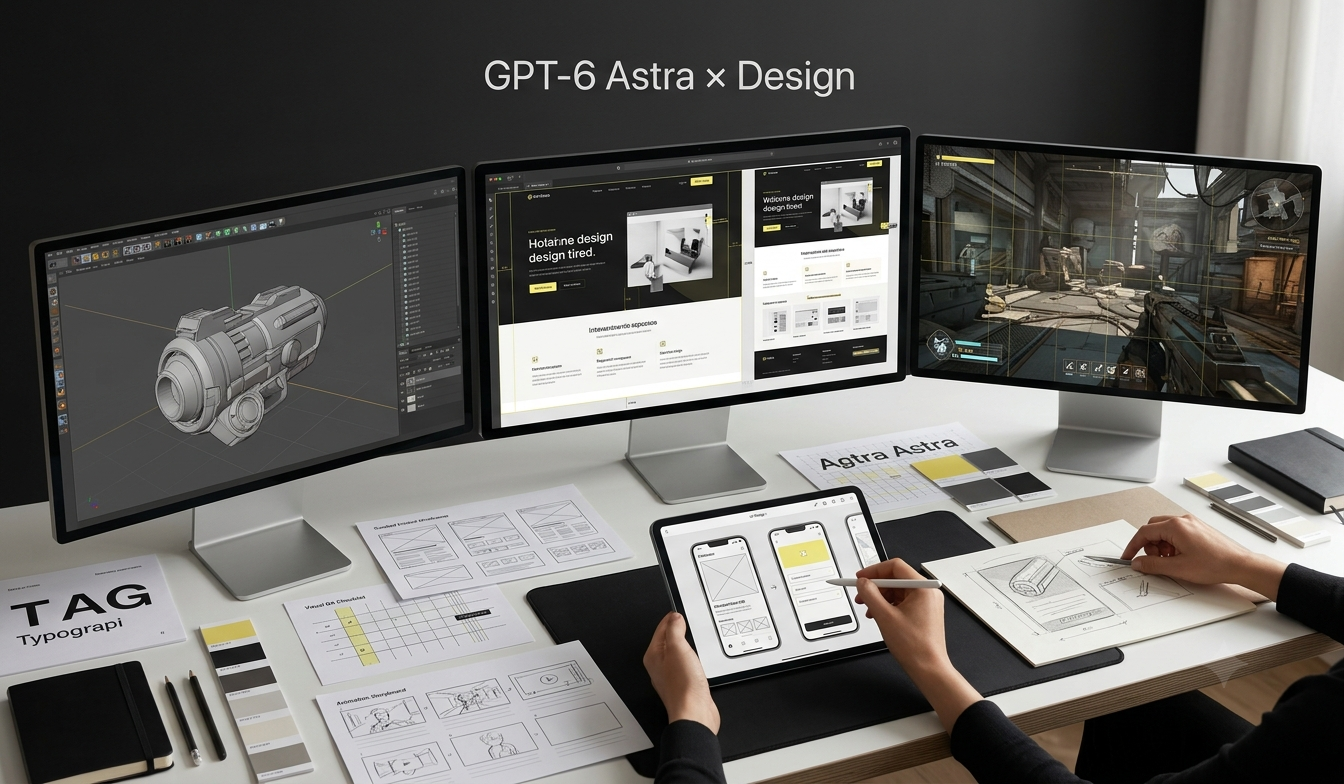
GPT-6 Astra can support designers beyond generating ideas. Its stronger visual judgement and computer-use capabilities allow it to create, inspect, test and refine visual work across websites, applications, games and 3D environments.
Website Creation
Astra can turn design instructions into working websites and web applications. It can work with layouts, visual elements and interactions, then make changes based on new requirements.
For designers, this can help turn an early concept into a functional visual output without switching constantly between planning, implementation and testing.
UI and Frontend QA
Astra can interact with websites and applications like a user. This makes it useful for checking whether interfaces work as intended, identifying visual or usability issues and testing frontend changes.
Designers can use this to review:
Layout and spacing
Navigation and interactions
Responsive behaviour
Visual consistency
User interface issues
Visual Layout and Design Judgement
Astra has stronger visual judgement for websites, games, applications and other visual outputs. It can assess whether an interface follows a given direction and help refine the result based on specific requirements.
This makes it useful during design reviews, where the goal is not only to create something that works but also to improve how it looks and feels.
3D Modelling Workflows
Astra can also support more complex visual workflows. OpenAI demonstrated a workflow where Astra worked with a Blender model and turned it into a walkable scene in Unreal Engine.
This shows how AI can connect different tools and stages of a visual production workflow instead of handling only one isolated design task.
Game Development
Astra can work across game-related tasks, including creating and testing interactive experiences. Its computer-use capabilities allow it to interact with software, inspect results and make changes as requirements evolve.
For designers and game creators, this can reduce the gap between an idea, a prototype and a working visual experience.
Design Iteration
Design work rarely ends with the first version. Requirements change, layouts need refinement and new feedback can affect the direction.
Astra can incorporate new instructions, change course and continue working on a broader task. This makes it useful for iterative design workflows where the output needs to evolve rather than start from scratch each time.
Visual Quality Checks
Astra can also act as an additional layer of visual review. It can inspect websites, applications and other visual outputs against specific requirements and identify areas that need attention.
However, AI-based visual review should support, not replace, a designer's judgement. Brand consistency, accessibility, user context and creative direction still require human oversight.
What Can GPT-6 Astra Do for Developers?
Developers are among the clearest beneficiaries of Astra's capabilities.
Instead of using AI only for isolated coding questions, developers can use it across larger development cycles.
A workflow could look like:
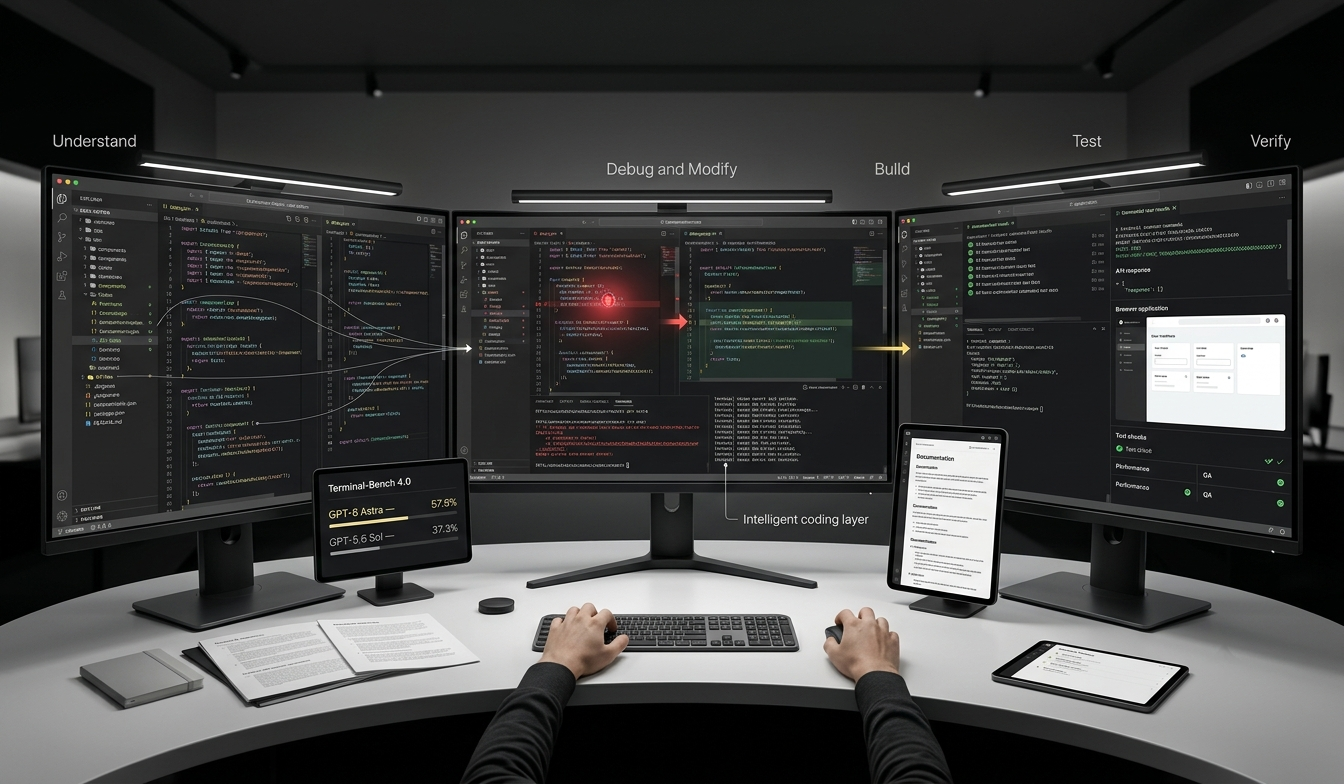
Understand codebase → identify issue → modify code → run tests → analyse errors → fix implementation → test again
This is particularly useful for:
Debugging
Refactoring
Testing
Code review
Documentation
Frontend development
Backend development
API integration
Software maintenance
Automated quality assurance
The improvement is also visible in coding evaluations. On Terminal-Bench 4.0, OpenAI reports 57.9% for GPT-6 Astra compared with 37.3% for GPT-5.6 Sol. The benchmark tests complex terminal-based tasks involving software engineering, system configuration and data analysis.
How Are Businesses Using GPT-6 Astra?
Astra is already being positioned for business workflows rather than only individual productivity. It is also designed to produce work that fits existing business standards. OpenAI says it can follow templates, match writing and visual styles, and create documents, presentations, spreadsheets and analyses without unnecessarily repeating information.
One useful example is Perplexity.
“OpenAI says Perplexity is using Astra to write communications, modify software, monitor production systems and build testing workflows. The company says it can trust Astra with more complete end-to-end systems and check in less frequently than with earlier models.”
Another example is financial services.
Reuters reported that OpenAI's financial-services offering uses GPT-6 Astra for areas including investment banking and equity research, with integrations for financial and market data sources.
The use cases include:
Research
Financial reasoning
Financial modelling
Client materials
Retrieval
Industry-specific workflows
This illustrates another important trend: businesses are not necessarily buying a general-purpose model simply because it is “smarter”.
They want models that can work inside specific professional workflows with relevant data, controls and permissions.
What Are GPT-6 Astra's Biggest Limitations?
Astra is powerful, but capability does not equal reliability. There are several limitations businesses should consider.
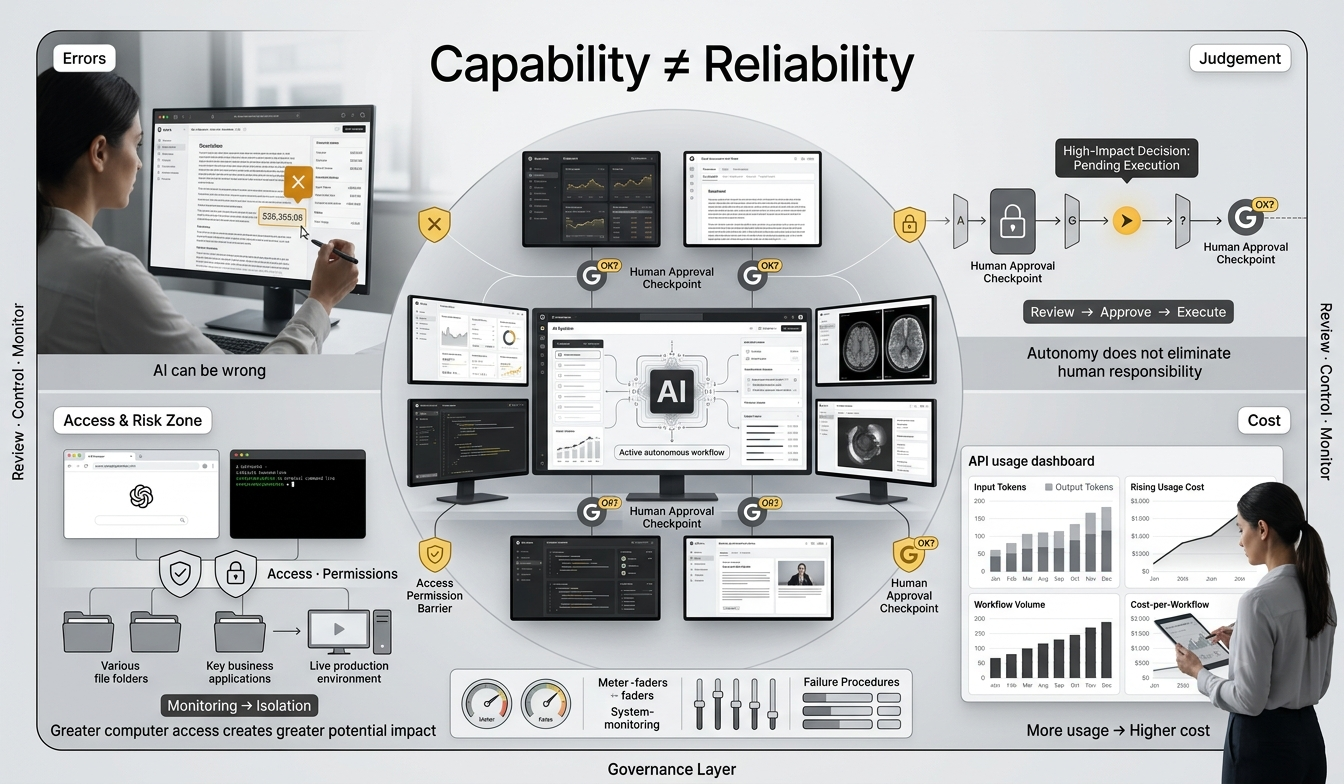
1. It can still make mistakes
A highly capable model can produce an incorrect answer with confidence.
Human review remains important for:
Financial decisions
Legal work
Medical information
Security
Production systems
Public-facing content
2. Computer access increases risk
A model that can interact with software has more ability to affect the real world. That makes permissions, monitoring and isolation more important.
OpenAI has classified Astra as reaching its Critical cybersecurity capability threshold and says it has strengthened safeguards around the model.
This is not a minor detail.
The more useful an AI agent becomes, the more important it becomes to control what that agent is allowed to access and change.
3. Cost can become significant
At $10 per million input tokens and $50 per million output tokens, heavy API usage can become expensive.
Businesses should therefore evaluate Astra based on cost per completed workflow, not only cost per token.
4. More autonomy does not remove the need for judgement
A model can complete more steps without human intervention, but that does not mean every decision should be delegated.
For high-impact workflows, organisations still need:
Approval systems
Access controls
Logging
Human review
Testing
Monitoring
Clear failure procedures
Is GPT-6 Astra AGI?
There is no objective consensus that GPT-6 Astra is AGI. The term Artificial General Intelligence does not have one universally accepted technical definition.
Astra demonstrates broad capabilities across reasoning, coding, science, computer use and professional tasks. That makes it reasonable to discuss Astra in the wider AGI debate.
But benchmark scores and broad capability alone do not settle the question.
A more useful way to evaluate Astra is to ask:
Can it generalise to unfamiliar tasks?
Can it operate reliably over long workflows?
Can it adapt when conditions change?
Can it recognise when it is wrong?
Can it work safely with real-world permissions?
Can it consistently perform without human correction?
These questions matter more than whether a company labels a model “AGI”.
How Good Is GPT-6 Astra According to Benchmarks?
OpenAI reports several notable results for Astra:
Area | Benchmark | GPT-6 Astra |
Computer use | OSWorld 2.0 | 72.6% |
Professional work | Agents' Last Exam | 59.3% |
Coding | Terminal-Bench 4.0 | 57.9% |
Science | GPQA Diamond | 96.0% |
Mathematics | FrontierMath Tier 4 | 97.6% |
Abstract reasoning | ARC-AGI-3 | 99.9% |
Cybersecurity | ExploitBench | 100% |
Long context | MRCR v2 256K–512K | 100% |
These numbers are useful for understanding the model's performance on specific evaluations. However, benchmarks should not be treated as a complete measure of real-world usefulness.
A model can perform exceptionally well on a benchmark and still struggle with:
Ambiguous requirements
Messy business data
Changing priorities
Unclear instructions
Unreliable external systems
Human communication
Real-world edge cases
For businesses, task completion quality, reliability and cost are often more useful metrics than a benchmark score alone.
What Does GPT-6 Astra Mean for the Future of AI?
Astra points towards a shift from AI that responds to AI that works. Earlier generative AI made it easier to create text, images and code.
The next stage is about connecting those capabilities into workflows.
Imagine a system that can:
Understand a business requirement
Research relevant information
Analyse the findings
Create a plan
Build an output
Test it
Identify problems
Correct them
Prepare the final deliverable
That is much closer to an AI worker than a traditional chatbot.
But this shift also changes what humans need to learn.
Knowing how to write a prompt will not be enough.
Professionals increasingly need to understand:
AI workflows
Data
Automation
Verification
Domain knowledge
Tool use
AI agents
Security
Human oversight
The advantage will go to people who know how to combine AI with real professional skills.
Should You Use GPT-6 Astra?
Use GPT-6 Astra when the task is genuinely complex.
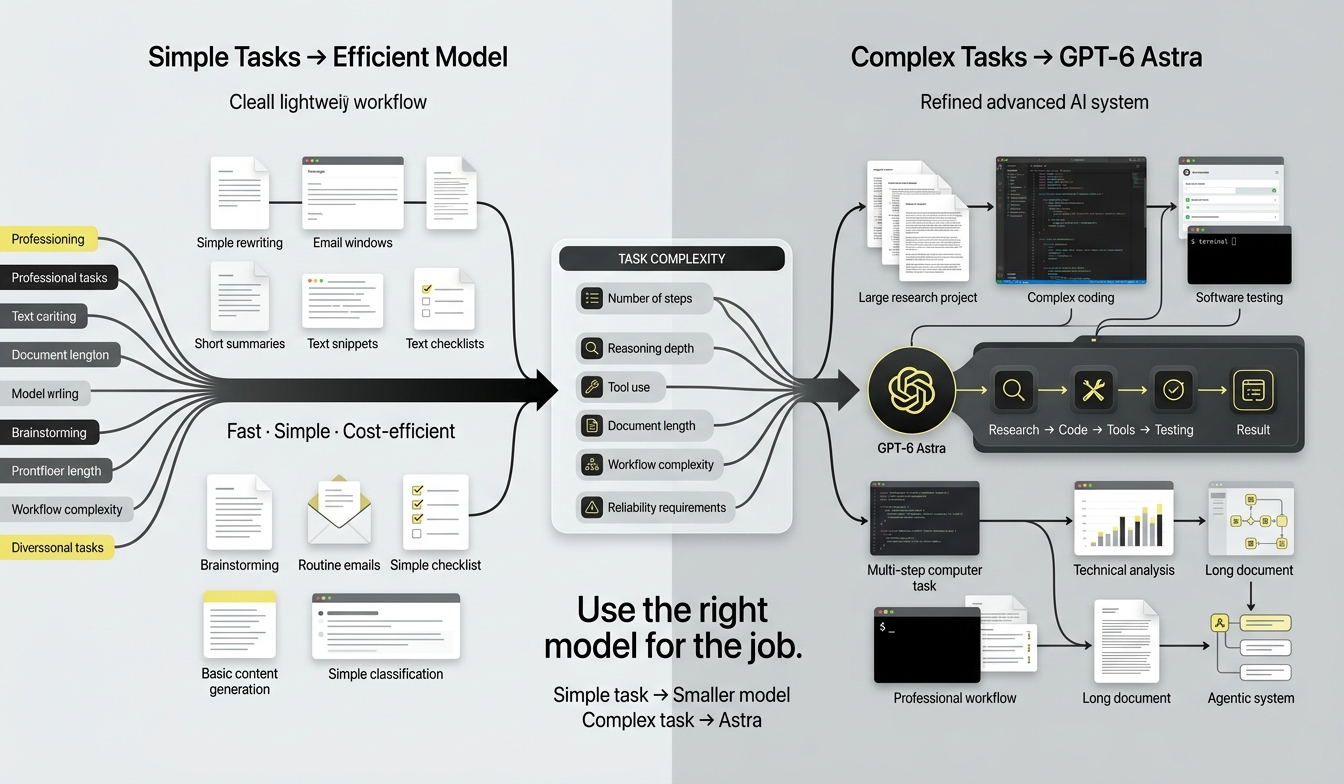
It makes more sense for:
Large research projects
Complex coding
Software testing
Multi-step computer tasks
Technical analysis
Professional workflows
Long documents
Agentic systems
A less expensive model may be sufficient for:
Simple rewriting
Short summaries
Basic brainstorming
Routine emails
Straightforward content generation
Simple classification
The smartest approach is not to use the most powerful model for everything.
Use the smallest model that can reliably complete the job, and move to Astra when the task complexity justifies it.
Conclusion
GPT-6 Astra is a major step towards AI systems that can do more than generate answers. It can reason through complex problems, use computers and websites, support software development, analyse information and handle multi-step professional workflows. Its large context window and stronger task-completion capabilities also make it useful for work that involves large amounts of information and several stages.
However, a more capable AI model does not mean that human skills are no longer needed. Astra can still make mistakes, and tasks involving business decisions, security, sensitive information or real-world systems need proper review and control. The biggest value comes from knowing when to use AI, how to guide it and how to check its work.
For professionals and students, this means AI skills are becoming closely connected with industry skills. Knowing how to use AI for digital marketing, coding, data, design or other professional tasks can help you work more efficiently and adapt to changing job requirements.
If you want to build these skills, HACA offers AI-advanced courses across Digital Marketing, Tech and Designing, helping learners develop practical skills for an AI-driven workplace. Explore HACA's AI-Advanced Courses