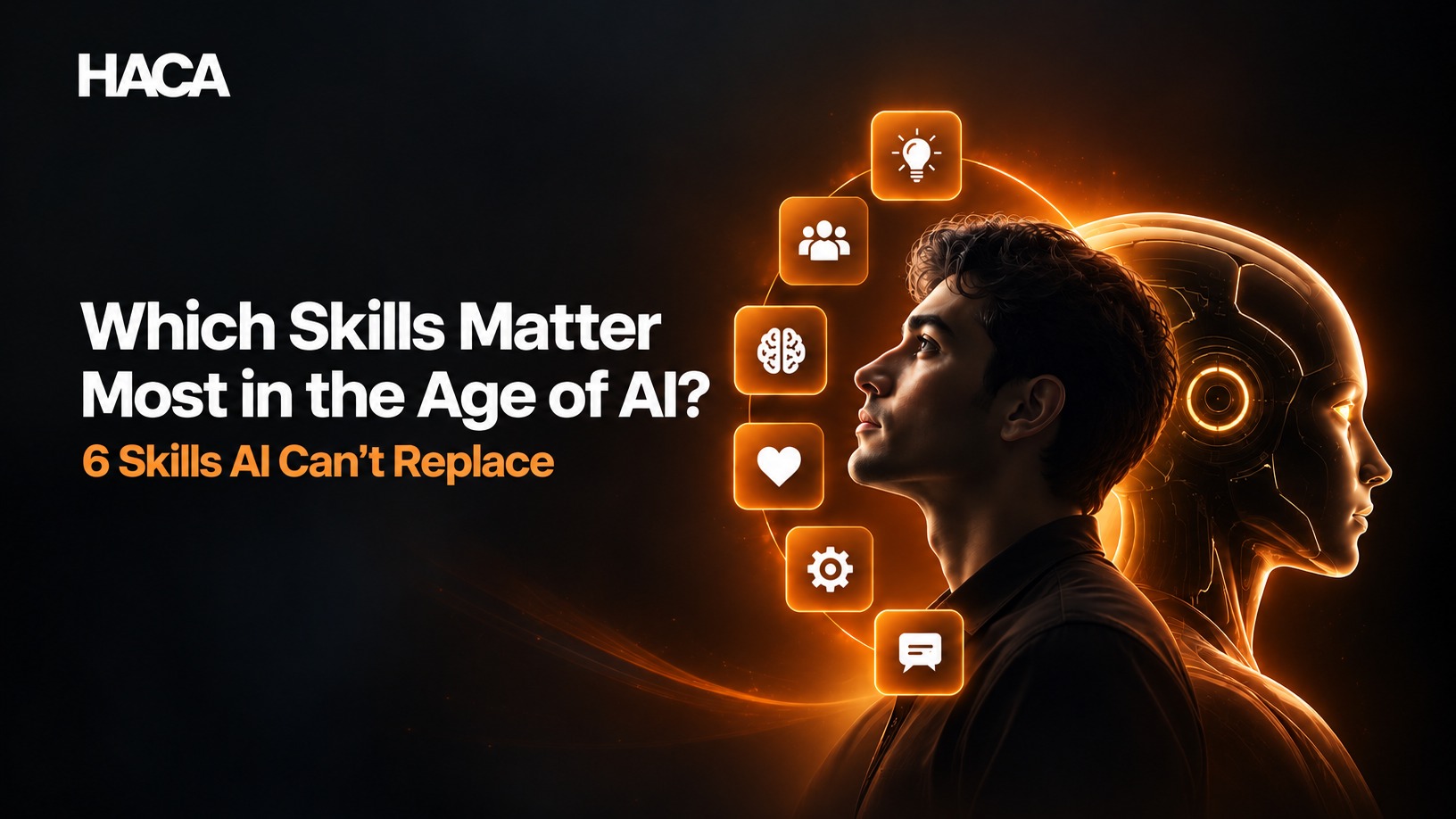
Artificial intelligence can write articles, generate code, analyse data and answer questions in seconds. But as AI tools become more capable, which skills will remain valuable?
The six skills worth developing are critical thinking, creativity, communication, problem-solving, adaptability and AI literacy. These skills help people evaluate AI-generated output, make informed decisions and apply technology to real-world problems.
The International Labour Organization's 2026 research on skills in the age of AI highlights the growing importance of cognitive, social and emotional skills alongside digital and AI-related capabilities. Rather than competing with AI at every task, beginners and professionals can prepare for the future by learning to use these tools effectively, verify their output and apply their own knowledge and judgement.
Which Skills Remain Valuable When AI Tools Can Generate Content or Code?
Skills that involve judgement, original thinking, human understanding and complex decision-making remain valuable in the age of AI. AI can generate a draft, suggest a solution or write a piece of code, but people still need to understand the problem, assess the result and decide what to do next.
Here are six skills worth developing.
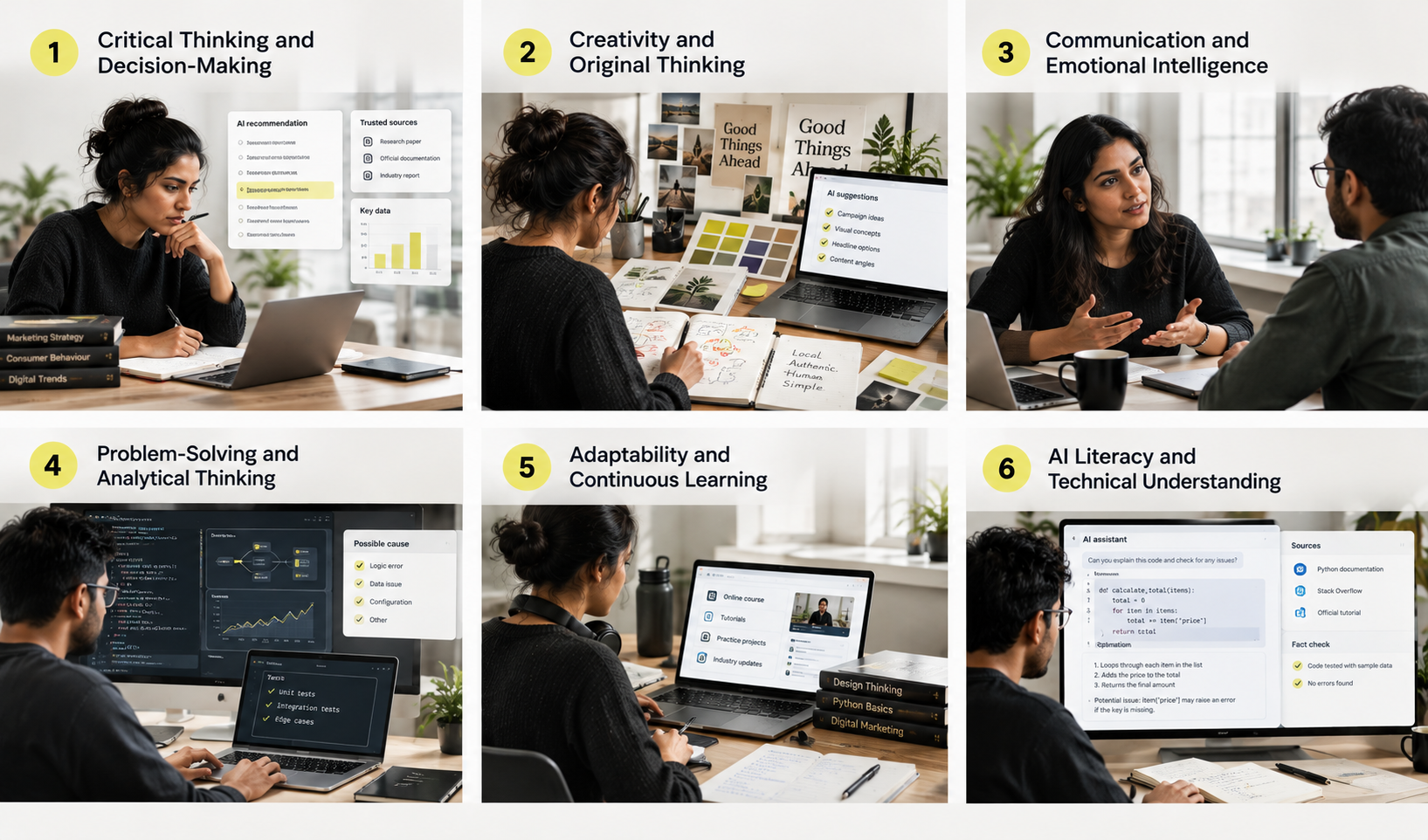
1. Critical thinking and decision-making
Critical thinking means examining information, questioning assumptions and reaching conclusions based on evidence rather than accepting the first answer you receive.
AI tools can produce convincing explanations even when their answers contain errors. Without critical thinking, it is easy to mistake a well-written response for a reliable one.
For example, an AI tool might recommend a marketing strategy based on general industry trends. A skilled marketer will examine the target audience, available budget, customer behaviour and business goals before deciding whether that strategy makes sense.
How to develop it: Question the reasoning behind recommendations, compare different viewpoints, look for supporting evidence and practise making decisions independently before asking AI for suggestions.
2. Creativity and original thinking
AI can generate hundreds of headlines, images, campaign ideas and content outlines. However, generating options is not the same as identifying an idea that connects with a particular audience.
Human creativity draws on personal experiences, cultural understanding, emotions and observations. These influences help people create work that feels relevant rather than generic.
Consider a brand launching a campaign for customers in Kerala. An AI tool might suggest familiar advertising concepts, but a writer who understands local humour, cultural references and everyday experiences can develop a more meaningful campaign.
How to develop it: Observe the world around you, explore different perspectives, experiment with ideas and use AI to challenge your thinking rather than make every creative decision for you.
Learners who want to turn their creative ideas into practical design skills can explore HACA’s Graphic Designing Course in Kerala. Learning design fundamentals, visual communication and creative decision-making can help them use AI-generated visuals more thoughtfully instead of relying on automated designs alone.
3. Communication and emotional intelligence
Clear communication involves more than producing grammatically correct sentences. It requires understanding the audience, choosing the right tone, listening carefully and explaining complex ideas in an accessible way.
Emotional intelligence adds another layer. It helps people recognise emotions, manage disagreements, build trust and respond appropriately to different situations.
AI can suggest a response to an unhappy customer, for instance. However, a person must still understand the customer's concern, recognise the wider context and decide how to respond with empathy.
How to develop it: Practise active listening, explain ideas in simple language, request feedback on your communication and learn to adapt your message to different audiences.
4. Problem-solving and analytical thinking
AI is useful for exploring possible solutions, analysing patterns and reducing repetitive work. Yet solving a real problem starts with identifying what is actually wrong.
A developer may use AI to identify a coding error, but they still need to understand why it occurred and whether the suggested fix will affect other parts of the application.
Similarly, an analyst must interpret data in the context of business objectives rather than simply accept an AI-generated summary.
How to develop it: Break complex problems into smaller parts, investigate their causes, compare possible solutions and test whether the chosen approach works.
For beginners interested in software development, HACA’s Coding Course in Kerala can provide a structured way to learn programming fundamentals, practise debugging and understand how applications work. These foundations are especially useful when reviewing AI-generated code and identifying errors that automated suggestions may overlook.
5. Adaptability and continuous learning
AI tools and workplace expectations change quickly. A skill that is valuable today may need to be updated as technology evolves.
Adaptability helps professionals learn new tools, adjust their workflows and respond to changing responsibilities. Continuous learning makes that adjustment possible without starting from scratch every time a new technology appears.
How to develop it: Set aside time to learn relevant tools, practise unfamiliar tasks and review which skills your industry increasingly requires. Focus on transferable knowledge instead of mastering only one platform.
6. AI literacy and technical understanding
AI literacy is the ability to understand what AI tools can do, where they can fail and how to use them responsibly. It does not mean everyone needs to become a machine learning engineer.
A content writer might need to understand prompting, fact-checking and content editing. A developer may need to evaluate generated code, test software and identify security risks. An analyst might focus on interpreting AI-assisted insights.
How to develop it: Learn the capabilities and limitations of the tools relevant to your field. Understand basic data privacy, responsible use and verification methods, then apply them to practical projects.
For those looking to apply AI skills in marketing, HACA’s Advanced Digital Marketing Course in Kerala can help learners understand how AI fits into SEO, content strategy, analytics and campaign optimisation. The focus should be on combining these tools with marketing fundamentals and independent decision-making.
How to Practise AI-Era Skills and Measure Your Progress
Skill | How to practise it | Evidence of progress |
Critical thinking | Verify AI-generated claims against reliable sources | A fact-checked report |
Creativity | Develop several ideas before using AI for alternatives | An original campaign concept |
Communication | Rewrite the same message for different audiences | A clear, audience-specific draft |
Problem-solving | Attempt a task before asking AI for help | A tested solution with an explanation |
Adaptability | Learn a new tool and apply it to a real task | A completed project |
AI literacy | Compare AI output with trusted references and test its limitations | A documented review of AI-assisted work |
How Can Beginners Use AI Tools Without Becoming Dependent on Them?
Beginners can use AI tools as learning partners by attempting tasks independently, asking for explanations, practising what they learn and checking their own understanding. The key is to use AI to strengthen a skill rather than consistently outsource the thinking required to develop it.
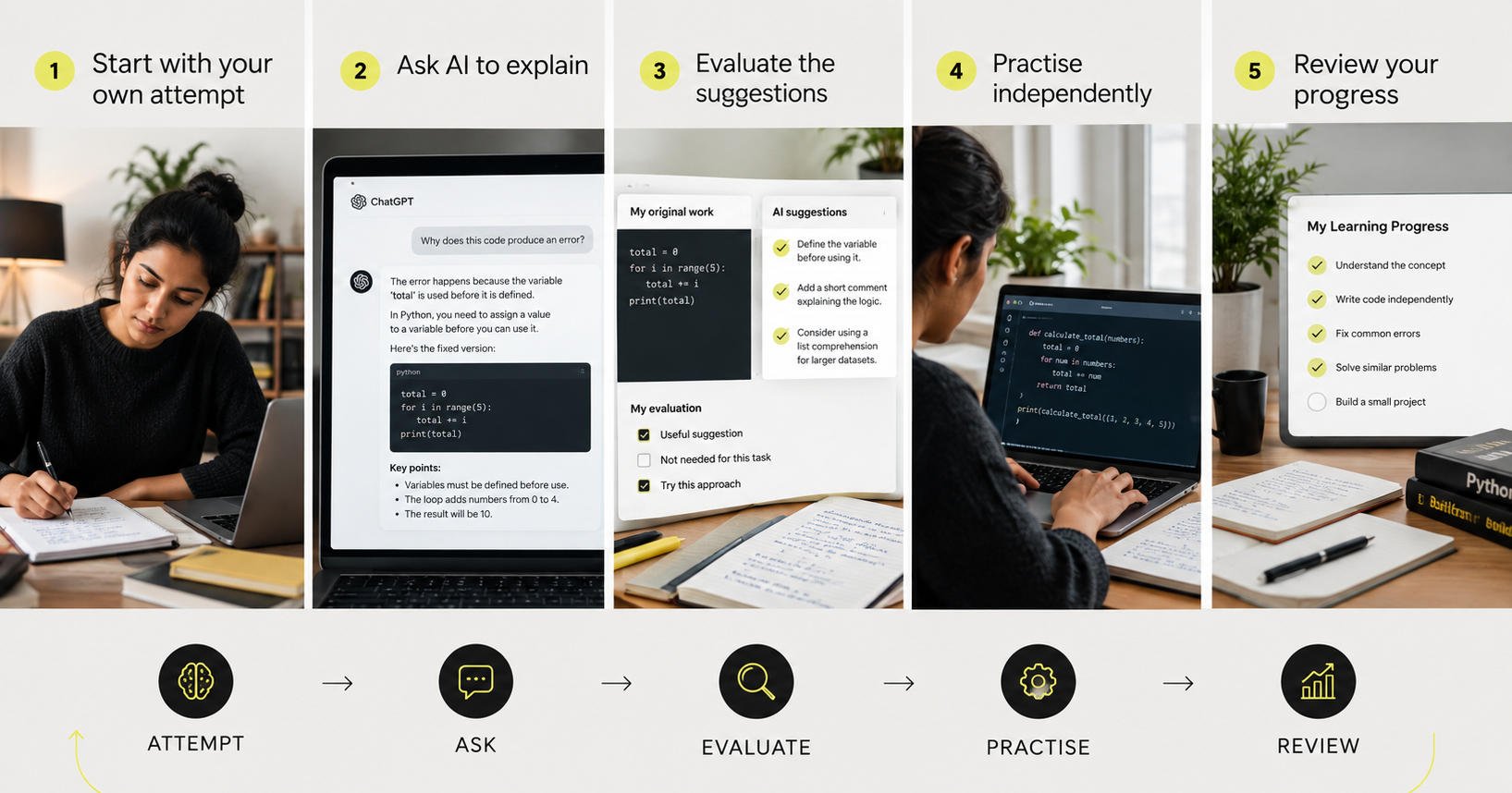
Start with your own attempt
Before asking AI to write an article, solve a problem or generate code, spend some time attempting the task yourself.
Your first attempt does not need to be perfect. Its purpose is to help you identify what you understand and where you need assistance.
For example, if you are learning content writing, create your own outline before asking an AI tool to review it. Compare its suggestions with your approach and decide which changes improve the article.
This helps you develop independent judgement instead of becoming dependent on ready-made answers.
Ask AI to explain, not just complete
Instead of asking AI to do an entire task, ask it to explain the process, demonstrate a technique or identify areas for improvement.
A beginner learning Python could ask:
Why does this code produce an error?
Can you explain the solution step by step?
What alternative approaches could solve this problem?
Can you give me a similar exercise to practise independently?
These prompts turn AI into a learning aid. They also encourage you to understand the reasoning behind an answer rather than simply copy the result.
Learning to write clear instructions is an important part of using AI effectively. Understanding what prompt engineering is and how it works can help beginners get more relevant responses, ask better questions and use AI as a learning aid.
Practise without AI assistance
Regular independent practice helps you check whether you have genuinely learned a skill.
If you use AI to learn a programming concept, try writing a similar programme without assistance. If you use it to improve your writing, attempt another piece without generating the first draft through AI.
You can then compare your independent work with AI suggestions to identify specific areas for improvement.
Use AI for feedback, not automatic approval
AI can help identify unclear sentences, suggest alternative approaches and highlight possible errors. However, feedback should be treated as a starting point rather than a final judgement.
Ask specific questions about your work. For instance, instead of asking whether an article is good, ask whether its introduction answers the reader's question, whether the examples support its claims and whether any sections repeat the same information.
Specific feedback is more useful because it gives you clear areas to examine and improve.
Build a workflow that preserves independent thinking
A simple learning workflow can help beginners benefit from AI without relying on it for everything.
Attempt: Complete the task using your current knowledge.
Ask: Use AI to explain difficult concepts or suggest improvements.
Evaluate: Compare its suggestions with your own reasoning.
Apply: Revise your work and practise the skill.
Review: Complete a similar task independently to test your understanding.
The objective is to become better at the task over time, not simply faster at generating an answer.
How Do You Check AI-Generated Output for Accuracy?
You can check AI-generated output by verifying factual claims against reliable sources, testing technical results, checking calculations and examining whether the answer fits the context. Never assume information is correct simply because it sounds confident or includes detailed explanations.
Use the following steps before publishing, submitting or implementing AI-generated work.
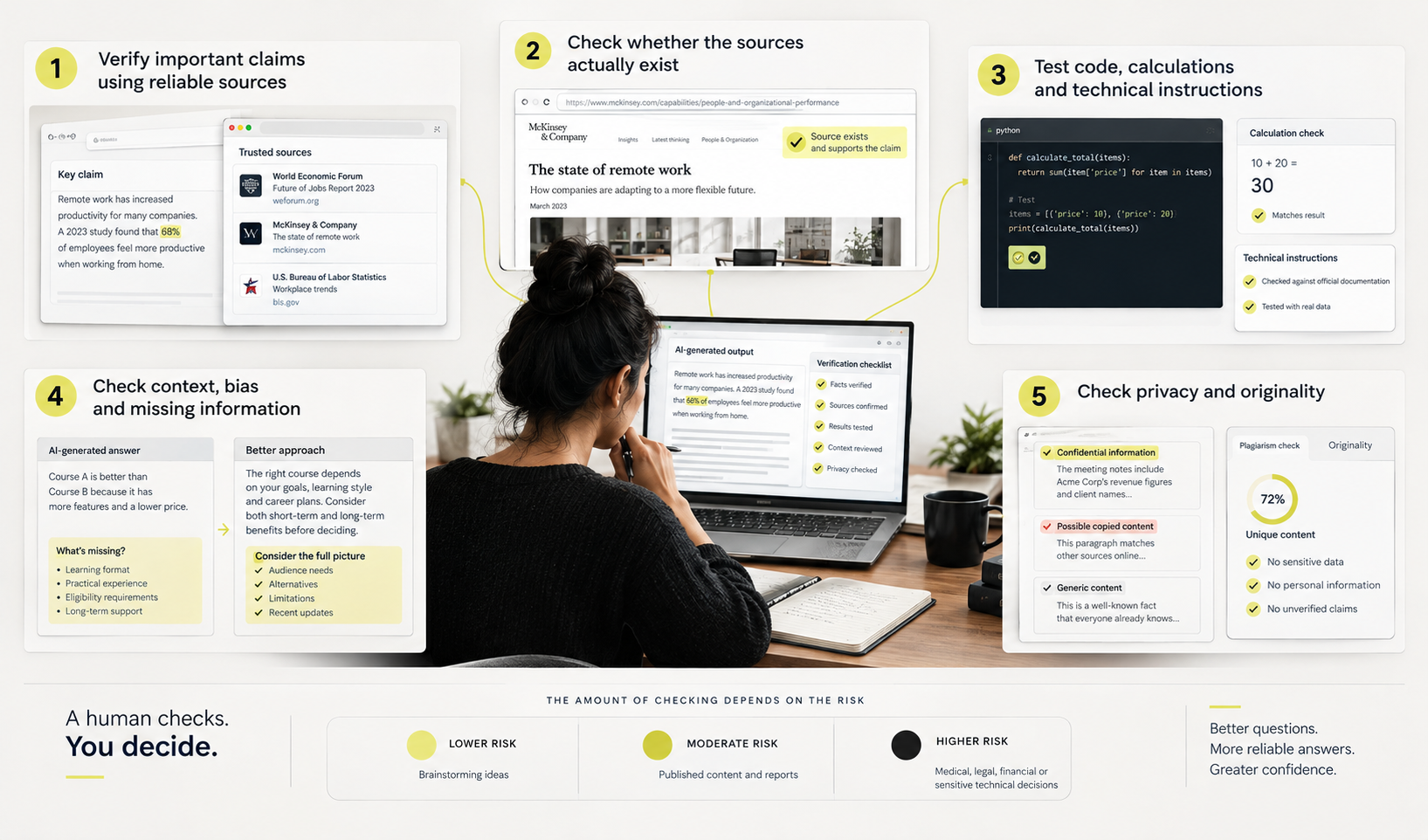
Verify important claims using reliable sources
Check names, dates, statistics, quotations, research findings and other claims that could influence a reader's understanding or decision.
For factual information, prioritise primary sources such as official documentation, government publications, original research and statements from the relevant organisation.
A source that supports a related topic does not necessarily support the exact claim you want to make.
Check whether the sources actually exist
AI tools may provide inaccurate citations, incorrect publication details or references that do not support the statements attached to them.
Open every important reference and confirm that it exists, comes from a credible source and contains the information being cited.
If you cannot verify a claim, do not present it as established fact. Find a reliable source, qualify the statement appropriately or remove it.
Test code, calculations and technical instructions
Generated code should be reviewed and tested before it is used in a live environment. Check whether it performs the intended task, handles unexpected inputs and introduces security or compatibility problems.
For calculations, repeat the working using a calculator or another suitable method. For technical instructions, compare the steps with the relevant product documentation.
Check context, bias and missing information
An AI-generated answer can contain individually correct statements that lead to a misleading conclusion because important context is missing.
Check whether the answer considers relevant limitations, alternative explanations, recent developments and the needs of the intended audience.
For example, an AI-generated comparison of two courses may list their features accurately but ignore differences in learning format, practical experience or eligibility requirements.
Review privacy and originality
Before using AI-generated work, check whether it contains confidential information, personal data or material you do not have permission to share.
Review the output for copied wording, unsupported claims and generic passages that do not contribute meaningful value. Follow the relevant workplace, educational or publishing rules on AI assistance and disclosure.
For content creators, this also means adding original analysis, relevant examples and useful insights instead of publishing an unedited AI-generated draft.
Use a practical verification checklist
Before accepting an AI-generated answer, ask yourself:
Are the key facts supported by reliable sources?
Do the cited sources exist and support the claims?
Are dates, figures, names and calculations correct?
Has the answer overlooked important context?
Have code or technical recommendations been tested?
Does the output meet the intended purpose and audience needs?
Is any confidential information or unverified material included?
The amount of checking should match the risk. A brainstorming suggestion needs less verification than medical guidance, financial advice, legal information or code that handles sensitive data.
How Can You Build Future-Ready Skills Alongside AI?
Start by identifying the skills your chosen career requires, then combine practical learning with responsible AI use. You do not need to master every AI tool or learn advanced programming to benefit from the technology.
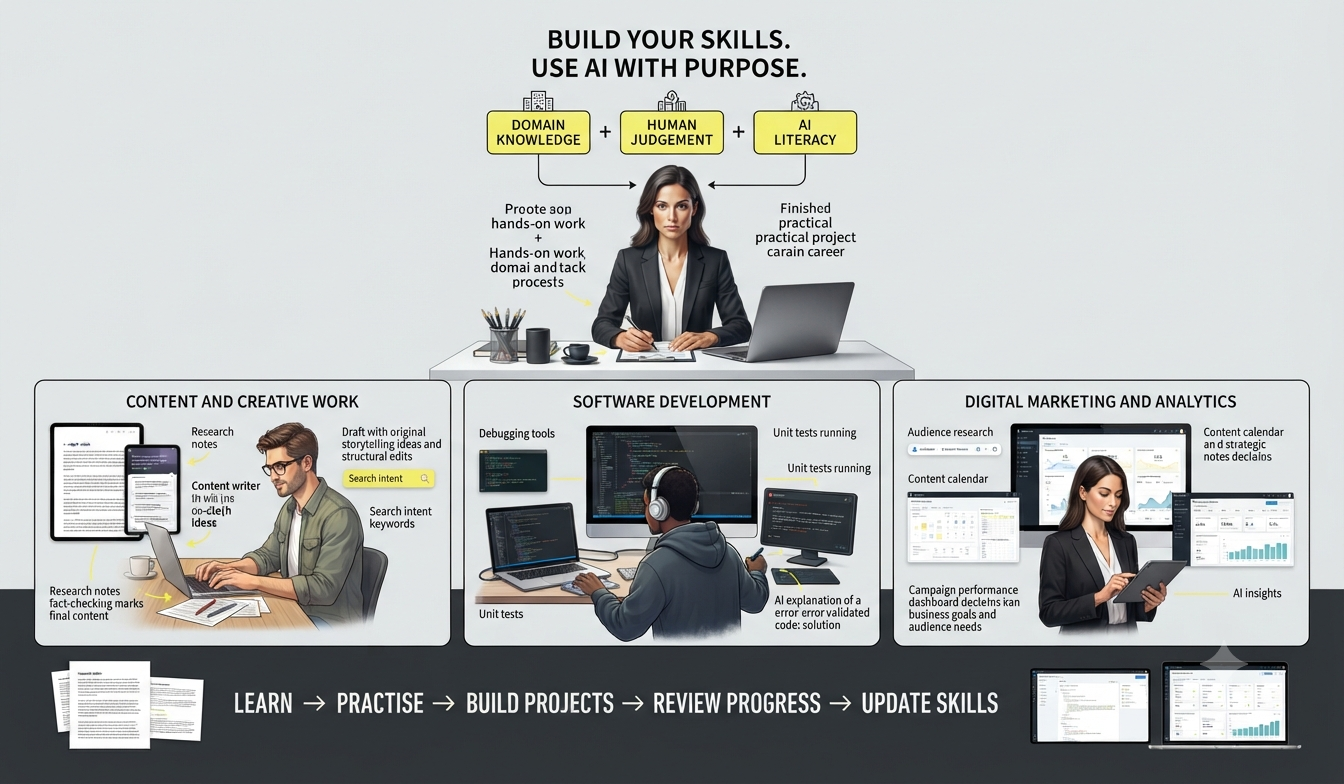
A content writer can strengthen research, storytelling, editing and search intent analysis while learning to use AI for brainstorming and content reviews. A developer can practise programming fundamentals while using AI to explain errors and explore solutions. A student can build subject knowledge while using AI to clarify difficult concepts and test understanding.
In marketing, for example, professionals can use AI to support audience research, content planning and campaign analysis while applying their own judgement to strategy and creative decisions. Explore how AI is used in digital marketing to understand how these skills translate into practical work.
In each case, the strongest approach combines domain knowledge, independent thinking and relevant technical skills.
Keep a record of projects you complete, problems you solve and improvements you make. Review your progress regularly and update your learning goals as your industry changes. Practical evidence of what you can do is more useful than familiarity with a long list of tools.
Conclusion
The most valuable skill in the age of AI is knowing how to combine technology with your own knowledge, creativity and judgement.
Critical thinking, creativity, communication, problem-solving, adaptability and AI literacy can help beginners and experienced professionals navigate changing workplace demands. These skills become more useful when combined with strong knowledge of a particular subject and regular practical experience.
You don't have to learn everything at once. Start with the skills your career requires, practise them through real projects and gradually explore how AI can improve your work without replacing your judgement.
If you want to take that learning further, explore HACA’s courses in digital marketing, coding and graphic design to develop practical skills and discover how AI can support your chosen career path.