The MERN Stack is one of the most popular technologies for modern web development. Many startups, software companies, and freelance developers use the MERN stack to build fast, scalable, and interactive web applications.
If you want to become a full-stack developer, understanding the MERN stack is essential. It helps you build both the frontend and backend of a website using a single programming language: JavaScript.
In this guide, you will learn:
What the MERN stack is
How each component works
Benefits and limitations
Common use cases
MERN stack architecture
MERN stack roadmap
Career opportunities
MERN stack salary prospects
Frequently asked questions
What Is MERN Stack?
MERN Stack is a full-stack JavaScript technology stack that combines MongoDB, Express.js, React.js, and Node.js to build complete web applications. The word MERN comes from the first letter of each technology. It enables developers to create both frontend and backend systems using JavaScript, making development faster, scalable, and more efficient.
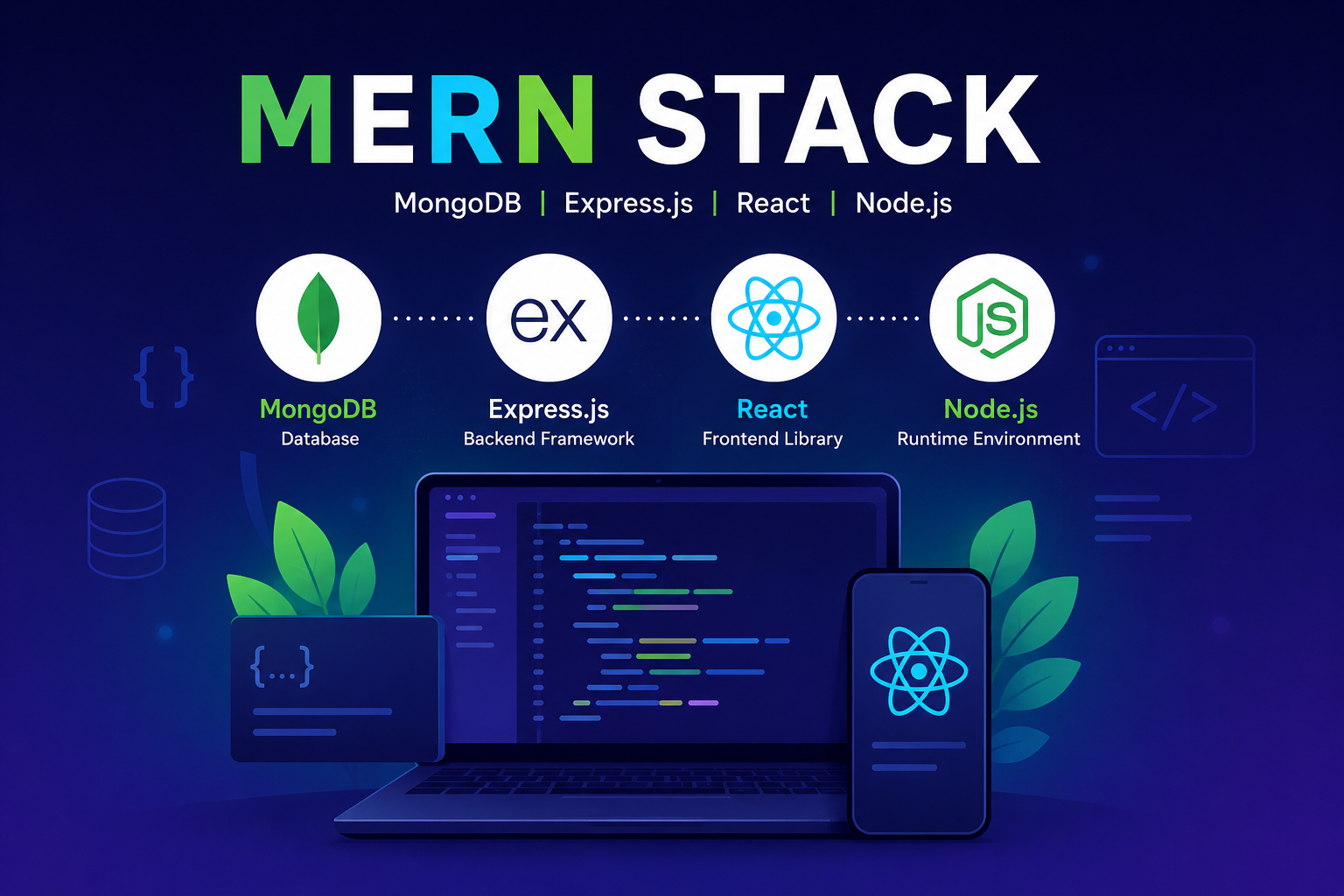
MERN Full Form
Letter | Technology | Purpose |
M | MongoDB | Stores application data |
E | Express.js | Handles server-side logic |
R | React.js | Creates user interfaces |
N | Node.js | Runs JavaScript on the server |
Together, these technologies help developers build complete web applications using a single programming language.
Why Is MERN Stack Popular?
Many developers choose the MERN stack because it uses JavaScript across the entire application.
Key Benefits
One language for frontend and backend
Faster development process
Large open-source community
Easy API integration
Scalable architecture
Strong demand in the job market
These benefits make MERN one of the best choices for startups and modern businesses.
Technologies Behind the MERN Stack
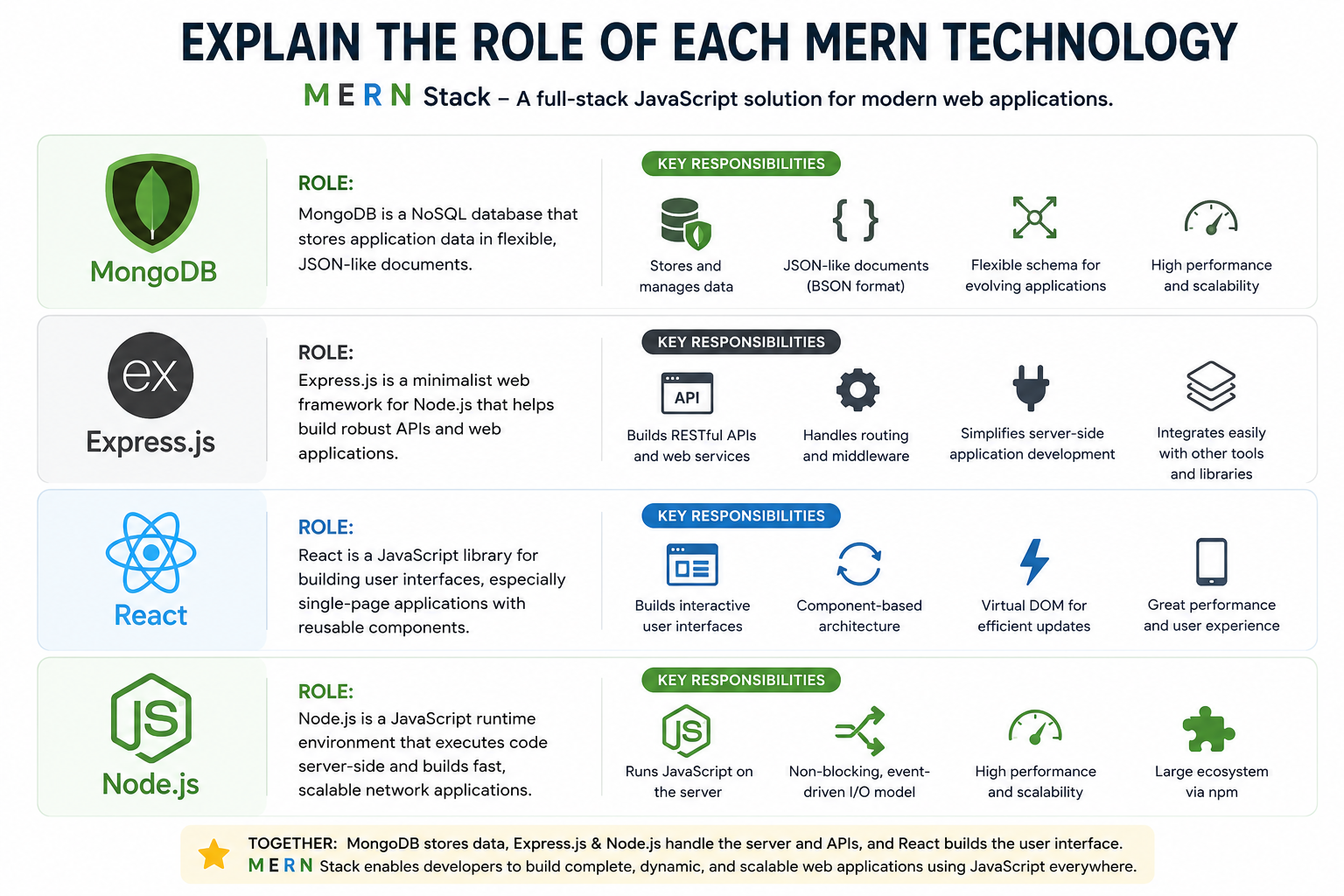
Each technology in the MERN stack plays a specific role in application development.
MongoDB
MongoDB is a NoSQL database that stores data in flexible JSON-like documents.
MongoDB Features
Flexible schema
Fast data retrieval
High scalability
Cloud support through MongoDB Atlas
Express.js
Express.js is a lightweight backend framework used to build APIs and manage server-side functionality.
Express.js Features
Fast routing
Middleware support
REST API development
Easy Node.js integration
React.js
React is a frontend JavaScript library developed by Meta that helps developers build interactive user interfaces.
React Features
Component-based architecture
Virtual DOM
Reusable code
High performance
Node.js
Node.js allows JavaScript to run on servers and powers backend development.
Node.js Features
Event-driven architecture
Non-blocking operations
High performance
Large package ecosystem
MERN Stack Architecture Explained
A MERN application typically consists of four layers working together.
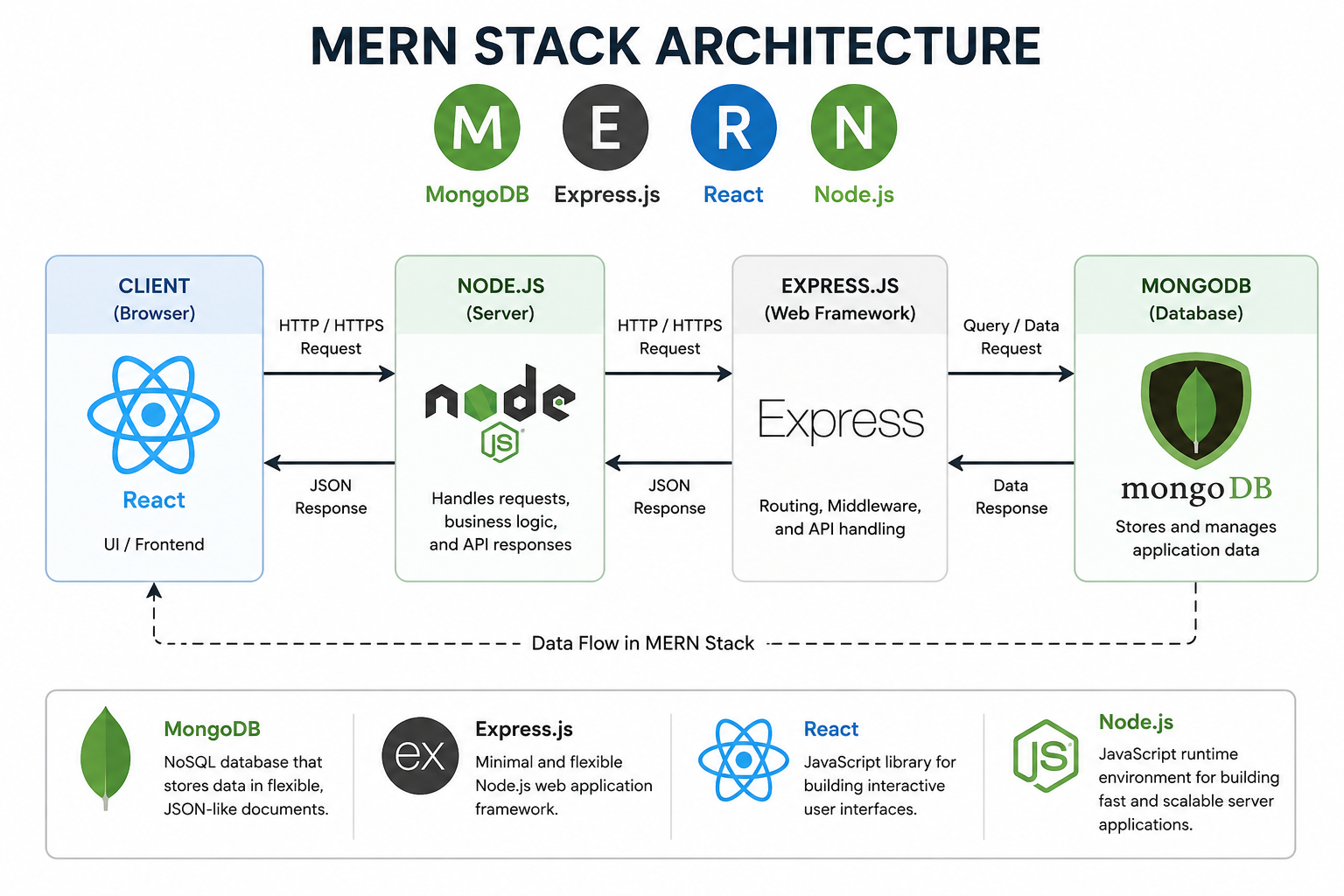
1. Presentation Layer
Built using React.js. Responsible for displaying information and interacting with users.
2. Application Layer
Built using Express.js and Node.js. Handles requests, business logic, and APIs.
3. Business Logic Layer
Processes data and application workflows.
4. Database Layer
Built using MongoDB. Stores and retrieves application data efficiently.
This layered architecture helps developers create scalable and maintainable applications.
How Does MERN Stack Work?
The MERN stack follows a simple workflow.
Step 1
Users interact with the React frontend.
Step 2
React sends requests to the Express server.
Step 3
Node.js processes the request.
Step 4
MongoDB stores or retrieves data.
Step 5
The server sends data back to React.
Step 6
React updates the user interface.
This process creates a smooth and responsive user experience.
What Are the Advantages of MERN Stack?
1. Single Programming Language
Developers use JavaScript throughout the application, reducing complexity.
2. Faster Development
Reusable components and libraries speed up development.
3. Cost Effective
Businesses often need fewer specialized developers.
4. Open Source Ecosystem
Thousands of packages and tools are freely available.
5. High Scalability
Applications can grow with increasing traffic and users.
6. Better User Experience
React enables fast rendering and smoother interactions.
What Are the Limitations of MERN Stack?
MongoDB Is Not Relational
Some enterprise applications require SQL databases.
Learning Curve
Beginners need to learn four different technologies.
SEO Challenges
Single-page applications may require additional optimization. Many developers use Next.js to improve SEO performance.
Large Application Complexity
Enterprise-level projects require strong architecture and planning.
Why Do Companies Prefer MERN Stack?
Companies choose MERN because it offers:
Faster product development
Lower development costs
Easy cloud deployment
Scalability for growing businesses
Strong developer community support
Efficient API integration
MERN is widely used by:
Startups
SaaS companies
E-commerce businesses
Educational platforms
Marketing technology companies
Common Use Cases of MERN Stack
Many businesses use MERN to build modern applications.
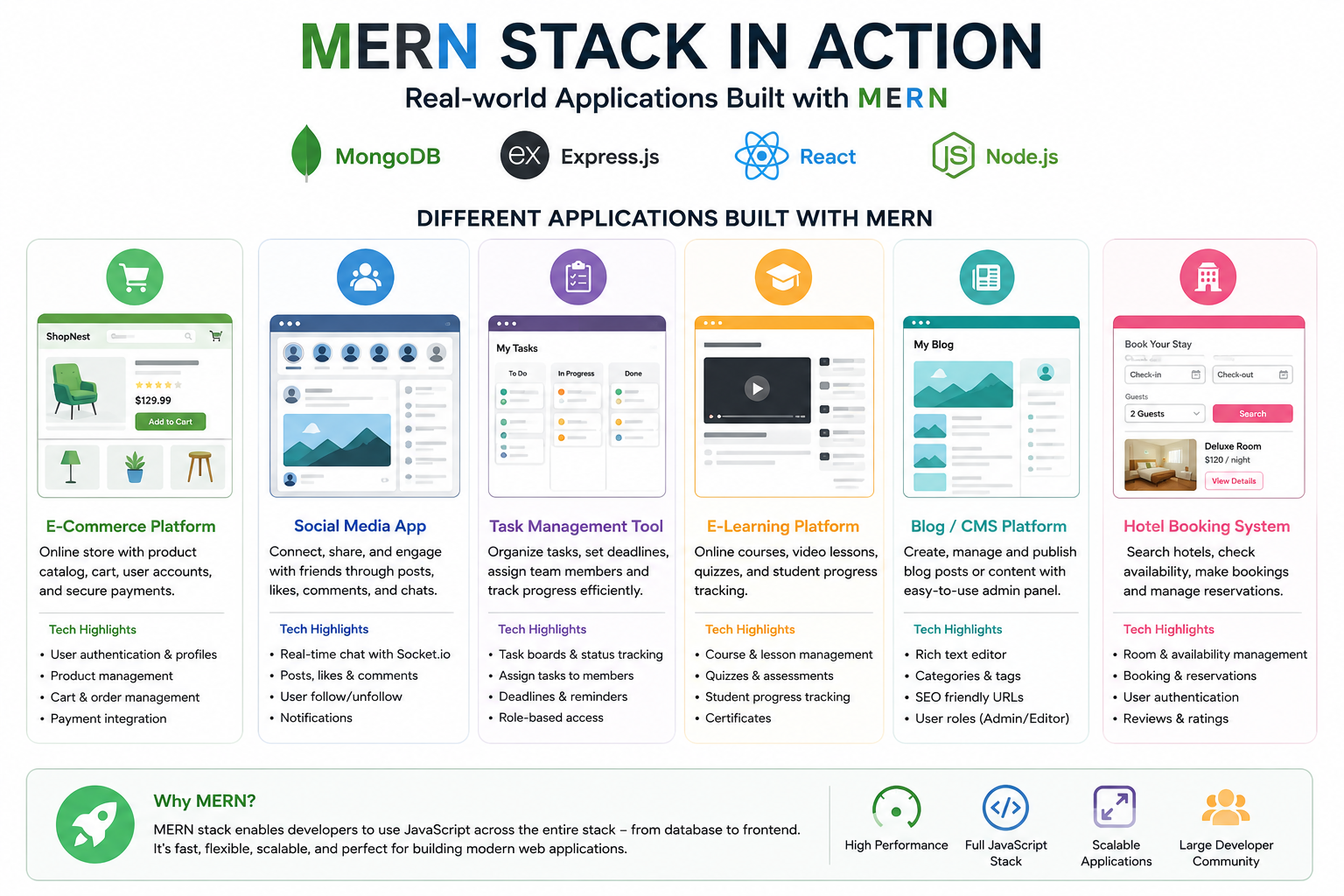
Application Type | Example Features |
E-commerce Websites | Product catalogs, carts, payments |
Social Media Platforms | Profiles, messaging, feeds |
Learning Platforms | Courses, quizzes, certificates |
CRM Software | Lead management, reporting |
SaaS Products | Subscription and user management |
Business Dashboards | Analytics and reporting |
MERN vs MEAN vs MEVN
Feature | MERN | MEAN | MEVN |
Frontend | React | Angular | Vue |
Learning Curve | Moderate | High | Easy |
Flexibility | High | Moderate | High |
Community Support | Very Large | Large | Growing |
Popularity | Very High | High | Growing |
Most startups prefer React because of its flexibility and large ecosystem.
MERN Stack Developer Roadmap
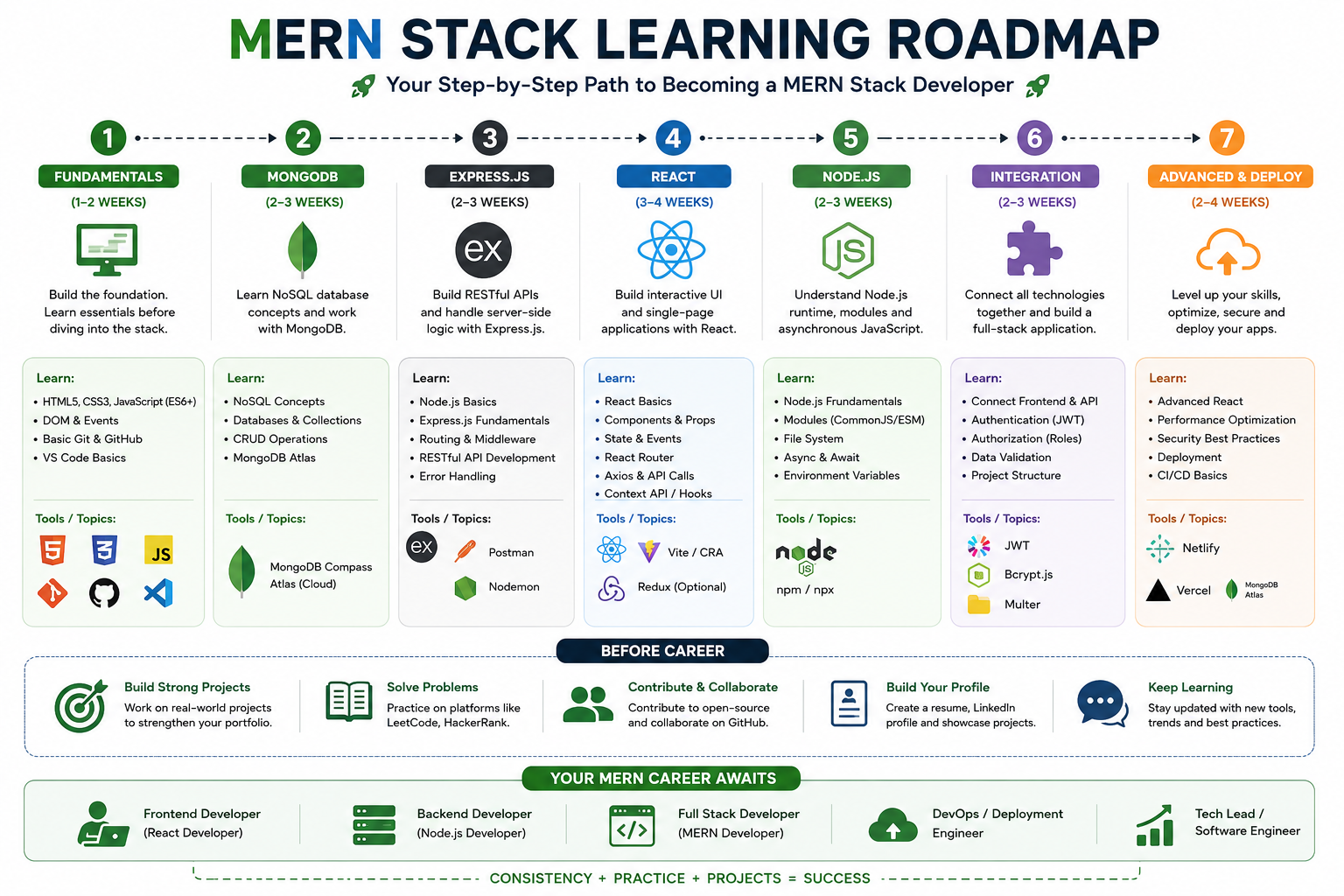
Step 1: Learn HTML and CSS
Understand webpage structure and styling.
Step 2: Master JavaScript
Learn:
Variables
Functions
Objects
Arrays
ES6 Features
Step 3: Learn React.js
Focus on:
Components
Props
State
Hooks
Routing
Step 4: Learn Node.js
Understand:
Modules
Events
APIs
Backend architecture
Step 5: Learn Express.js
Build REST APIs and learn routing.
Step 6: Learn MongoDB
Understand:
CRUD Operations
Collections
Documents
Aggregation
Step 7: Build Projects
Create:
Blog application
Task manager
E-commerce platform
Social media clone
Step 8: Learn Deployment
Use:
Vercel
Render
AWS
Docker
MERN Stack Developer Salary in 2026
The demand for MERN developers remains strong across startups, software companies, and digital agencies.
Experience Level | Average Salary in India |
Fresher | ₹3 LPA – ₹6 LPA |
1–3 Years | ₹6 LPA – ₹12 LPA |
3–5 Years | ₹12 LPA – ₹20 LPA |
Senior Developer | ₹20 LPA+ |
Actual salaries depend on skills, projects, and location.
Is MERN Stack a Good Career Choice in 2026?
Yes, the MERN Stack is a good career choice in 2026, as the demand for full-stack JavaScript developers continues to grow.
Popular Job Roles
MERN Stack Developer
Full Stack Developer
React Developer
Node.js Developer
Software Engineer
Skills Employers Look For
JavaScript
React
Node.js
MongoDB
API Development
Git and GitHub
Developers who build real projects often receive better job opportunities.
Once you understand the core technologies and start preparing for developer roles, practicing MERN Stack interview questions can help you test your technical knowledge and prepare for common questions about React, Node.js, Express.js, MongoDB, and full-stack development.
Who Should Learn MERN Stack?
MERN is suitable for:
College students
Fresh graduates
Career switchers
Freelancers
Entrepreneurs
Aspiring software developers
It provides a practical pathway into full-stack web development.
Best Practices for MERN Development
Use Clean Folder Structure
Organized code improves maintainability.
Validate User Input
Always verify incoming data.
Secure APIs
Use:
JWT Authentication
HTTPS
Environment Variables
Optimize Database Queries
Create indexes where appropriate.
Use Version Control
Git helps track and manage code changes efficiently.
Conclusion
The MERN Stack continues to be one of the most practical choices for anyone who wants to build modern web applications with JavaScript. Its combination of MongoDB, Express.js, React, and Node.js helps developers create fast, scalable, and feature-rich applications while learning a single programming language across the entire development process.
The best way to master MERN is through consistent practice. Start with JavaScript fundamentals, understand how each technology works, and build real-world projects that strengthen your portfolio. Practical experience not only improves your coding skills but also prepares you for technical interviews and real development environments.
If you are looking for structured guidance, mentorship, and hands-on projects, learning through a dedicated AI-integrated coding course in Kerala can make your journey much smoother. Programs that focus on industry-ready skills, code reviews, and project-based learning often help beginners gain confidence faster than learning through theory alone.
No matter where you begin, stay consistent, keep building projects, and continue learning. Every application you create brings you one step closer to becoming a confident full-stack developer.