A powerful visual can communicate an idea before a person reads a single sentence.
Visual storytelling combines images, colours, typography, composition, layout, movement and other visual elements to communicate a story, idea or emotion. It is widely used in graphic design, branding, advertising, photography, filmmaking, social media and digital experiences.
But visual storytelling is not simply about adding attractive visuals to content. It is about making every visual choice contribute to a larger message.
In this guide, let's understand what visual storytelling means, why it matters, its key elements, common techniques, applications and how designers can create stronger visual narratives.
What Is Visual Storytelling?
Visual storytelling is the practice of communicating a story, idea or emotion through visual elements instead of relying entirely on written or spoken words.
These visual elements can include:
Images and photography
Colour
Typography
Shapes and lines
Composition
Layout
Illustration
Icons and graphics
Video and animation
Lighting
Visual symbols
Movement
The goal is to help an audience understand or feel something through what they see.
For example, instead of writing “this product is designed for adventurous people,” a brand might show a person using the product while hiking through a challenging landscape. The image communicates the lifestyle and emotion behind the product without explaining everything in words.
This is the “show, don't just tell” principle at the heart of visual storytelling.
Visual storytelling can exist in a single image or develop across multiple visuals. A photograph can tell a story within one frame, while a film, advertising campaign or social media series can build a narrative over several visual moments.
Why Is Visual Storytelling Important?
People encounter an enormous amount of visual content every day. Because of this, simply presenting information is often not enough. Designers and brands need to make that information understandable, memorable and emotionally relevant.
Visual storytelling helps because it can:
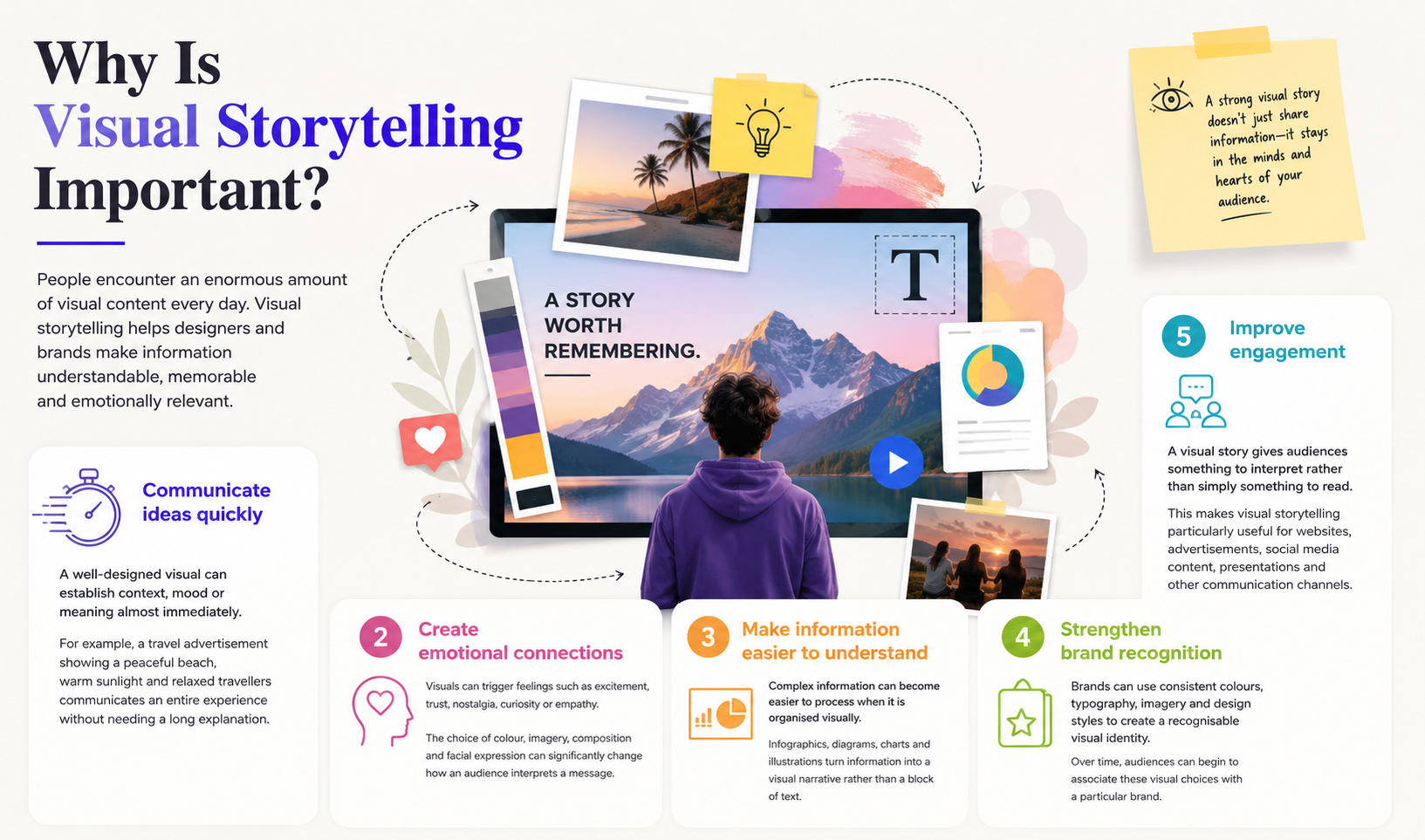
1. Communicate ideas quickly
A well-designed visual can establish context, mood or meaning almost immediately.
For example, a travel advertisement showing a peaceful beach, warm sunlight and relaxed travellers communicates an entire experience without needing a long explanation.
2. Create emotional connections
Visuals can trigger feelings such as excitement, trust, nostalgia, curiosity or empathy.
The choice of colour, imagery, composition and facial expression can significantly change how an audience interprets a message.
3. Make information easier to understand
Complex information can become easier to process when it is organised visually.
Infographics, diagrams, charts and illustrations are examples of visual storytelling because they turn information into a visual narrative rather than presenting it as a block of text.
4. Strengthen brand recognition
Brands can use consistent colours, typography, imagery and design styles to create a recognisable visual identity.
Over time, audiences can begin to associate these visual choices with a particular brand.
5. Improve engagement
A visual story gives audiences something to interpret rather than simply something to read.
This makes visual storytelling particularly useful for websites, advertisements, social media content, presentations and other communication channels.
What Are the Key Elements of Visual Storytelling?
There is no single formula for every visual story. The elements used will depend on the medium and the purpose of the communication.
However, several fundamental elements appear repeatedly in effective visual storytelling.
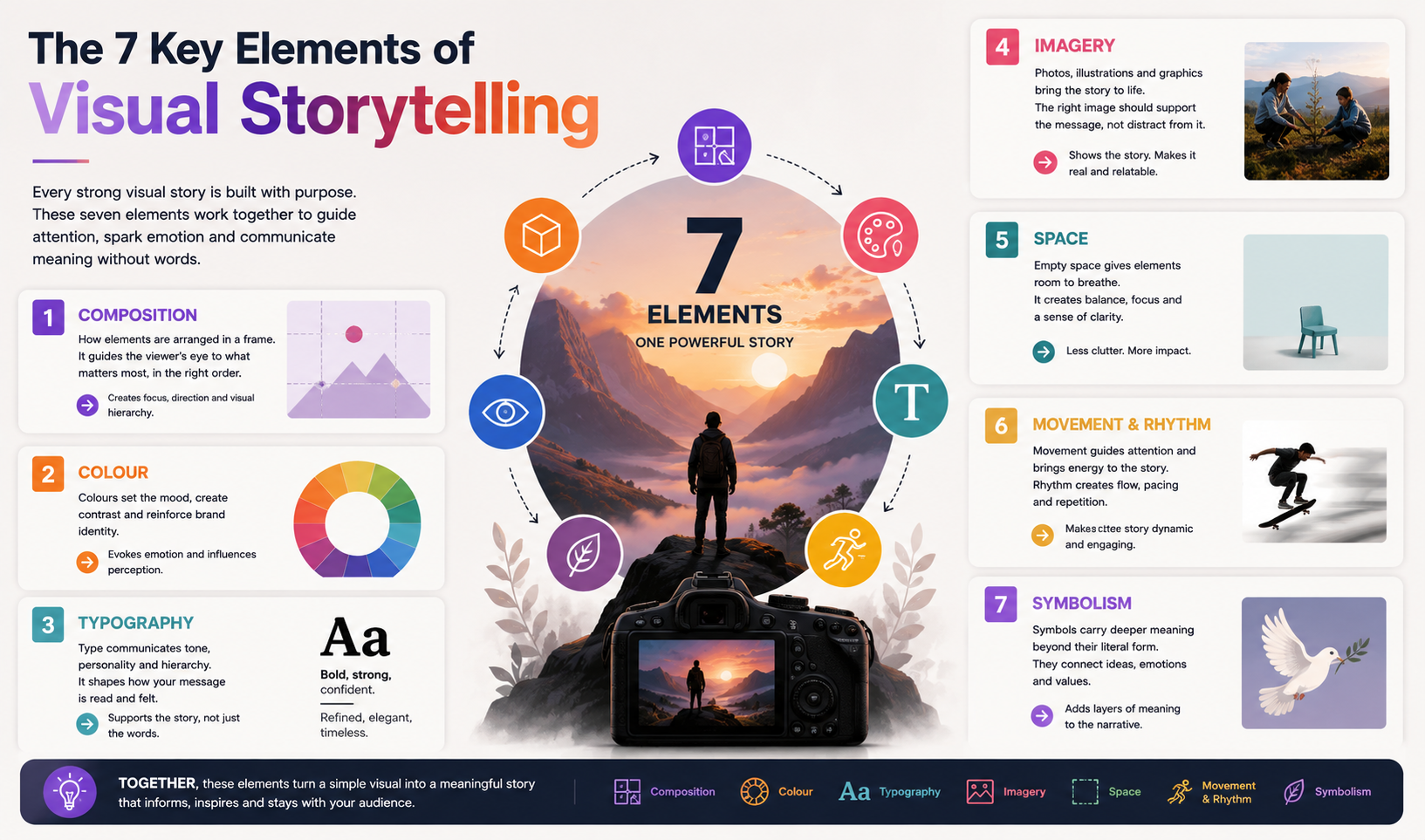
1. Composition
Composition refers to how visual elements are arranged within a design or frame.
It determines where the viewer looks first, what they notice next and how they move through the visual.
For example, placing a product prominently in the foreground can establish it as the main subject, while surrounding space can help create focus.
Good composition creates visual direction instead of allowing every element to compete for attention.
2. Colour
Colour is more than decoration.
Different colours can influence mood, create contrast, establish hierarchy and reinforce brand identity. A designer may use a warm palette to create energy or a muted palette to communicate calmness or seriousness.
However, colour meanings can also vary across cultures and contexts, so designers should consider the audience before assigning emotional meanings to specific colours.
3. Typography
Typography can communicate personality as well as information.
A bold typeface may feel confident and energetic, while a refined serif typeface may communicate sophistication or tradition.
Font size, weight, spacing and placement also contribute to visual hierarchy.
This means typography should be treated as part of the story rather than simply as text placed on top of an image.
4. Imagery
Photography, illustration and graphics provide the visual material through which a story is communicated. The right image should support the message rather than simply fill empty space.
For example, a sustainability campaign may use natural landscapes, human interaction and real-world environmental situations to communicate its message more effectively than a generic stock image.
5. Space
Empty space is also part of visual storytelling.
White space can isolate an important subject, create a sense of calm or make a design feel more premium. Crowded layouts, on the other hand, can create energy but may also reduce clarity.
The important thing is to use space intentionally.
6. Movement and rhythm
Movement is especially important in video, animation and interactive design.
The direction of movement, camera movement, transitions and editing can guide attention and influence how a story unfolds.
Even static graphic designs can create a sense of movement through lines, diagonals, repetition and visual direction.
7. Symbolism
A visual object can represent an idea beyond its literal meaning.
For example, a particular object, colour, shape or recurring image can become associated with a character, emotion, value or theme.
Symbolism adds depth to a visual narrative when it has a clear purpose.
The visual storytelling reference material similarly identifies space, line, shape, tone, colour, movement and rhythm as fundamental visual components.
Visual Storytelling Techniques Designers Can Use
Understanding the elements is only the beginning. Designers need to combine them strategically to create a visual narrative.
Here are some useful visual storytelling techniques.
1. Create a clear visual hierarchy
Decide what the audience should notice first, second and third. Use size, contrast, placement, colour and typography to establish that order.
A strong hierarchy prevents the viewer from asking, “Where should I look?”
2. Use contrast to communicate meaning
Contrast can be created through colour, size, shape, scale, texture or positioning.
For example, placing a small subject in a large empty space can communicate loneliness or vulnerability.
3. Use visual symbolism
Choose objects or design elements that support the central message. The symbol should strengthen the story rather than exist simply because it looks interesting.
4. Repeat visual motifs
A visual motif is a recurring image, colour, shape or design element that reinforces an idea. Repetition helps audiences recognise patterns and connect different parts of a story.
In branding, this could be a recurring colour, illustration style or photographic treatment used consistently across different campaigns.
5. Use juxtaposition
Juxtaposition places contrasting visual ideas next to each other. A designer might place an old image beside a modern image to communicate transformation, or show a problem beside its solution.
The contrast makes the relationship between the two ideas easier to understand.
6. Design for emotion
Before choosing colours, images or typography, ask:
“What should the audience feel?”
The answer could be curiosity, excitement, trust, nostalgia, urgency or inspiration. Once the emotional goal is clear, visual decisions become more purposeful.
How to Create Emotional Designs
Emotional design focuses on creating a specific emotional response through intentional visual decisions. Instead of asking only whether a design looks attractive, designers should consider how the audience should feel when they see it.
Some important emotional design principles include:
Choose an intentional colour palette
Colours can influence mood and perception, although their meaning can vary depending on context and culture.
Select imagery that supports the emotion
A photograph showing a real human experience can create empathy more effectively than a generic decorative image.
Use typography to establish personality
Type choices can make a design feel playful, serious, elegant, energetic or trustworthy.
Use composition to control attention
The position, scale and spacing of elements can create feelings such as tension, calmness, isolation or excitement.
Keep the emotion aligned with the message
An emotional visual should strengthen the communication rather than distract from it.
How Does Visual Storytelling Work in Graphic Design?
Storytelling through graphic design happens when design elements work together to communicate a narrative or experience.
A poster, for example, can establish:
Who or what the story is about
What is happening
What the audience should feel
What makes the subject important
What action the audience should take
This can happen through a combination of typography, imagery, colour, layout and visual hierarchy.
A book cover can suggest the genre and emotional tone of a story before the reader opens it. A campaign poster can communicate a social issue through one carefully constructed image. A product package can tell consumers whether a product feels premium, playful, natural or practical.
This is why graphic design is not only about making things look good. It is also about communicating meaning visually.
How Do Brands Use Visual Storytelling?
Brands use visual storytelling to communicate more than product features.
Instead of saying “our product is high quality,” a brand can create visuals that make the audience associate the product with quality, lifestyle, confidence or aspiration.
Brand storytelling design often brings together:
Logo and visual identity
Brand colours
Typography
Photography
Illustration
Packaging
Advertising
Social media content
Website design
Video
Customer stories
Consistency is important. When the same visual language appears across different touchpoints, the audience can begin to recognise the brand more easily.
Effective brand storytelling also starts with the audience.
A useful question is:
“What does our audience want to experience, solve or become?”
The brand then becomes part of that story rather than making itself the entire story.
The marketing-focused reference describes this customer-centred approach as placing the customer at the centre of the narrative and connecting visual experiences with different stages of the buyer journey.
Where Is Visual Storytelling Used?
Visual storytelling is not limited to films or advertising.
It can be used across many creative and communication fields.
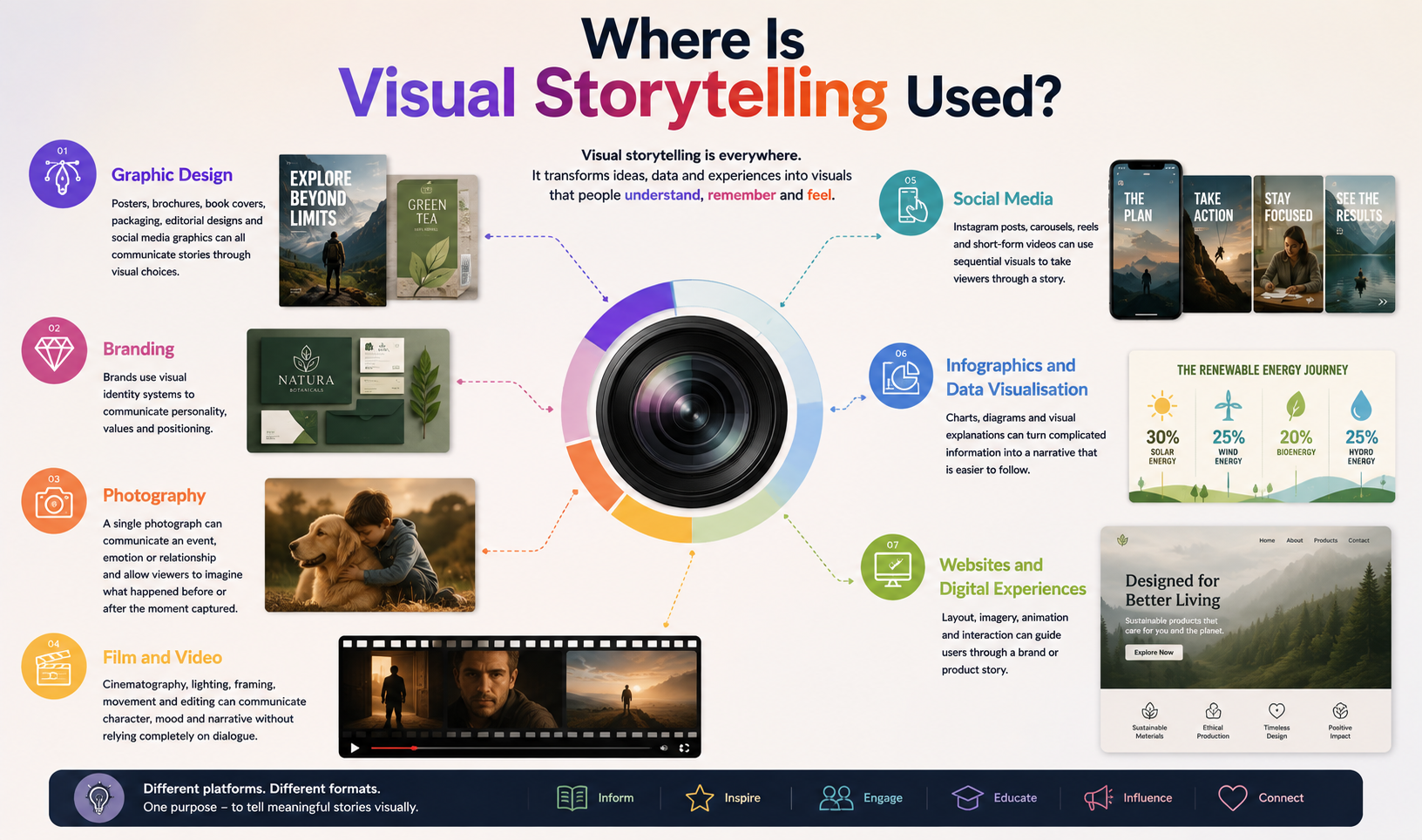
Graphic Design
Posters, brochures, book covers, packaging, editorial designs and social media graphics can all communicate stories through visual choices.
Branding
Brands use visual identity systems to communicate personality, values and positioning.
Photography
A single photograph can communicate an event, emotion or relationship and allow viewers to imagine what happened before or after the moment captured.
Film and Video
Cinematography, lighting, framing, movement and editing can communicate character, mood and narrative without relying completely on dialogue.
Social Media
Instagram posts, carousels, reels and short-form videos can use sequential visuals to take viewers through a story.
Infographics and Data Visualisation
Charts, diagrams and visual explanations can turn complicated information into a narrative that is easier to follow.
Websites and Digital Experiences
Layout, imagery, animation and interaction can guide users through a brand or product story.
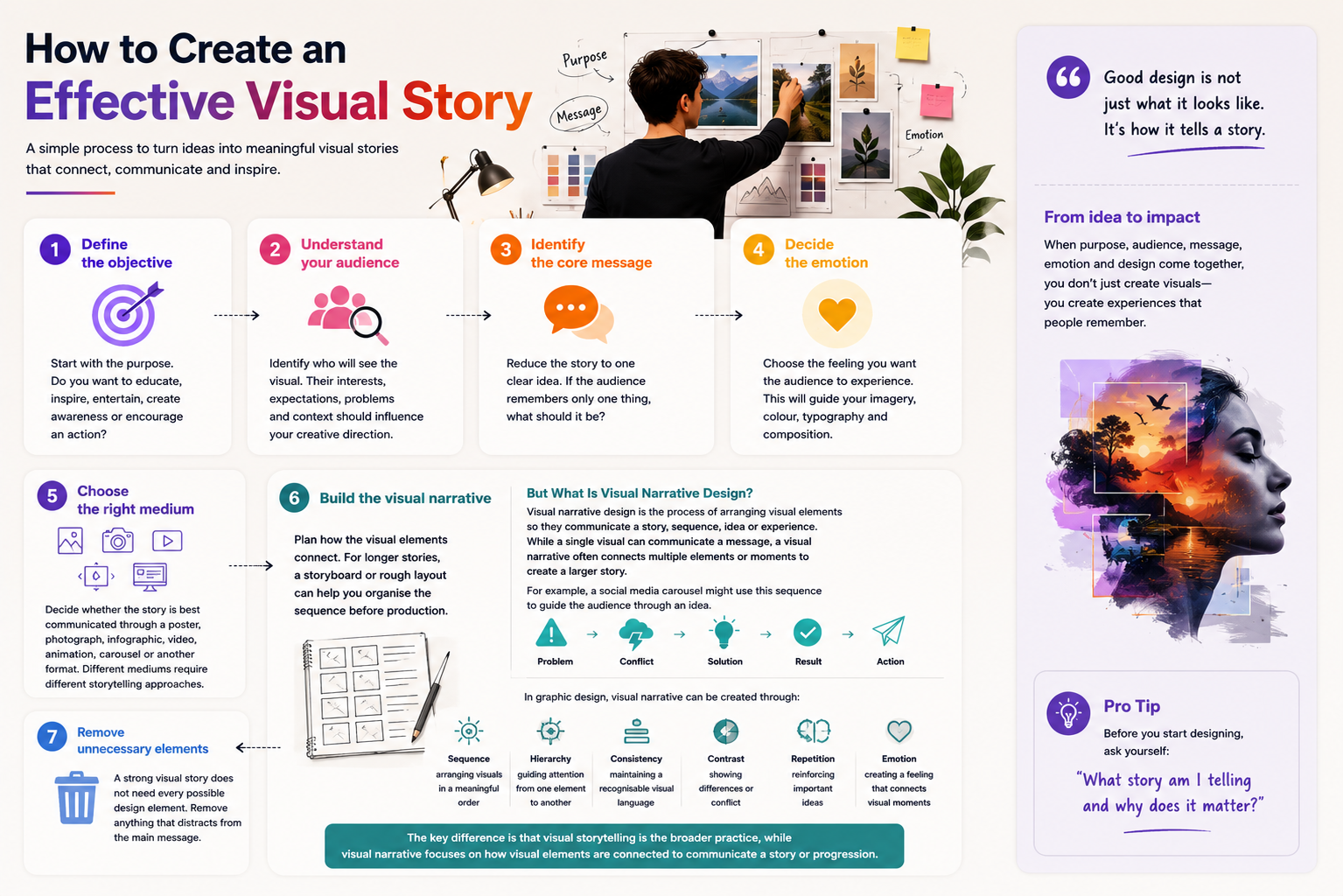
How to Create an Effective Visual Story
Whether you are creating a poster, campaign, video or brand identity, follow a simple process.
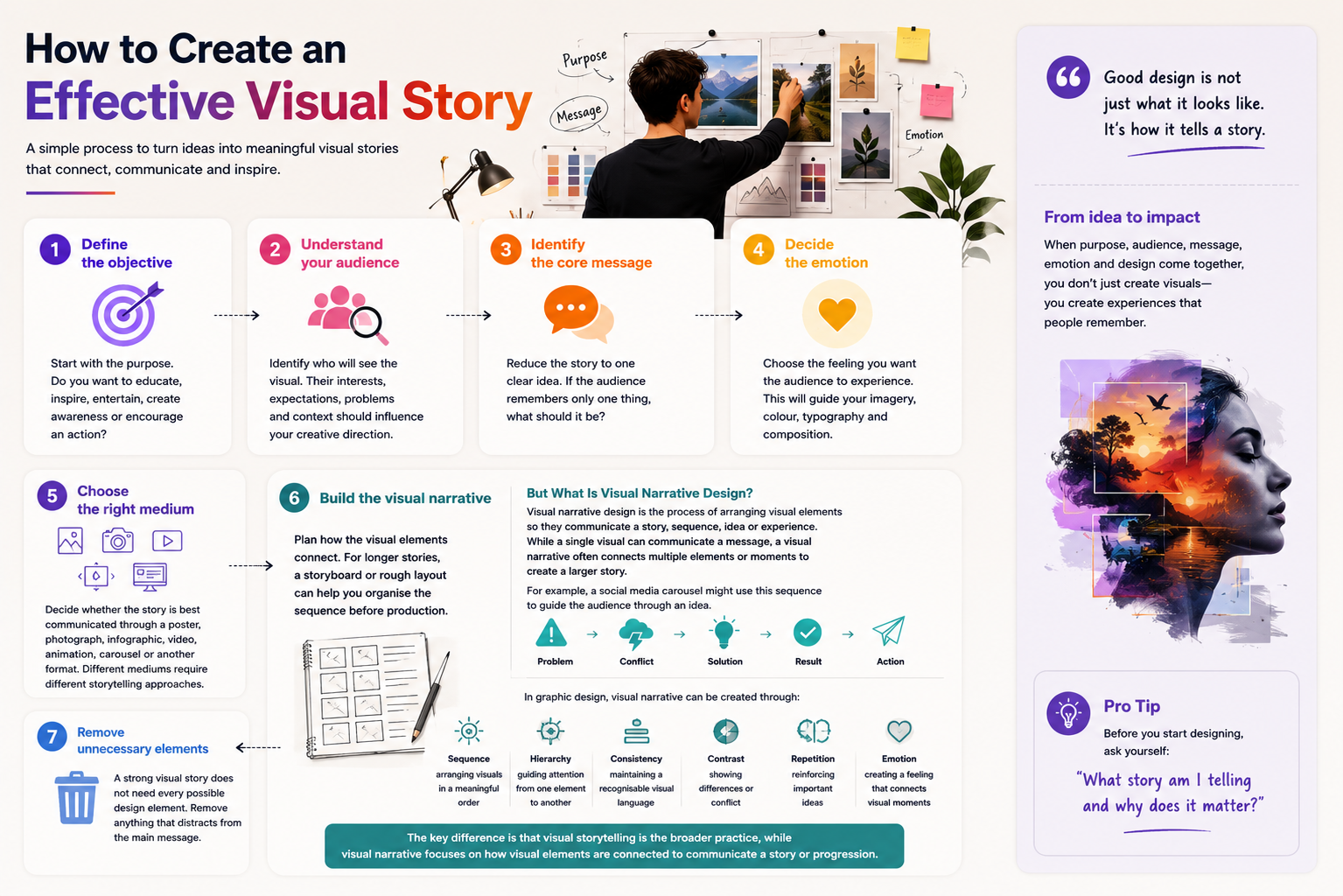
Step 1: Define the objective
Start with the purpose.
Do you want to educate, inspire, entertain, create awareness or encourage an action?
Step 2: Understand your audience
Identify who will see the visual.
Their interests, expectations, problems and context should influence your creative direction.
Step 3: Identify the core message
Reduce the story to one clear idea.
If the audience remembers only one thing, what should it be?
Step 4: Decide the emotion
Choose the feeling you want the audience to experience.
This will guide your imagery, colour, typography and composition.
Step 5: Choose the right medium
Decide whether the story is best communicated through a poster, photograph, infographic, video, animation, carousel or another format.
Different mediums require different storytelling approaches.
Step 6: Build the visual narrative
Plan how the visual elements connect. For longer stories, a storyboard or rough layout can help you organise the sequence before production.
But What Is Visual Narrative Design?
Visual narrative design is the process of arranging visual elements so they communicate a story, sequence, idea or experience.
While a single visual can communicate a message, a visual narrative often connects multiple elements or moments to create a larger story.
For example, a social media carousel might use the gien below sequence to guide the audience through an idea.
Problem → conflict → solution → result → action
In graphic design, visual narrative can be created through:
Sequence – arranging visuals in a meaningful order
Hierarchy – guiding attention from one element to another
Consistency – maintaining a recognisable visual language
Contrast – showing differences or conflict
Repetition – reinforcing important ideas
Emotion – creating a feeling that connects different visual moments
The key difference is that visual storytelling is the broader practice, while visual narrative focuses on how visual elements are connected to communicate a story or progression.
Step 7: Remove unnecessary elements
A strong visual story does not need every possible design element.
Remove anything that distracts from the main message.
Common Visual Storytelling Mistakes
Even attractive designs can fail to communicate a story effectively.
Some common mistakes include:
Too much visual clutter: When every element competes for attention, the main message becomes unclear.
Weak hierarchy: If everything looks equally important, the audience does not know where to look.
Unnecessary symbolism: Visual symbols should support the message rather than make the design unnecessarily complicated.
Inconsistent visual language: Random changes in colour, typography, imagery or composition can weaken the overall narrative.
Designing without an audience: A visual may look impressive to the designer but fail to connect with the intended audience.
The key principle is simple: every visual choice should have a reason.
The reference material similarly highlights visual clutter, over-explaining, inconsistent visual language and symbolism without purpose as common problems that can weaken visual storytelling.
Visual Storytelling vs Traditional Storytelling
The main difference between visual storytelling vs traditional storytelling is how the story is communicated.
Traditional storytelling may rely heavily on words, dialogue or narration to explain information.
Visual storytelling allows the audience to interpret meaning through imagery, composition, colour, action and other visual cues.
For example:
Traditional approach:
“She was nervous about the presentation.”
Visual storytelling approach:
Show her repeatedly checking her notes, gripping a pen tightly and standing alone outside the presentation room.
The second approach allows the audience to infer the emotion instead of simply being told about it.
This does not mean visual storytelling should completely replace words. In many situations, the strongest communication combines visuals and text so that each supports the other.
Final Thoughts
Visual storytelling is not simply about creating beautiful visuals. It is about using design with intention to communicate meaning.
A strong visual story tells the audience where to look, what to understand and, most importantly, what to feel.
For designers, this means going beyond choosing attractive colours, fonts and images. Every creative decision should support the central message and the audience's experience.
For brands, visual storytelling creates an opportunity to communicate identity and build emotional connections instead of simply listing product features.
And for aspiring designers, learning visual storytelling can become a valuable creative skill because it connects graphic design, branding, UI/UX, photography, video, motion graphics and communication.
For those looking to take this understanding further, a structured Graphic Designing Course in Kerala can provide the opportunity to develop these concepts through practical design work, creative projects and industry-focused learning.
Once you understand how visuals can communicate a story, you stop designing only for appearance and start designing for meaning, emotion and impact.