

What If You Could Ask Questions and Get Answers Directly from Institutional Documents? Meet HACA GPT.
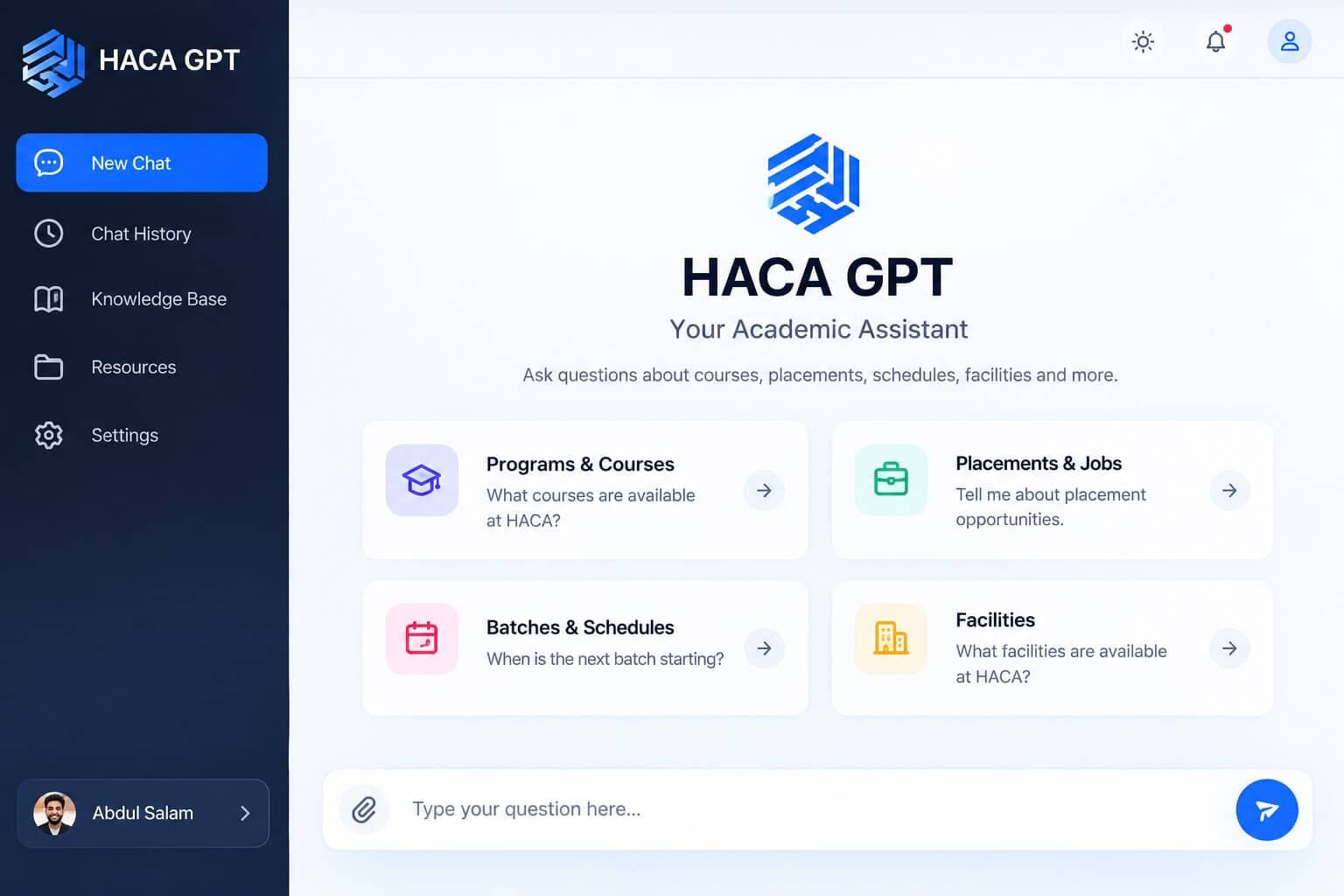
Finding information in institutional documents can take time. But what if users could simply ask a question and receive an answer based on those documents?
The Py06 offline student team at HACA Tech School explored this idea through HACA GPT, an AI-powered institutional knowledge chatbot developed as part of their project.
The project focuses on making HACA's institutional information accessible through natural language queries. Instead of requiring users to search through multiple documents, the chatbot retrieves relevant information and uses it to generate contextual answers.
To achieve this, the team implemented Retrieval-Augmented Generation (RAG), connecting a Large Language Model (LLM) with information extracted from HACA's institutional documents.
The project demonstrates how Python, document processing, embeddings, semantic search and Generative AI can work together to develop a domain-specific knowledge assistant.
The Challenge: Getting Relevant Answers from Institutional Data
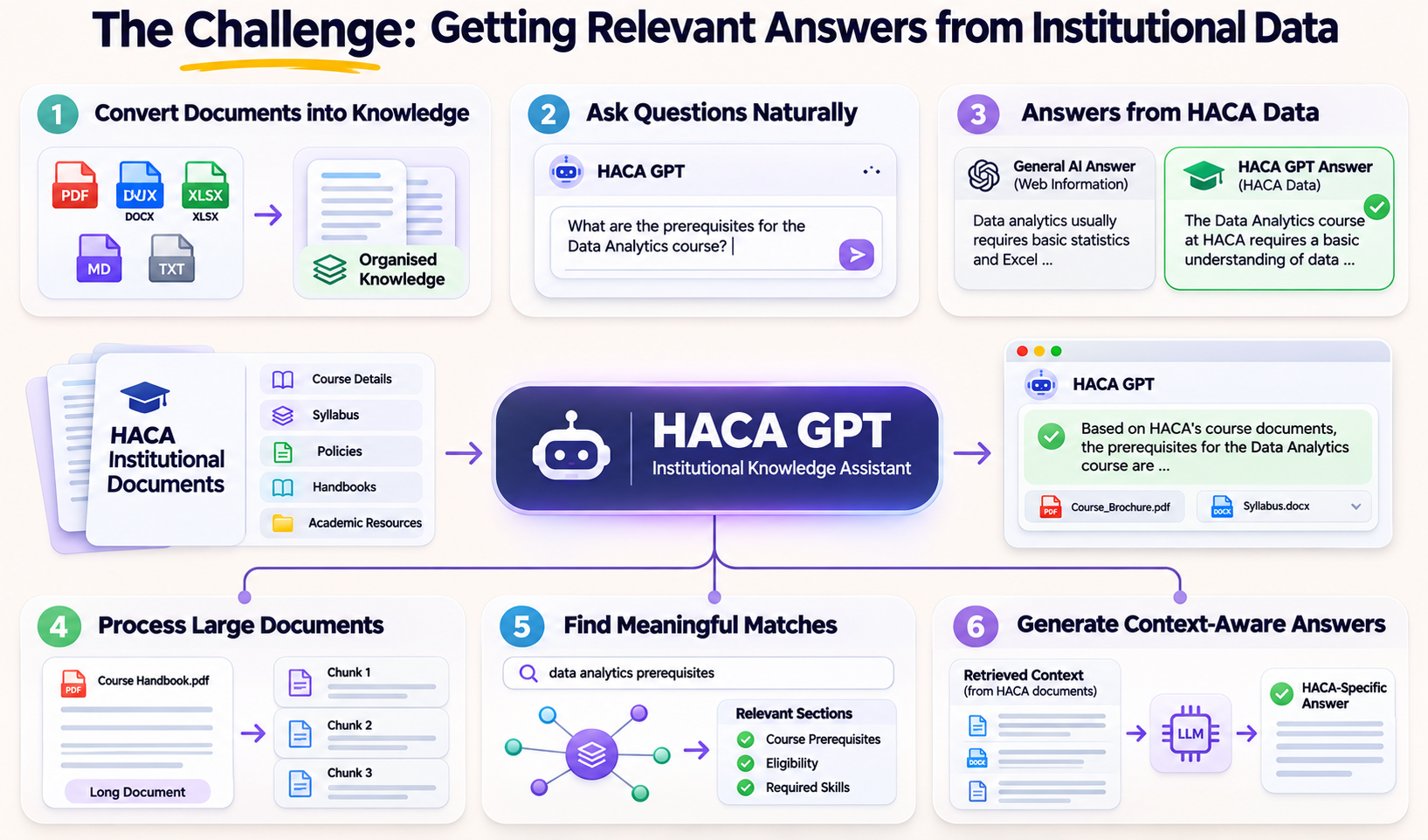
Educational institutions maintain different types of documents containing course details, academic resources, institutional information and other reference materials.
Although these documents contain useful information, finding specific answers manually can be time-consuming. General-purpose AI chatbots may also provide answers that are not directly based on an institution's internal information.
The PY06 team focused on addressing these challenges through an AI-powered question-answering system.
Their approach explored six key requirements:
Converting institutional documents into searchable knowledge.
Retrieving relevant information through natural language questions.
Generating answers using HACA's institutional data.
Processing large documents efficiently.
Identifying relevant content through semantic search.
Connecting retrieved information with LLMs to generate context-aware responses.
These requirements shaped the development of HACA GPT and its RAG-based architecture.
Inside the Development: How the Team Built HACA GPT
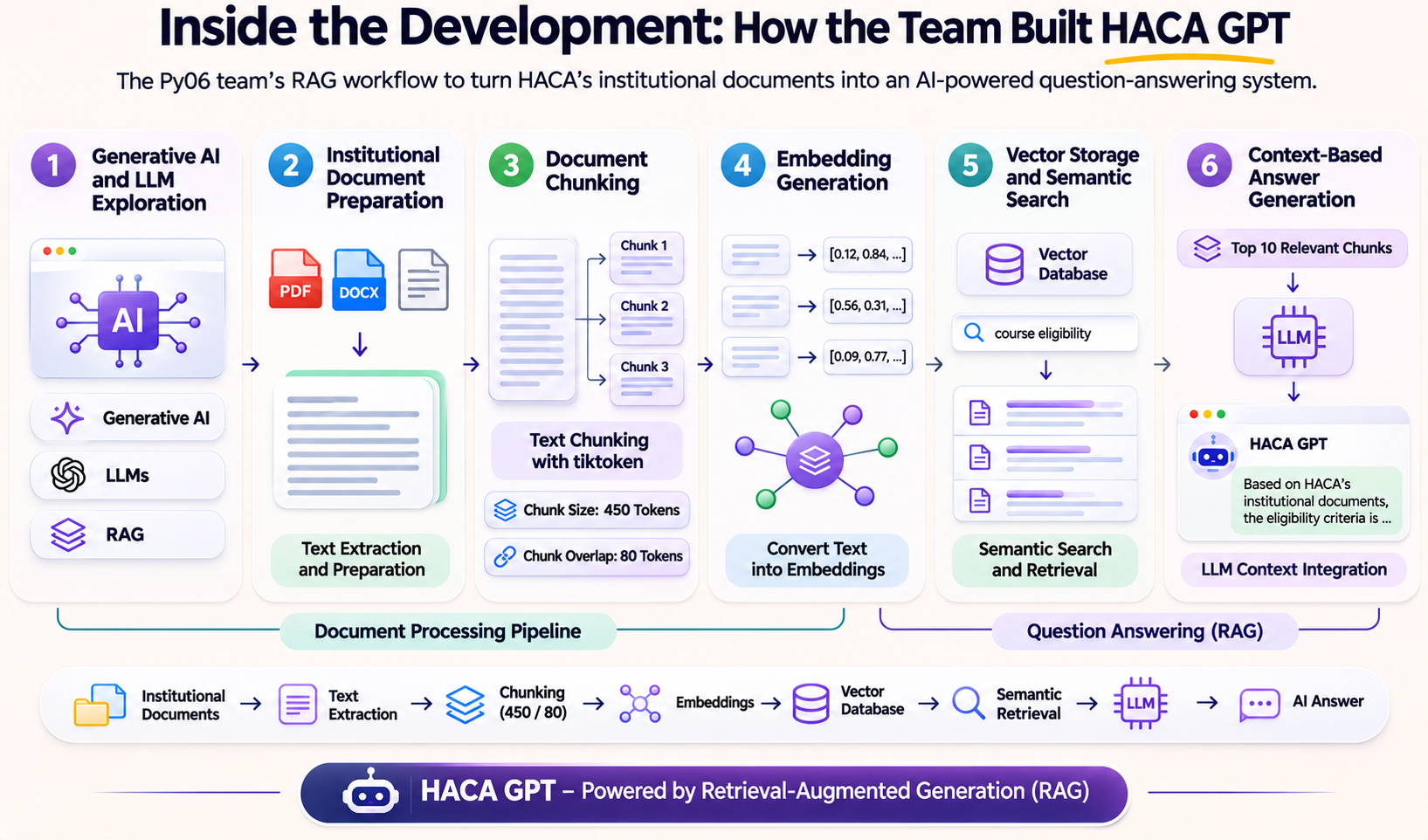
The team developed a structured workflow that transforms institutional documents into searchable information and uses that information to answer user queries.
The implementation involved six major stages.
1. Exploring Generative AI and Large Language Models
The team started by understanding the fundamentals of Generative AI, Large Language Models and Retrieval-Augmented Generation.
This provided the foundation for understanding how language models generate responses and how external knowledge sources can improve the relevance of AI-generated answers.
2. Preparing Institutional Documents
The next step involved processing HACA's institutional documents.
The team extracted text from the documents and converted the content into a structured format suitable for further processing. This prepared the information for the subsequent stages of the RAG pipeline.
3. Breaking Documents into Manageable Chunks
Large documents can contain more information than an AI application can conveniently process at once. The team addressed this by using Python and the tiktoken library to divide extracted text into smaller sections.
The project followed these configurations:
Chunk Size: 450 tokens
Chunk Overlap: 80 tokens
The overlap maintained contextual continuity between consecutive chunks, helping preserve relevant information when the original documents were divided.
4. Converting Text into Embeddings
After chunking, the team converted the processed text into numerical vector representations called embeddings.
These representations enabled the system to identify semantically related content and retrieve information based on the meaning of a query.
5. Storing Information for Semantic Search
The generated embeddings were stored in a vector database.
When users submitted questions, the system performed semantic search to identify relevant document sections. This allowed it to retrieve information based on the context and meaning of the query rather than depending only on matching keywords.
6. Generating Context-Based Answers
The final stage connected the retrieved information with an LLM.
For each user question, the chatbot retrieved the top 10 relevant text chunks and supplied them to the language model as context.
The LLM then used this information to generate a response based on HACA's institutional documents.
Understanding the RAG Architecture
HACA GPT follows two connected workflows: document processing and question answering.
Document Processing: Preparing the Knowledge Base
Stage | What Happens |
Institutional Documents | HACA's documents provide the source information |
Text Extraction | Document content is extracted and prepared |
Chunking and Tokenisation | Text is divided into 450-token chunks with 80-token overlap |
Embedding Generation | Text is converted into numerical vectors |
Vector Database | Embeddings are stored for semantic retrieval |
Question Answering: Finding and Generating Answers
Stage | What Happens |
User Question | The user submits a natural language query |
Semantic Search | The system retrieves the top 10 relevant chunks |
LLM Context Integration | Retrieved content is supplied to the LLM along with the question |
AI-Generated Answer | The LLM generates a response using the retrieved information |
This architecture connects HACA's institutional knowledge with an AI-powered question-answering process.
Key Project Highlights
The project brings together several components to support document-based information retrieval and AI response generation.
Component | Implementation |
Knowledge Source | HACA institutional documents |
Text Processing | Python |
Tokenisation | tiktoken |
Chunk Size | 450 tokens |
Chunk Overlap | 80 tokens |
Embedding Generation | Text embeddings |
Knowledge Storage | Vector database |
Retrieval Method | Semantic search |
Retrieval Count | Top 10 relevant chunks |
Response Generation | LLM integration |
AI Architecture | Retrieval-Augmented Generation (RAG) |
The AI Concepts Applied in the Project
Developing HACA GPT gave the team an opportunity to explore how different Generative AI concepts contribute to an intelligent chatbot.
The major concepts demonstrated through the project include:
Large Language Models (LLMs): Understanding how language models process questions and generate responses.
Retrieval-Augmented Generation (RAG): Connecting LLMs with external institutional information.
Tokenisation: Breaking text into manageable token sequences using tiktoken.
Text Chunking: Dividing large documents into smaller sections while maintaining contextual overlap.
Embeddings: Representing text as numerical vectors for semantic comparison.
Vector Search: Retrieving relevant information based on the meaning of user queries.
Contextual Prompting: Supplying retrieved document content to an LLM before response generation.
Together, these concepts form the foundation of the chatbot's document-based question-answering functionality.
Skills Demonstrated Through HACA GPT
Through this project, the Py06 team demonstrated practical application of several AI development concepts and techniques.
The key skills include:
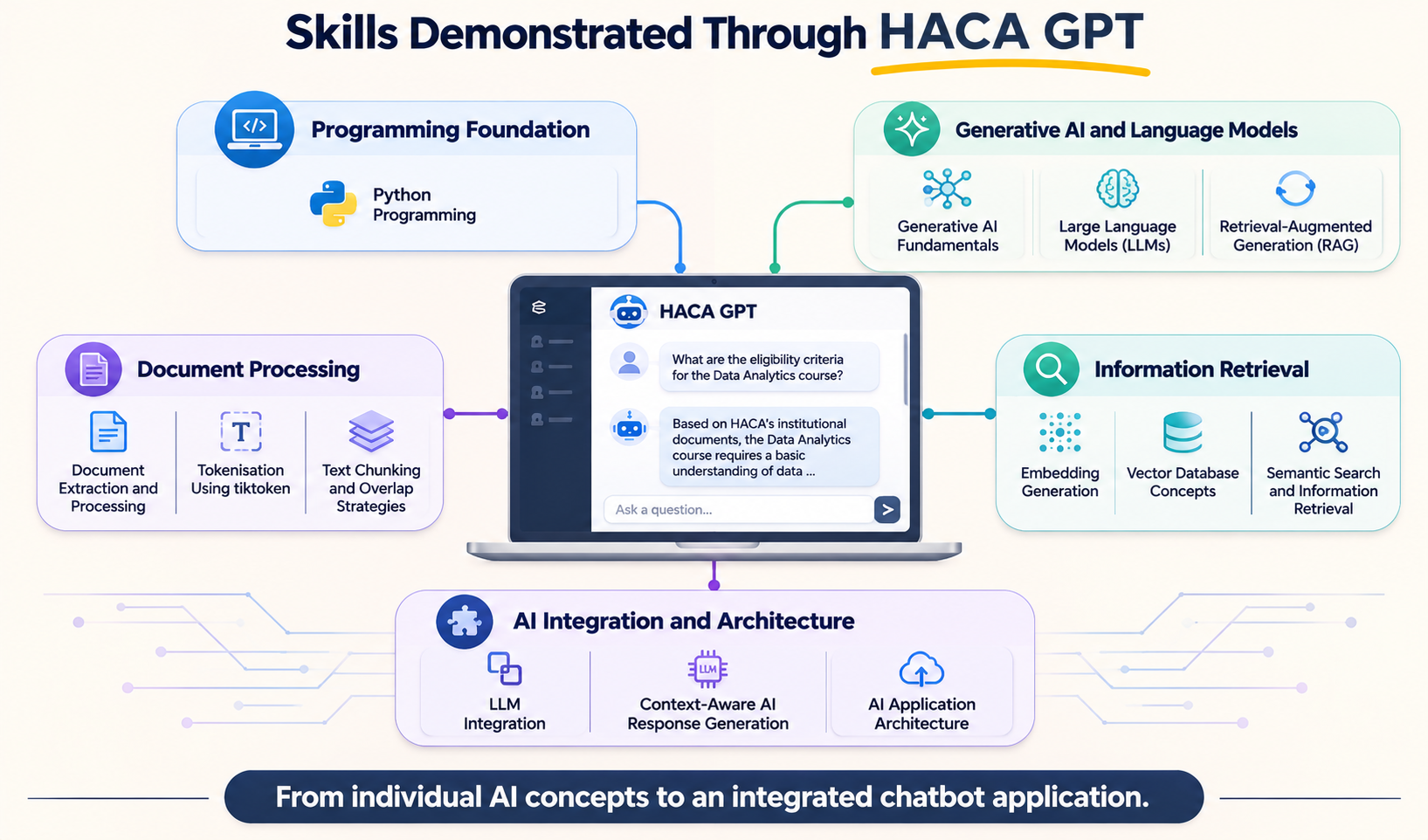
Python programming
Generative AI fundamentals
Large Language Models (LLMs)
Retrieval-Augmented Generation (RAG)
Document extraction and processing
Tokenisation using tiktoken
Text chunking and overlap strategies
Embedding generation
Vector database concepts
Semantic search and information retrieval
LLM integration
Context-aware AI response generation
AI application architecture
The project helped the team understand how individual AI components can be integrated into a single application to solve a specific information retrieval challenge.
A Practical Application of Generative AI
HACA GPT demonstrates how institutional documents can be transformed into an intelligent knowledge assistant using Retrieval-Augmented Generation.
By combining document processing, tokenisation, embedding generation, vector storage, semantic retrieval and LLM integration, the Py06 team developed a practical approach to answering institution-specific questions.
The project also highlights the importance of connecting AI models with relevant external information to generate responses based on a defined knowledge source.
For the Py06 team, HACA GPT represents an opportunity to apply Python and Generative AI concepts to a practical application while developing an understanding of how modern AI-powered systems retrieve, process and use information.
