Understanding Political Awareness Among Kerala's Gen Z
Is Kerala's Gen Z becoming disconnected from politics, or are young people engaging with it in different ways?
This question became the starting point for a survey analytics project developed by HACA Tech School students Shamil, Rinshad, Ashna, Hiba, Farzin, Safreena and Omkar. The project examined political awareness, engagement, voting behaviour and perspectives on governance among Gen Z respondents in Kerala.
Rather than assuming that young people were losing interest in politics, the students set out to understand how they interact with political information, what influences their decisions and which issues matter most to them.
The project explored several aspects of political behaviour, including political knowledge, social media usage, information verification, voting preferences and satisfaction with the current government.
By examining these areas together, the students aimed to develop a clearer picture of how young people in Kerala perceive and engage with politics.
Defining the Research Objectives
Before analysing the data, the team established a set of research objectives to guide the project.
The first objective was to understand the level of political awareness among respondents and examine whether their perceived knowledge matched their measured knowledge.
The team also wanted to investigate whether political engagement was declining or simply taking different forms. For example, a person might regularly watch political videos, read news and follow public discussions without actively commenting on or sharing political content.
Another objective was to explore the relationship between political knowledge, online engagement, information sources and voting behaviour. The students also examined whether respondents followed fixed political positions or made decisions based on particular issues, circumstances and expected outcomes.
The research further explored government priorities, concerns about governance and the problems respondents associated with the current administration.
These objectives helped the team approach political awareness as a combination of knowledge, information consumption, participation and personal perspectives rather than treating it as a single measure.
Designing the Survey and Research Approach
The project began with discussions around the research problem and the questions needed to investigate it.
Before finalising the questionnaire, the team conducted an initial pilot survey that received around 100 responses. However, the students found that some respondents misunderstood certain questions. They also identified wording that could influence answers instead of capturing respondents' actual views.
The team reviewed these issues through further discussions and analysis before revising the questionnaire. Shamil and Ashna were part of the student group working on the broader research and questionnaire development process.
This stage helped the students recognise that a survey involves more than asking questions. Questions must be framed carefully to collect meaningful responses without leading participants towards a particular answer.
The team explored indirect ways to understand political knowledge and behaviour. For example, asking whether respondents would watch or scroll past a political reel offered a way to examine their engagement with political content without directly asking them to judge their own political interest.
The survey focused specifically on Kerala politics, allowing the team to examine concerns and perspectives within the state's political context.
The questionnaire was organised into four analytical areas: Respondents, Political Knowledge, Political Engagement and Perspective. Questions about political interest and an attention check were also incorporated into the survey design.
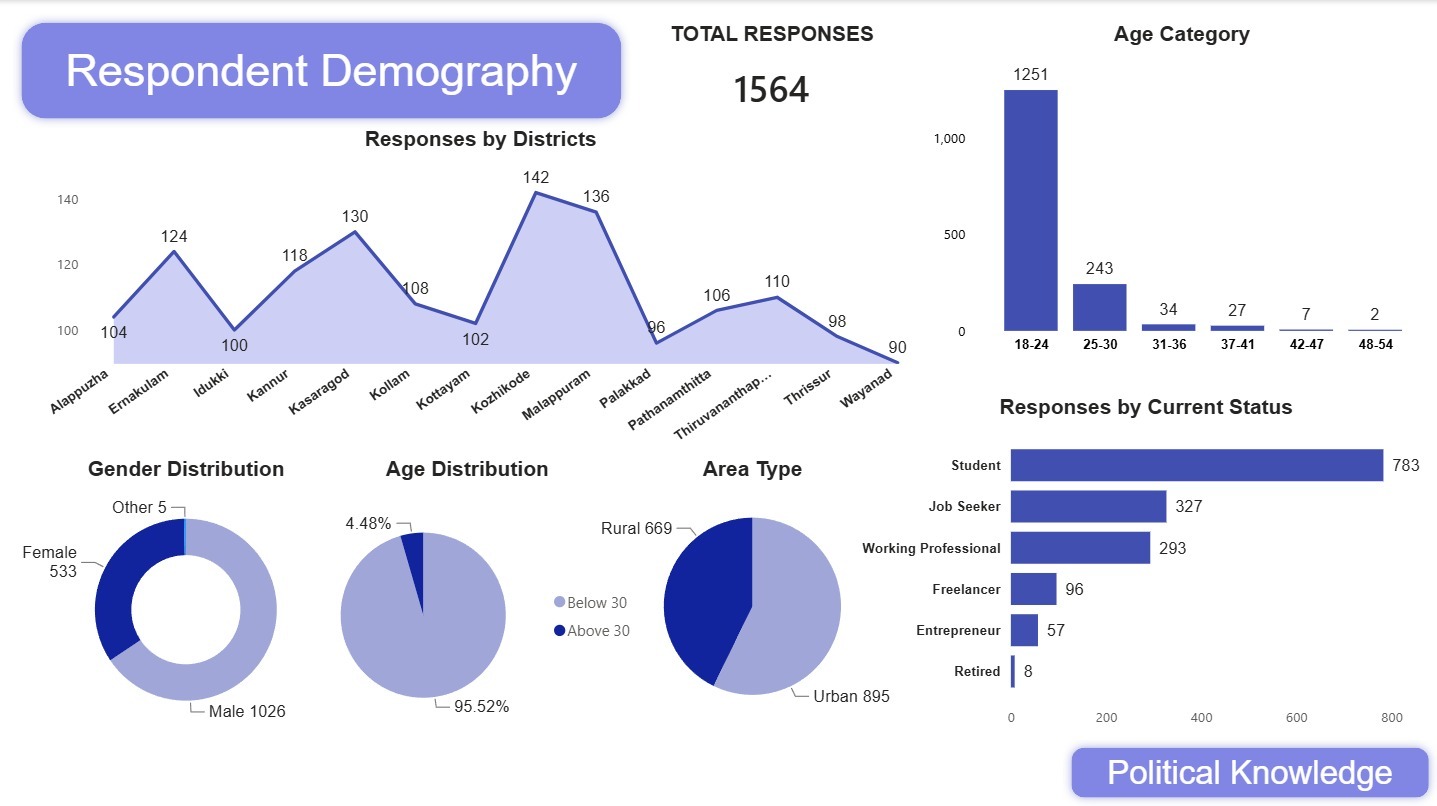
Respondents: Captured demographic information such as district, gender, age, area type and current status.
Political Knowledge: Examined self-rated and measured political knowledge.
Political Engagement: Focused on political content consumption, information sources, verification behaviour and voting style.
Perspective: Explored government priorities, political positions, government ratings and major concerns.
An attention-check question was included to help identify submissions where respondents may not have read the questions carefully.
This iterative approach helped the students improve the questionnaire before moving to the larger data collection stage.
Collecting and Validating More Than 2,000 Responses
The survey initially received more than 2,000 responses. However, the team did not treat every submission as suitable for the final analysis.
To improve the quality of the dataset, the students carried out a data-cleaning and validation process before proceeding with their analysis.
The team developed a web application to support data collection after identifying limitations with its initial Google Forms approach. The application recorded response start and end times and IP addresses, helping the team review response duration and identify potential duplicate submissions.
Rinshad and Omkar were part of the student team working on the wider digital survey and response validation process.
The validation process included:
Checking for duplicate responses.
Reviewing answers to attention-check questions.
Screening submissions completed faster than the team's stated response-time threshold of approximately 2 minutes and 45 seconds.
Reviewing entries that appeared potentially unreliable.
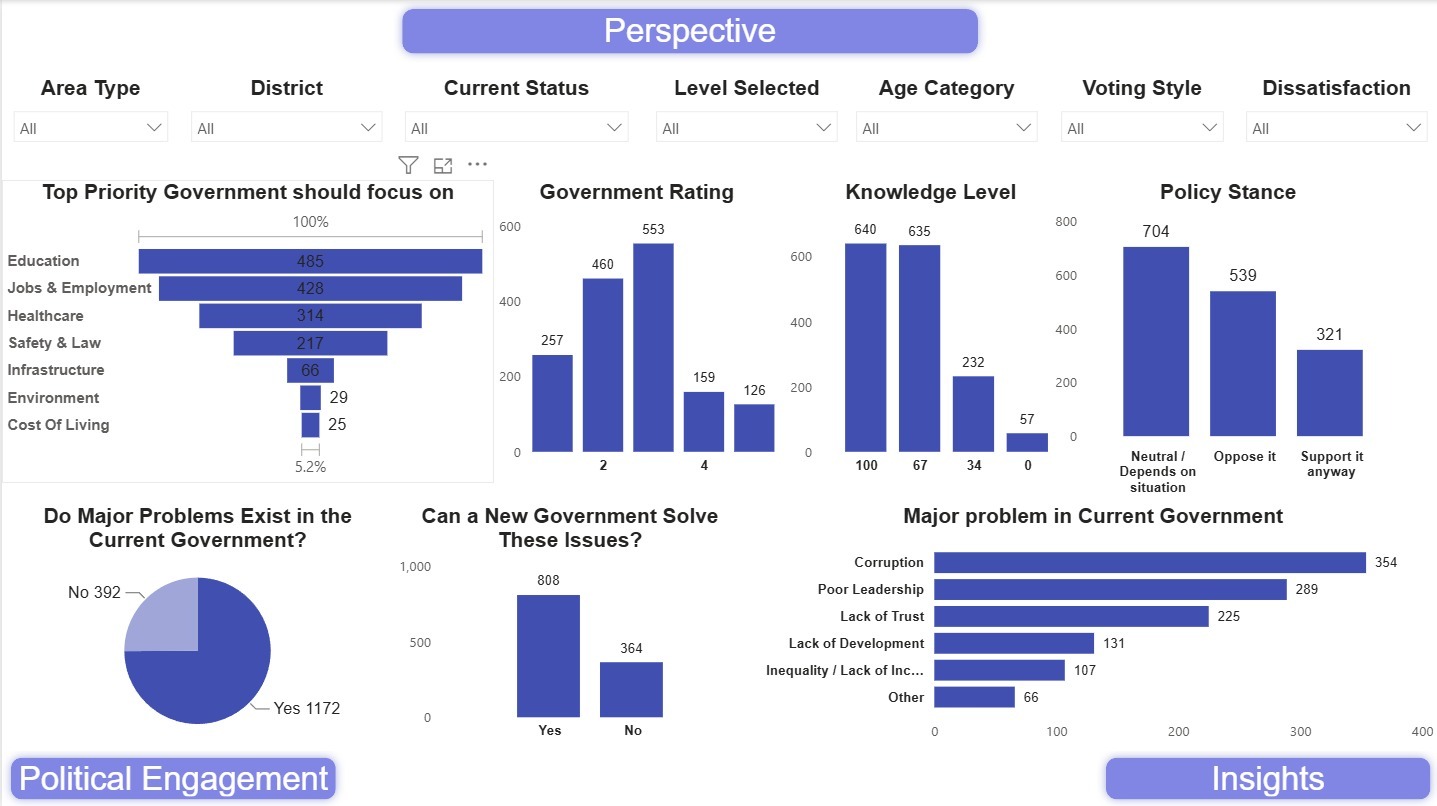
These checks helped the team identify submissions that required exclusion from the final dataset. The students retained 1,564 validated respondents for the final analysis.
Response time was considered alongside other checks rather than treated as a standalone measure of response quality. This step helped the team prepare a defined dataset for further analysi
Analysing Political Knowledge and Engagement
With the validated dataset ready, the students examined how political knowledge related to engagement with political content.
One of the important patterns was the relationship between measured political knowledge and engagement. Respondents with higher measured knowledge generally showed stronger engagement with political content.
The voting-style analysis also showed a strong presence of informed voting among respondents with higher political knowledge, particularly those classified at the advanced level.
These patterns suggest that political awareness and engagement may be connected. However, the findings describe relationships within the surveyed group and do not establish that greater political knowledge directly causes higher engagement or more informed voting.
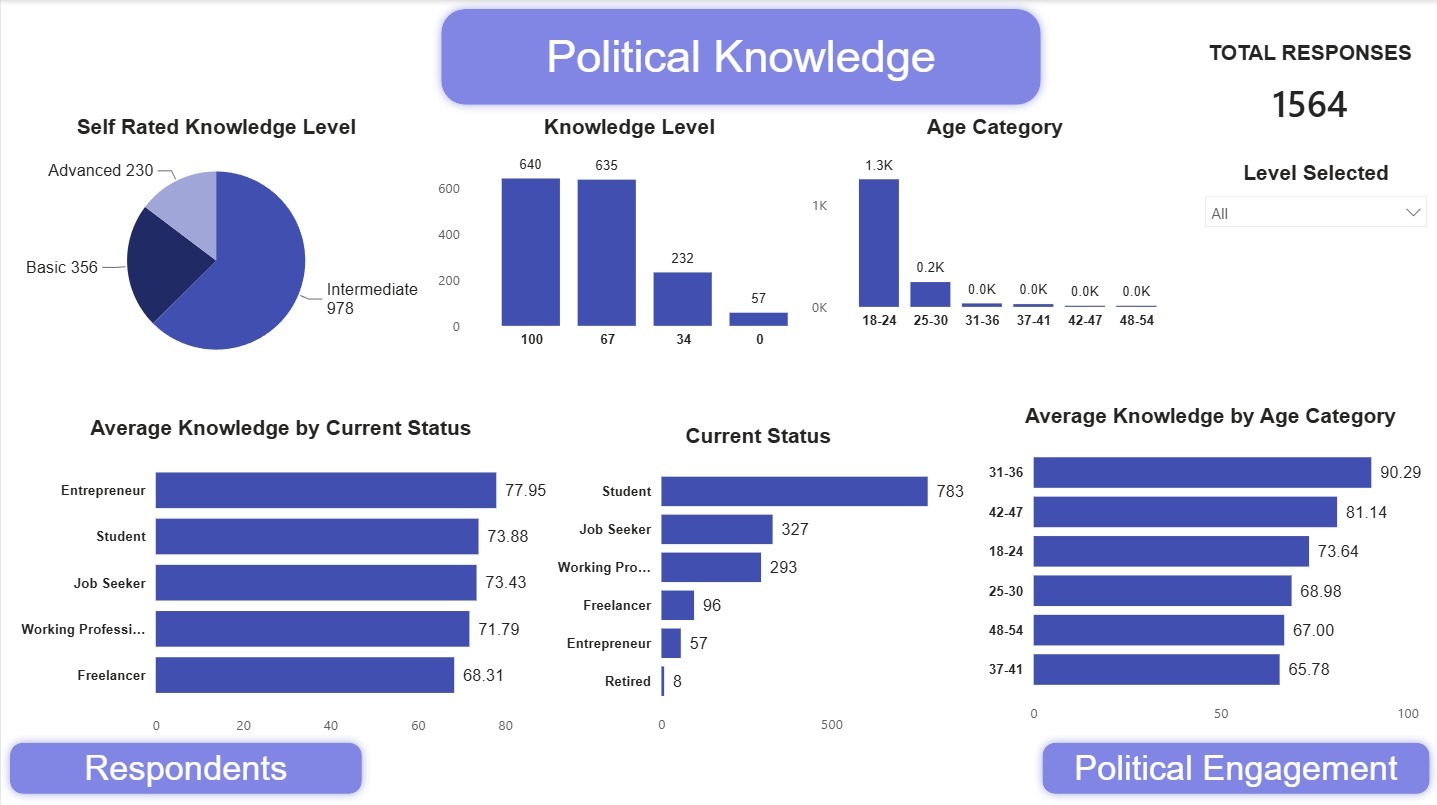
The analysis also considered the difference between consuming political content and participating publicly. Only a relatively small group reported ignoring political content altogether. Many respondents continued to watch or read political material and try to understand it, even when they did not actively share or publicly engage with it.
This distinction helped the team look beyond visible online activity when assessing political engagement.
Understanding Social Media's Role in Political Awareness
Social media emerged as the main source of political information among respondents.
This finding highlighted the importance of online platforms in understanding how Kerala's Gen Z encounters political news, opinions and discussions.
Social media can expose young people to a wide range of viewpoints and make political content easier to access. At the same time, the platform through which information is received does not automatically establish whether that information is accurate or whether a person has evaluated it critically.
The survey's focus on information sources and research or verification behaviour provided a way to examine these aspects of political engagement together.
Rather than viewing social media usage as proof of political awareness on its own, the project considered it alongside measured knowledge, content consumption and voting behaviour.
The findings therefore offered a broader perspective on how young people interact with political information in an increasingly digital environment.
Exploring Voting Behaviour and Political Positions
Another important area of the project was how respondents approached political decisions.
A large share selected a neutral or situation-dependent political position. This suggests that many respondents in the surveyed group may assess political choices according to the issue, circumstances or expected outcomes rather than consistently following one fixed ideological position.
This pattern provides an alternative perspective on how political preferences can be understood. A respondent's decision may involve evaluating specific issues and expectations rather than simply identifying with a particular political position.
However, a neutral or situation-dependent response does not necessarily mean that a person lacks political knowledge or interest. It may reflect how they prefer to approach political choices.
By examining voting style alongside political knowledge and engagement, the students explored the different ways respondents reported making political decisions.
Identifying the Issues That Matter Most to Respondents
The project also examined the issues respondents considered important for government attention.
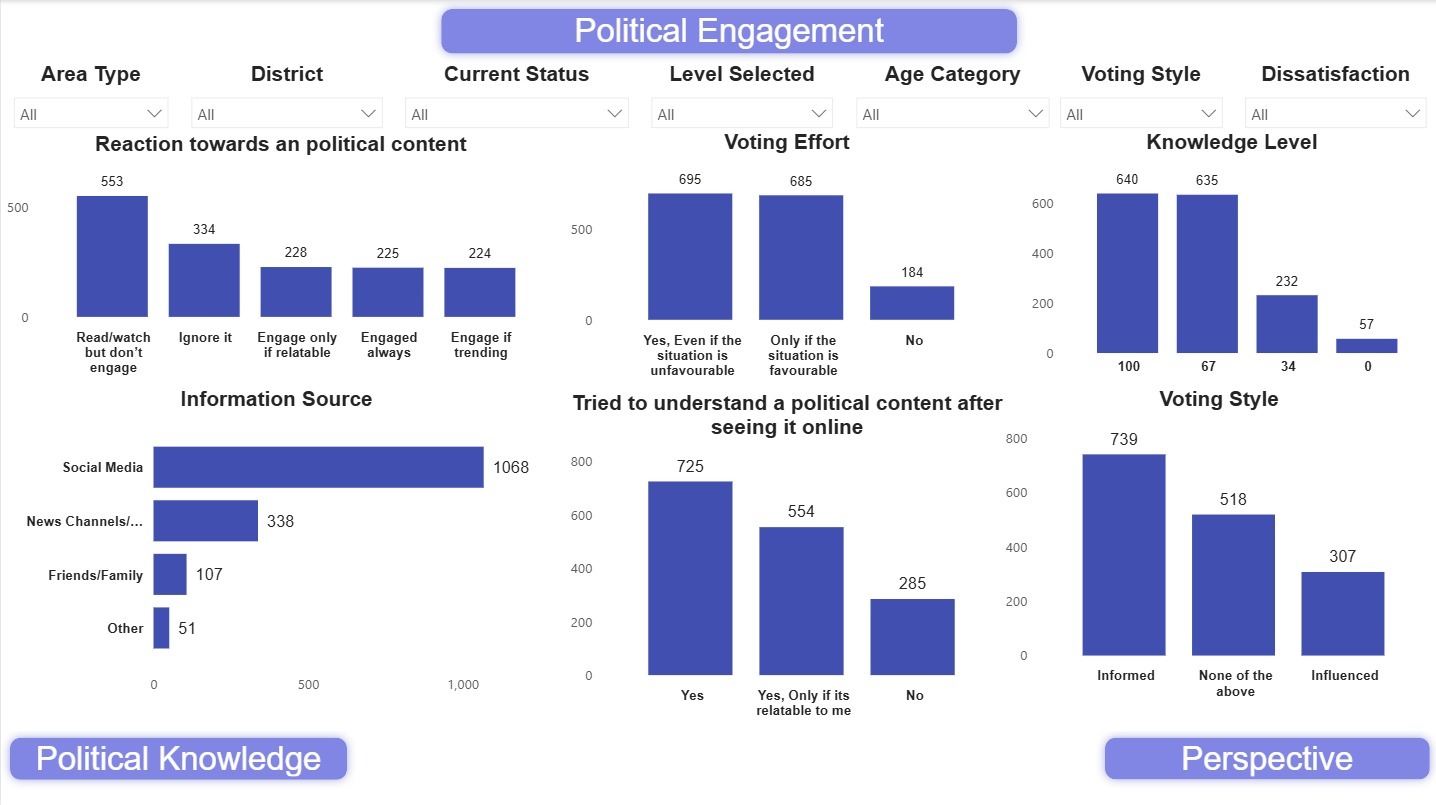
Education received the highest number of top-priority selections, followed by jobs and employment, and healthcare.
The recorded selections were:
Education: 485 top-priority selections
Jobs and employment: 428 top-priority selections
Healthcare: 349 top-priority selections
These findings placed education, employment opportunities and healthcare among the leading priorities reported by respondents.
The results suggest that practical concerns affecting everyday life, access to opportunities and future prospects were prominent within the surveyed group.
For the students, this part of the analysis helped translate individual survey responses into a clearer picture of the issues that respondents wanted the government to address.
It also demonstrated how survey analytics can be used to identify recurring priorities and organise them into findings that are easier to communicate and interpret.
Examining Dissatisfaction With the Current Government
Government satisfaction was another major component of the analysis.
Among the 1,524 respondents represented in this question's results, 1,132 reported that major problems existed in the current government, while 392 said they did not identify major problems.
This indicates substantial dissatisfaction within the surveyed group.
The team also examined a follow-up question shown only to respondents who identified problems with the current government. This distinction mattered because recognising problems with an existing administration does not necessarily mean that a respondent believes a change of government would resolve them.
The follow-up responses suggested that dissatisfaction with the present government should not automatically be interpreted as confidence in an alternative administration.
The analysis also identified poor leadership, corruption and lack of trust as prominent concerns among respondents who reported government problems.
Together, these findings highlighted governance, leadership and institutional trust as important themes in the surveyed group's political perspectives.
They also demonstrated why survey questions need to be interpreted in context. A response about dissatisfaction with the current government and a response about confidence in a potential alternative measure different things.
Turning Survey Responses Into Meaningful Findings
One of the central outcomes of the project was a more nuanced understanding of political engagement among Kerala's Gen Z.
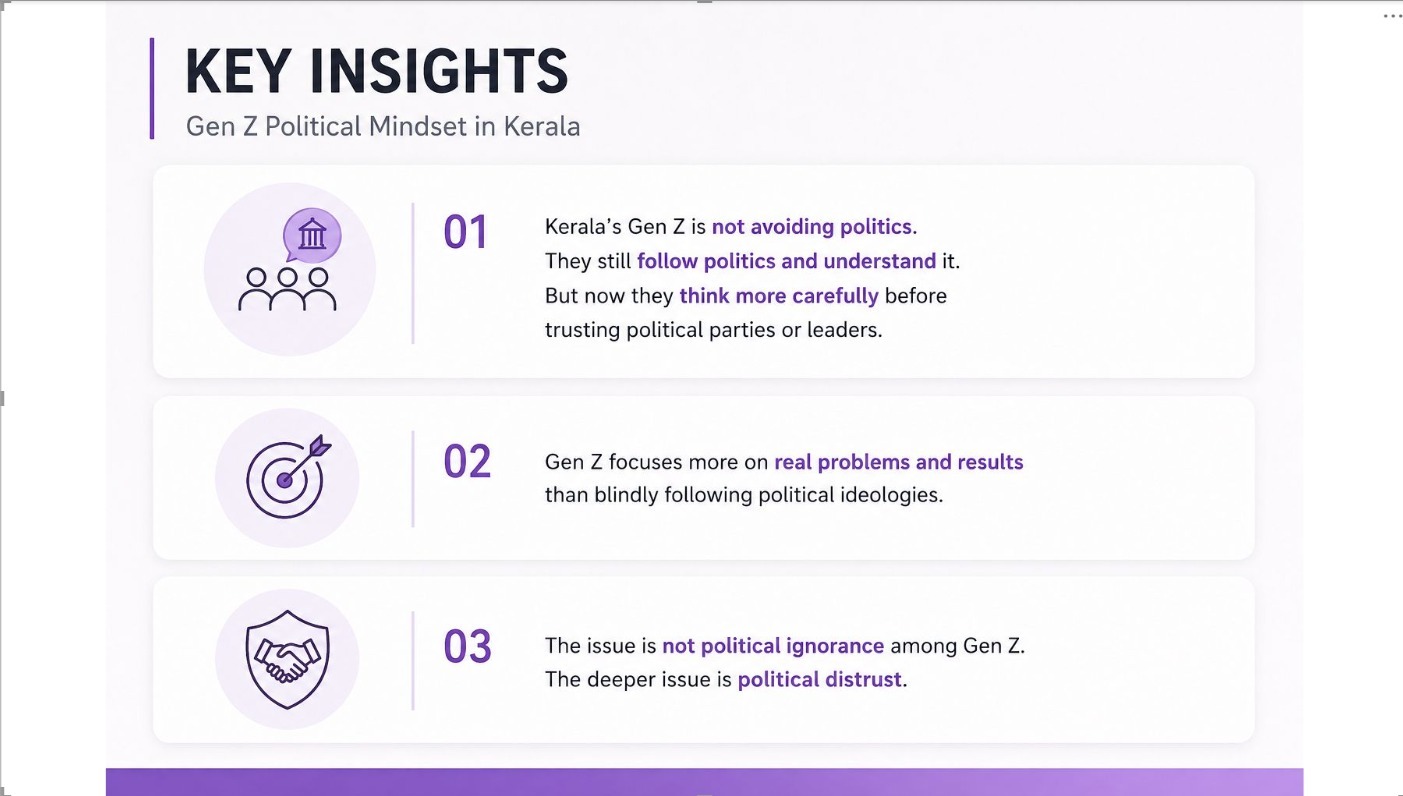
The findings did not support a simple conclusion that young people had completely withdrawn from politics. Instead, many respondents continued to encounter political information, while higher measured political knowledge was generally associated with stronger engagement.
Social media played a major role in information consumption, and respondents frequently reported priorities connected to education, employment and healthcare.
At the same time, dissatisfaction with governance, leadership, corruption and trust featured prominently in the responses.
The project also revealed the importance of distinguishing between political content consumption, public participation, political knowledge and voting behaviour. These aspects can be related without being interchangeable.
By bringing these findings together, the students developed a broader view of the political attitudes and behaviours reported by the respondents.
The results should be understood as findings from the surveyed group rather than as definitive conclusions about every member of Kerala's Gen Z. The extent to which they represent the wider population depends on factors such as the sampling method, respondent distribution and survey design.
What the Project Demonstrates
The Kerala Gen Z Political Awareness & Engagement Analysis project demonstrates how a survey analytics workflow can turn a broad research question into structured, interpretable findings.
The students worked through several stages, from defining research objectives and designing the questionnaire to validating responses, organising the dataset and interpreting patterns across multiple analytical categories.
The project also highlighted the importance of data quality. Screening more than 2,000 initial submissions and retaining 1,564 validated responses gave the team a defined dataset for its analysis.
More importantly, the project required the students to look beyond individual numbers and consider how different findings related to the original research question.
Political knowledge, online engagement, voting behaviour and government satisfaction each offered a different perspective. Analysing them together helped the team develop a more complete understanding of the responses.
The project also underlined the need to interpret data carefully. Relationships between variables do not necessarily establish cause and effect, and survey findings should not be generalised beyond what the research design supports.
These are important considerations when using data to understand public opinion and communicate evidence-based conclusions.
A Student Project Connecting Data With Real-World Questions
Through this project, HACA Tech School students explored how survey data can be organised and analysed to investigate a real-world question relevant to Kerala.
From refining survey questions and validating the dataset to identifying patterns in political knowledge, social media engagement, voting behaviour and governance concerns, the project brought together research and analytical thinking.
Its central finding was that political engagement among the surveyed respondents was more complex than a simple narrative of disengagement. The data pointed towards continued exposure to political content, practical policy priorities and substantial concerns about governance.
The students also identified transparency, accessible communication and practical civic learning as areas worth exploring further. These recommendations connected their findings to the wider question of how young people can better understand politics and public decision-making.
The project reflects the value of student-led analytical work in examining real-world questions, interpreting survey evidence and communicating findings in a structured and responsible way.
Watch the Project Presentation
The project presentation offers an opportunity to explore the Kerala Gen Z Political Awareness & Engagement Analysis and understand how HACA Tech School students approached the research question, collected responses, analysed the data and presented their findings.
Watch the project video to learn more about the study and its key insights.
YouTube Video: https://youtu.be/x8yEmF6d8Hs?si=K1TuMEflyIKQ_Ny7