

Learno: Making Learning Management Smarter with AI
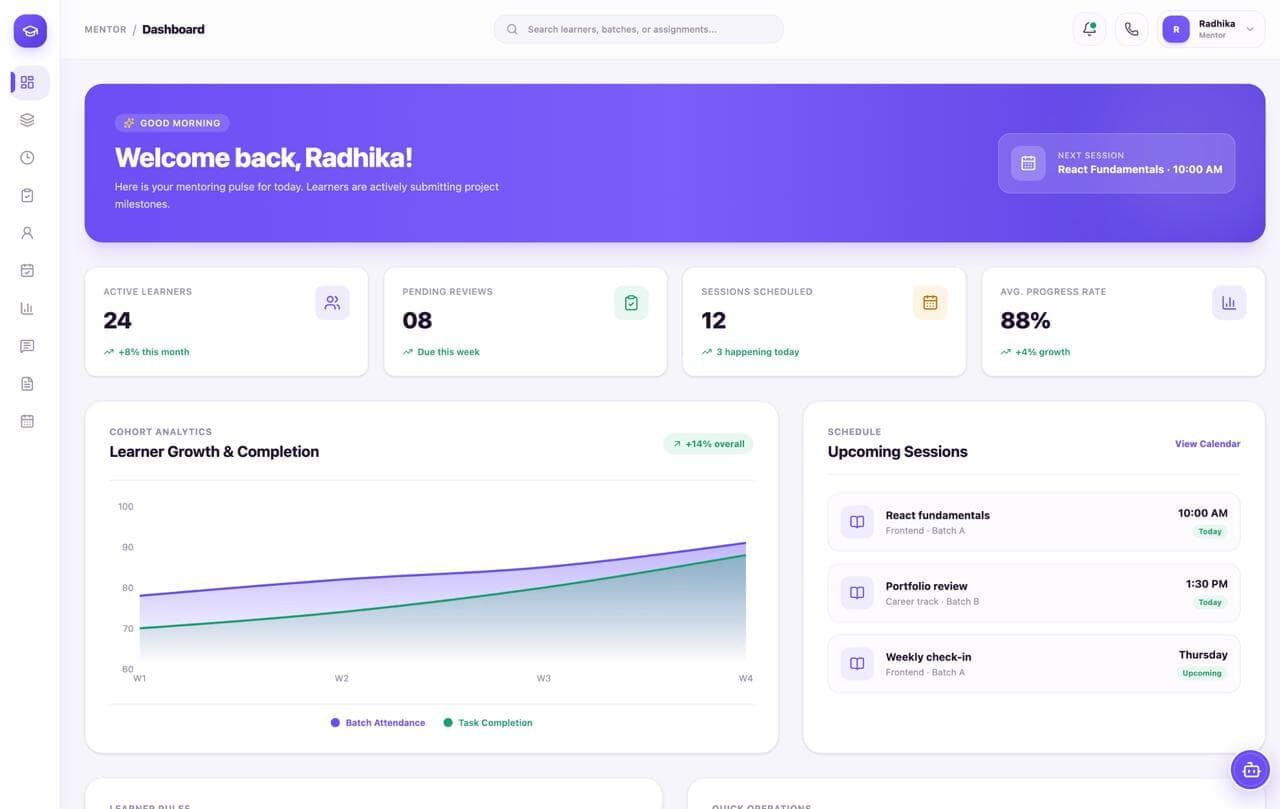
How can educational institutions manage student information, simplify academic activities and provide personalised learning assistance through a single platform?
The students of offline Python batch 07 (PY07) at HACA Tech School explored this through Learno, an AI-powered Learning Management System developed as part of their Full-Stack AI Engineer Program.
The project was developed collaboratively by Fijas Muhammed C P, Muhammed Alfaz, Subhana, Jithin Joseph and Sooraj. It focuses on building a centralised backend application that combines student management, administrative operations and AI-powered learning support.
Using Python and Django REST Framework, the team developed APIs to manage student profiles, mentors, batches, enrollments, attendance, assignments and academic results. They also integrated Generative AI features to support personalised learning, document-based question answering and automated leave communication.
Understanding the Challenges in Academic Management
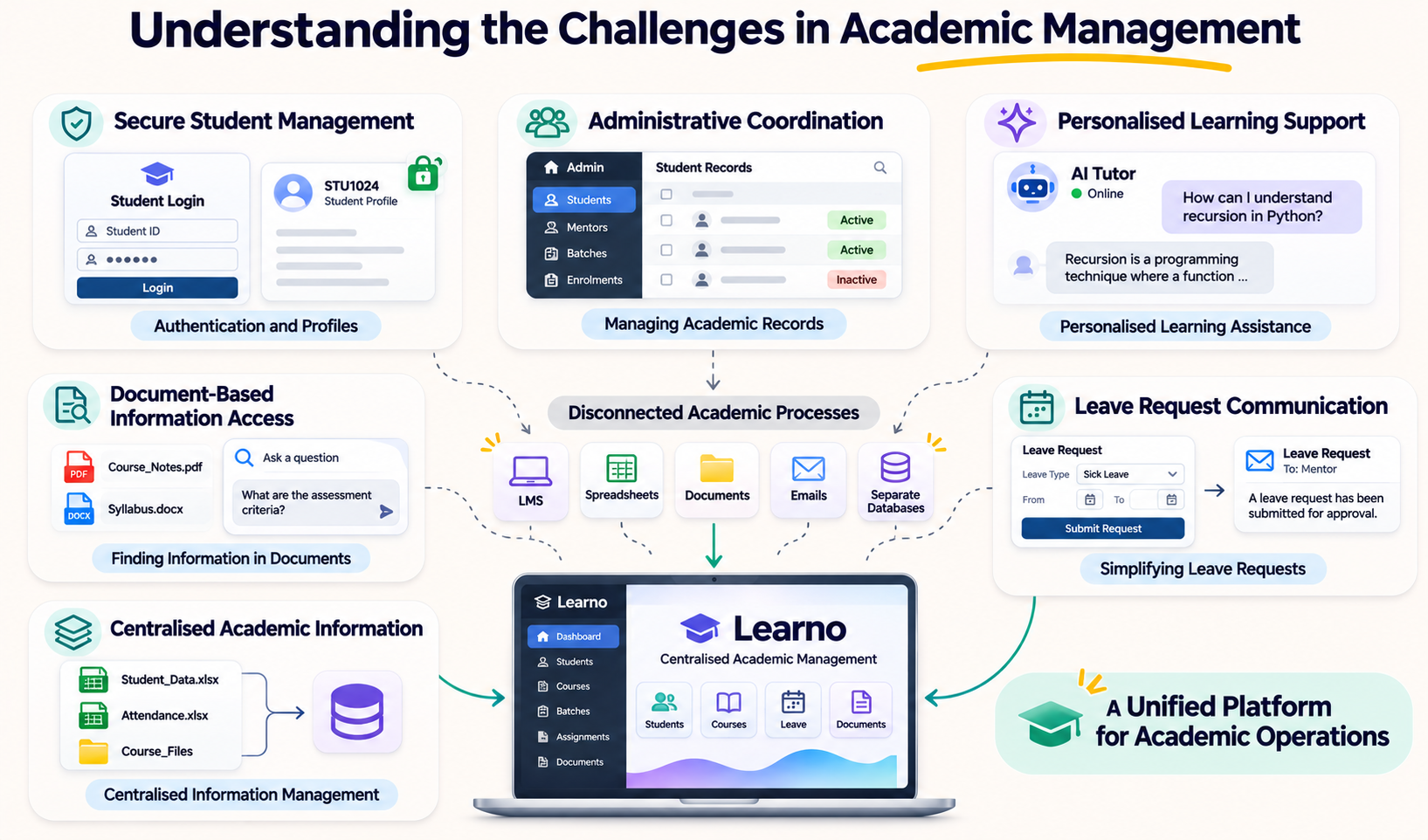
Educational institutions manage several activities, including student registration, batch allocation, attendance tracking, assignment management, leave requests and academic performance monitoring.
Handling these activities through separate systems can make information management and communication more complicated. Students may also find it difficult to access relevant academic information and personalised learning support.
The PY07 team identified several challenges their project needed to address:
How can student authentication and profile management be handled securely?
How can administrators manage students, mentors, batches and enrollments efficiently?
How can students access personalised learning assistance?
How can students find relevant information from uploaded academic documents?
How can leave-request communication be simplified?
How can academic information be stored and managed centrally?
These requirements helped the team establish the key functionalities of Learno.
Building Learno: An LMS with Eight Functional Components
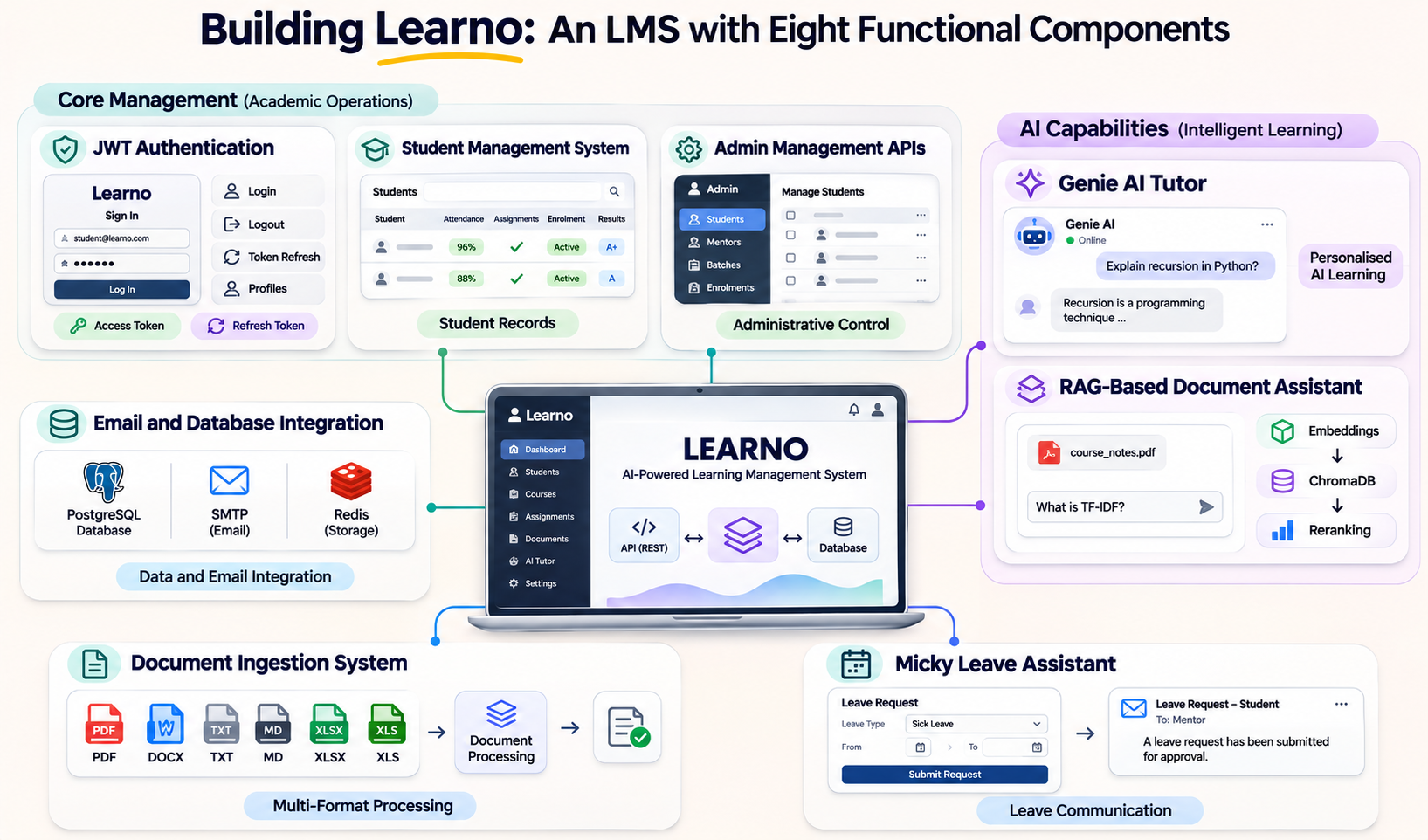
To address these requirements, the team developed a backend application using Django REST Framework. The system combines academic management APIs, authentication, document processing and AI-powered assistance through eight major components.
1. JWT Authentication
The team implemented JSON Web Token (JWT) authentication to manage secure user access. The authentication module supports login, logout, token refresh and profile management.
2. Student Management System
This module provides APIs to manage student profiles, course enrollments, attendance records, assignments and academic results. It helps organise essential student information within the platform.
3. Admin Management APIs
The administrative module allows authorised administrators to manage students, mentors, batches and enrollments through dedicated backend APIs.
4. Genie AI Tutor
Genie is a personalised AI learning assistant that uses authenticated student context to provide relevant academic support. This helps connect AI-generated assistance with individual student information.
5. RAG-Based Document Assistant
The document assistant uses Retrieval-Augmented Generation (RAG) to answer questions using uploaded academic documents. It combines embeddings, ChromaDB and reranking techniques to retrieve relevant information and generate context-based responses.
6. Micky Leave Assistant
Micky simplifies leave-request communication by generating email previews and supporting the submission of approved leave requests to mentors.
7. Document Ingestion System
The system supports document processing across multiple formats, including PDF, DOCX, TXT, Markdown, XLSX and XLS. These documents can be processed and used as knowledge sources for AI-powered information retrieval.
8. Email and Database Integration
Learno uses PostgreSQL to store student and academic information. SMTP integration supports leave-request email communication, while Redis provides optional session storage.
Exploring the AI Features of Learno
A key part of the project is its integration of Generative AI into academic activities. The team explored how AI could support students, improve access to information and simplify routine communication.
Some of the main AI capabilities include:
AI Feature | Functionality |
Personalised AI Tutoring | Provides learning assistance using authenticated student context |
Document-Based Question Answering | Retrieves relevant information from uploaded academic documents |
Intelligent Document Retrieval | Uses embeddings, ChromaDB and reranking to improve retrieval relevance |
Automated Leave Communication | Generates leave-request email previews and supports approved submissions |
Multi-Format Document Processing | Processes different document formats for AI-powered information retrieval |
These features demonstrate how Generative AI can be integrated into an LMS to support academic activities beyond traditional student management.
The Technology Stack Behind Learno
The team worked with Python backend development technologies, database systems and AI frameworks to develop the application.
Category | Technologies |
Programming Language | Python |
Backend Framework | Django |
API Development | Django REST Framework |
Database | PostgreSQL |
Authentication | Simple JWT |
Generative AI | Groq API |
AI Framework | LangChain |
Vector Database | ChromaDB |
Embeddings | Hugging Face |
Session Storage | Redis |
Email Integration | SMTP |
Putting Full-Stack AI Engineering Skills into Practice
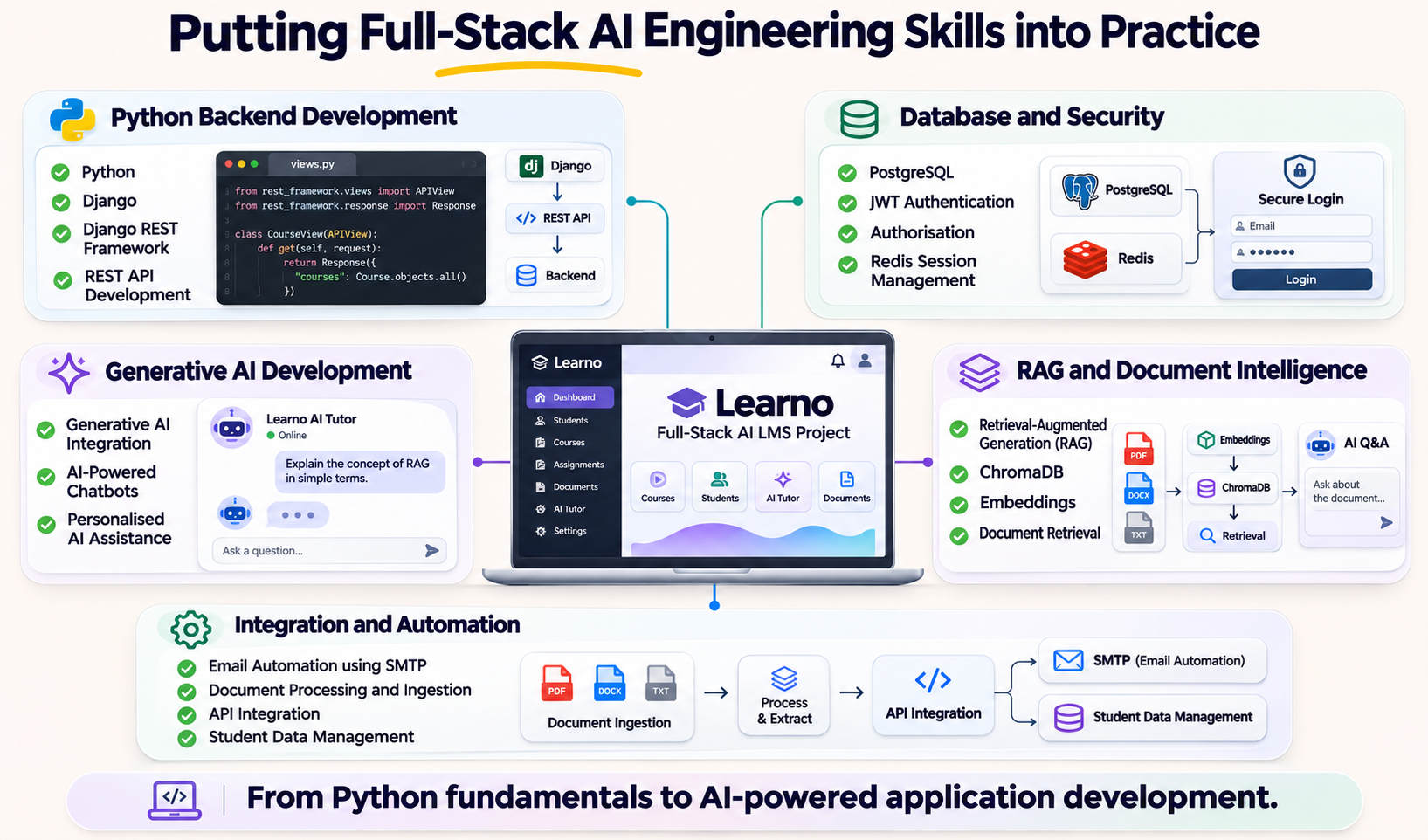
Through this collaborative project, the five students applied several concepts from Python development, backend engineering and Generative AI.
Some of the key skills demonstrated include:
Python programming and backend development
Django and Django REST Framework
REST API development and integration
JWT authentication and authorisation
PostgreSQL database management
Student and academic data management
Generative AI integration
Retrieval-Augmented Generation (RAG)
Vector database implementation using ChromaDB
Embeddings and document retrieval
AI-powered chatbot development
Document processing and ingestion
Email automation using SMTP
Redis-based session management
Working on Learno gave the team practical experience in integrating multiple technologies, developing backend APIs and applying AI concepts to an educational application.
Building Smarter Educational Solutions with AI
Learno brings together essential Learning Management System functionalities and AI-powered assistance in a unified backend application.
By combining secure authentication, student administration, academic management, document intelligence, personalised AI tutoring and automated leave communication, the Py07 team developed a solution that addresses practical requirements of educational institutions.
The project demonstrates how Python, Django REST Framework, Generative AI and Retrieval-Augmented Generation can be integrated to develop applications for the education sector.
Through this collaborative project, Fijas Muhammed C P, Muhammed Alfaz, Subhana, Jithin Joseph and Sooraj demonstrated their ability to develop RESTful APIs, integrate multiple technologies, manage databases and implement AI-powered functionalities.
The project reflects their practical understanding of backend development and their ability to apply modern AI technologies to build smarter educational solutions.
