A digital marketing strategy for a small business in the UAE should connect your business goal, target customer, marketing channels, budget and conversion process. Instead of trying every platform, start with the channels that can reach your customers and support a measurable business outcome. For many UAE businesses, that means combining a strong website with SEO, local search, paid advertising, social media and a clear lead-generation process.
The UAE is also actively building its digital economy. The UAE Digital Economy Strategy aims to increase the digital economy's contribution, while Dubai's Economic Agenda D33 includes digital transformation and initiatives supporting the growth of SMEs.
For a small business owner, however, the question is more practical:
Which digital channels should the business use, what should come first, how much should it invest, and how can it tell whether the money is producing results?
This guide breaks down that decision-making process for businesses operating in Dubai and other parts of the UAE.
What Should a Small Business in the UAE Do First With Digital Marketing?
A small business should first build a measurable digital foundation before spreading its budget across multiple channels.
Start with these five areas:
Define one primary business goal.
Identify the customers you want to reach.
Make the website and conversion path clear.
Choose two or three channels based on customer behaviour.
Set up measurement before increasing your spending.
This order matters.
A business can publish on Instagram every day and run Google Ads at the same time, but if nobody knows which activity produces enquiries, the marketing budget becomes difficult to manage.
A strategy is therefore not a list of platforms. It is a set of decisions about where to compete, what to say, how customers can respond and how results will be measured.
Why Is Digital Marketing Different for Small Businesses in the UAE?
A small business may be targeting customers in Dubai, Abu Dhabi, Sharjah or another emirate. It may serve residents, tourists, businesses or a combination of audiences. Language, location, industry and purchasing behaviour can also influence the marketing approach.
Dubai's D33 agenda specifically identifies SMEs, digital transformation and the growth of the private sector as parts of its wider economic objectives.
That creates an important strategic point: A UAE digital marketing strategy should be specific to the business, location and customer rather than copying a generic international marketing plan.
For example, a Dubai-based salon, a B2B consultancy in Abu Dhabi and an e-commerce business serving the whole UAE may all use Instagram, Google and SEO, but they should not use them in the same way.
How Do You Set Digital Marketing Goals for a UAE Small Business?
Start with the business outcome, not the marketing platform. A goal such as "increase Instagram followers" does not tell you whether the business is growing.
A more useful goal could be:
Generate more qualified enquiries
Increase online bookings
Increase e-commerce sales
Generate B2B leads
Increase calls from local customers
Improve organic search visibility
Increase repeat purchases
The goal determines the marketing activity.
For example:
Business goal | Possible digital focus |
Local enquiries | Local SEO + Google Business Profile |
Immediate search leads | Google Ads |
Long-term organic visibility | SEO + content |
Product discovery | Social media + paid social |
B2B enquiries | SEO + LinkedIn + Google Ads |
Online sales | SEO + paid media + conversion optimisation |
Repeat purchases | Email + WhatsApp + remarketing |
This prevents a common small-business problem: choosing a channel before deciding what that channel needs to achieve.
How Should a Small Business Identify Its Target Customer in the UAE?
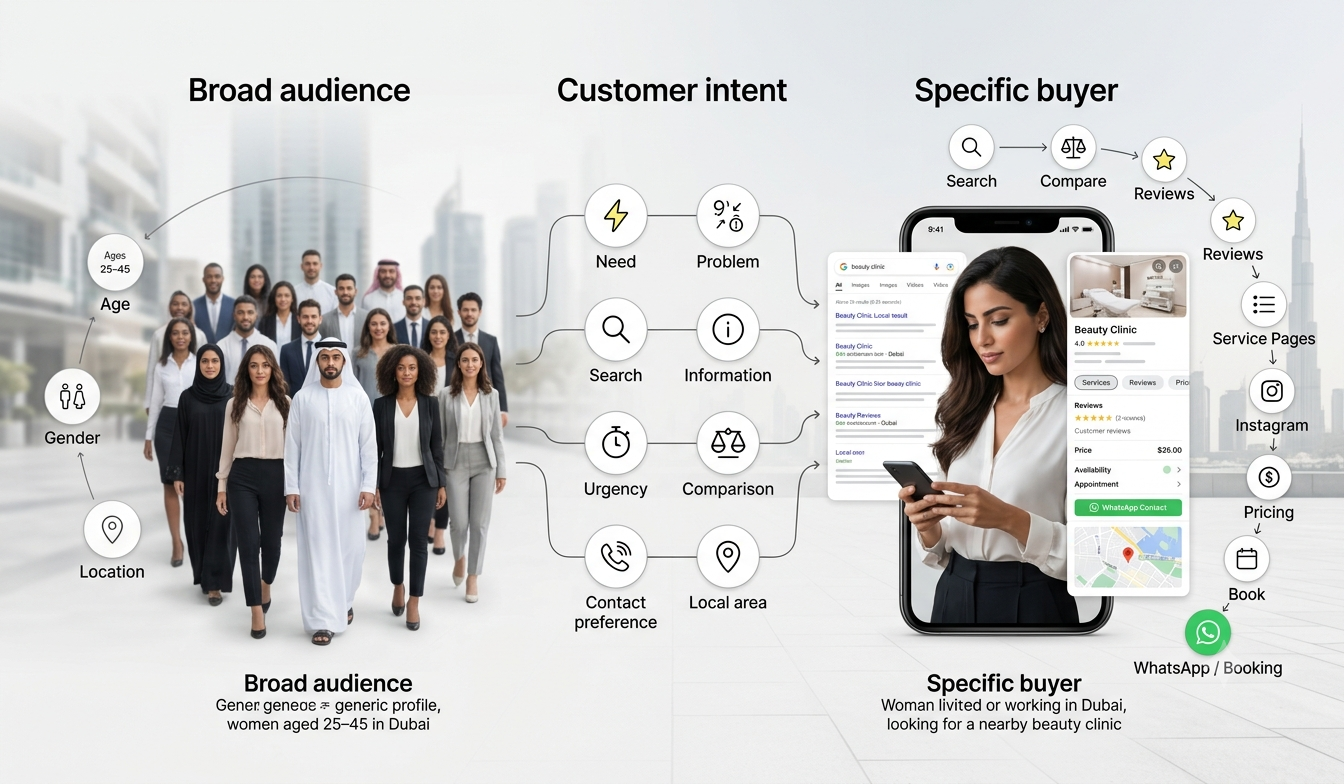
Your target customer should be defined by the problem they have and the buying situation, not just by age or location.
Consider:
What does the customer need?
What problem are they trying to solve?
Where do they search for solutions?
What information do they need before buying?
How urgent is the purchase?
What makes them compare businesses?
Do they prefer calls, forms, WhatsApp or online purchases?
Which emirate or local area does the business serve?
For example, "women aged 25-45 in Dubai" is still broad.
A more useful profile could be:
“Women living or working in Dubai who are looking for a nearby beauty clinic and compare services, reviews, prices and availability before booking.”
That profile immediately gives the marketing strategy more direction. It suggests local search, reviews, service pages, Instagram content, clear pricing information and an easy booking or WhatsApp route.
How Should You Map the UAE Customer Journey?
A customer does not always see an advertisement and buy immediately.
Different channels can support different stages. Understanding the sales funnel in digital marketing helps businesses connect awareness, consideration and conversion instead of treating each channel separately.
Stage | Customer behaviour | Useful digital activity |
Discovery | Finds a business or solution | SEO, social media, video |
Research | Compares options | Website, blogs, reviews |
Consideration | Evaluates the offer | Service pages, Google Ads, case studies |
Conversion | Takes action | Forms, calls, WhatsApp, bookings |
Retention | Returns or recommends | Email, WhatsApp, social content |
This is why traffic should not be the only objective. A website can receive visitors without generating meaningful business results if the offer, trust signals or conversion path are weak.
What Website Foundation Does a UAE Small Business Need?
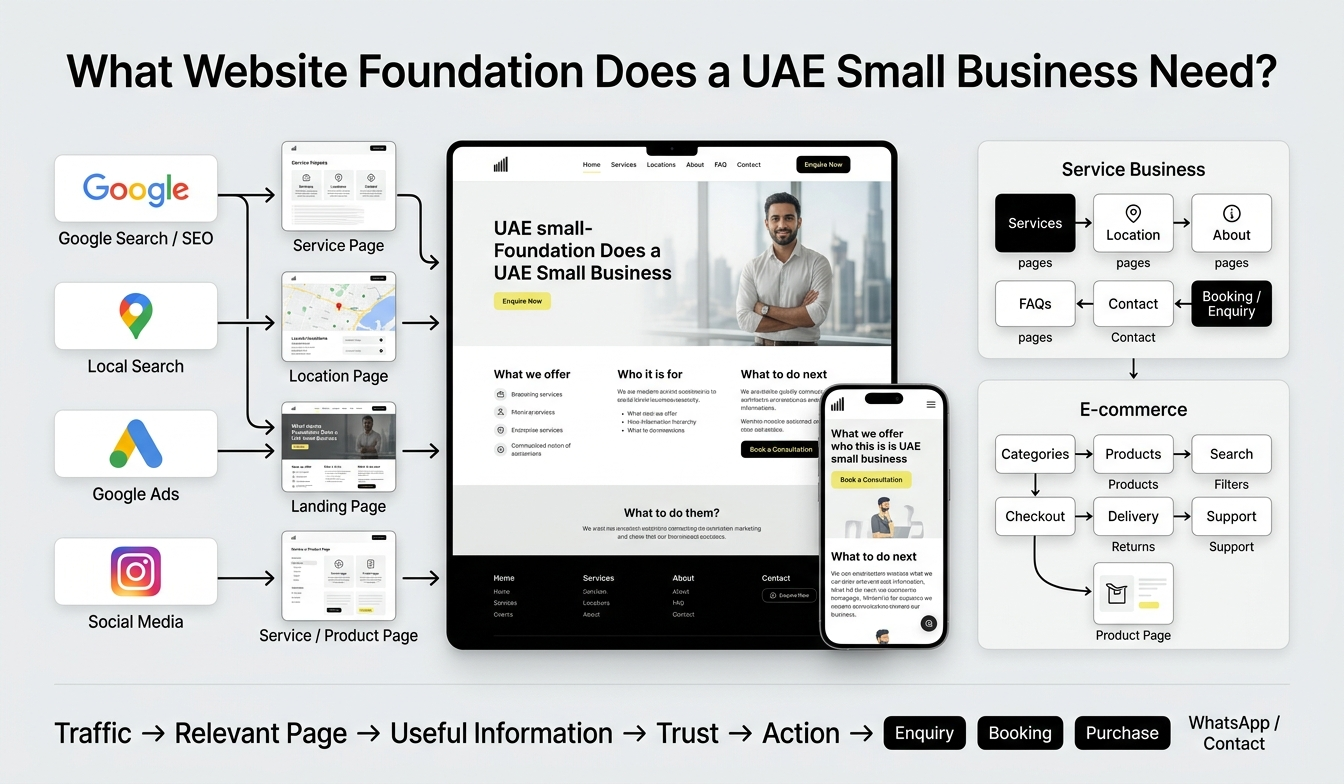
Your website should answer three questions quickly:
What does the business offer?
Who is it for?
What should the visitor do next?
A service business may need:
Homepage
Service pages
Location pages
About page
Contact page
Enquiry or booking forms
FAQ sections
Blog or resource content
An e-commerce business may need:
Category pages
Product pages
Search
Product filters
Checkout
Delivery information
Returns information
Customer support
The important point is that the website should support the rest of the marketing system.
SEO traffic, Google Ads clicks and social media visitors should not all land on the same generic homepage when a more relevant page exists.
Should UAE Small Businesses Invest in SEO?
Yes, when customers search for the products, services or information the business provides. SEO helps a business build visibility for relevant searches without paying for every individual click.
A small-business SEO strategy can include:
Keyword research
Search-intent mapping
On-page SEO
Technical SEO
Internal linking
Helpful content
Local SEO
Digital PR and relevant links
Performance measurement
The key is to connect SEO with commercial pages.
For example, a Dubai interior design business could create content around customer questions while also strengthening its service and location pages.
When Should a Small Business in Dubai Use Local SEO?
A business that serves customers at a physical location or within a defined service area should consider local SEO early.
Google states that eligible businesses can manage how they appear on Google Search and Maps through a Business Profile. Businesses can add information such as hours, phone number, website, location, photos and other details, and can respond to customer reviews.
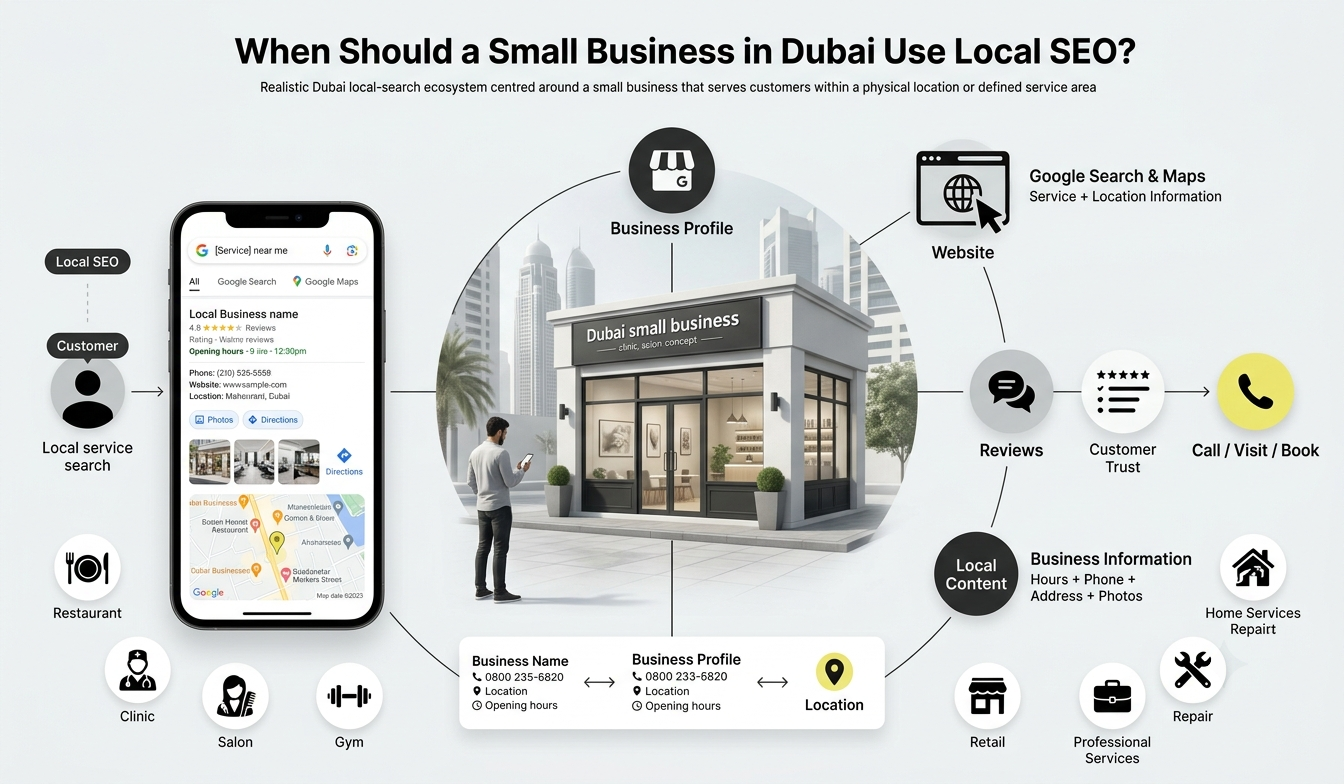
That makes local search particularly relevant to businesses such as:
Restaurants
Clinics
Salons
Gyms
Training institutes
Home-service providers
Retail stores
Professional services
Local repair businesses
The strategy should go beyond simply creating a profile.
The website, Business Profile, reviews, location information and local content should all give customers consistent information.
Google also notes that information shown in local results can come from multiple sources, including information supplied by businesses and other sources.
For more detail, see HACA's Google Business Profile complete guide and how to promote your business locally.
Which Social Media Platforms Should a UAE Small Business Use?
Choose social platforms based on customer behaviour and content format, not popularity alone.
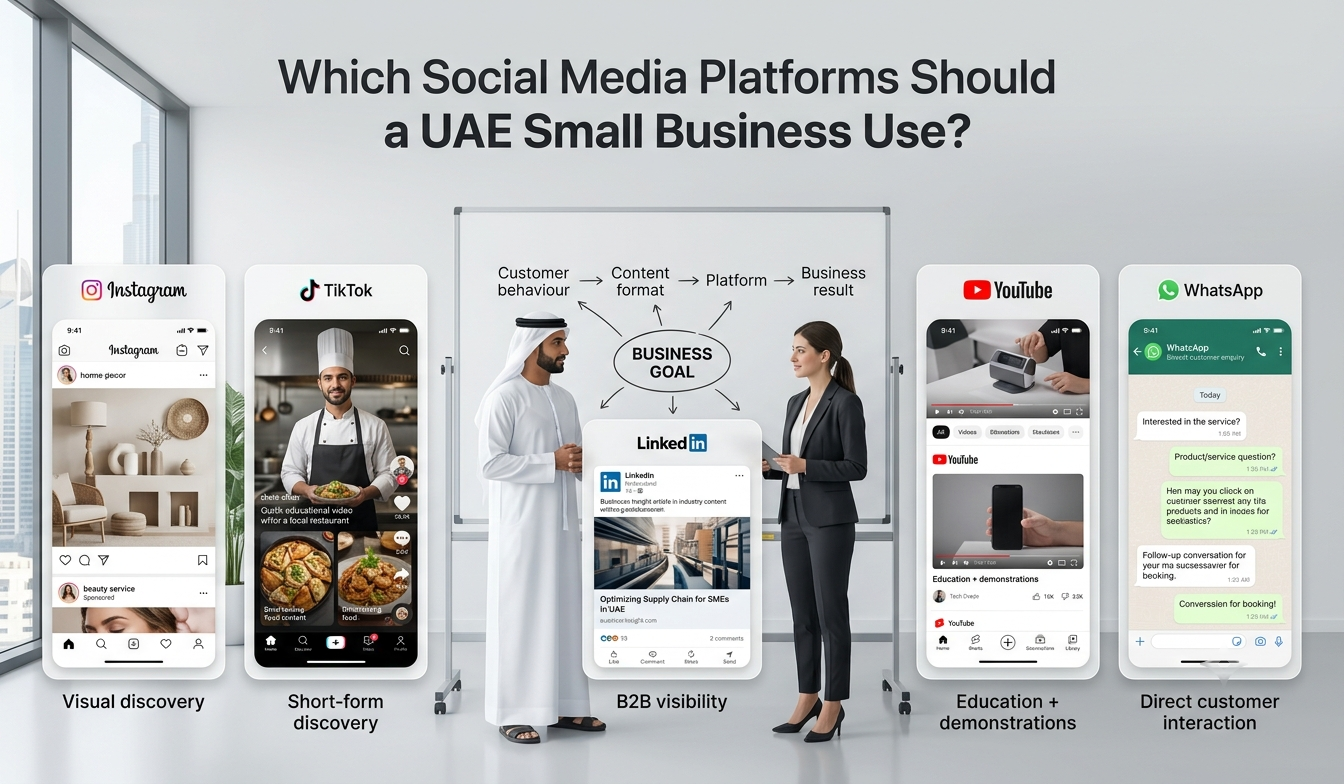
For example:
Instagram can support visual discovery and product/service presentation.
TikTok can support short-form discovery and educational or entertaining content.
LinkedIn can support B2B visibility and professional audiences.
YouTube can support demonstrations, education and longer-form content.
WhatsApp can support enquiries and customer communication.
A small business does not need to maintain every platform. A better approach is to choose one or two priority platforms, establish a repeatable content system and measure whether they contribute to the business goal.
If you need a more detailed framework, see HACA's social media strategy guide
When Should a Small Business Use Google Ads?
Google Ads can be useful when potential customers are already searching for a product or service and the business wants paid visibility.
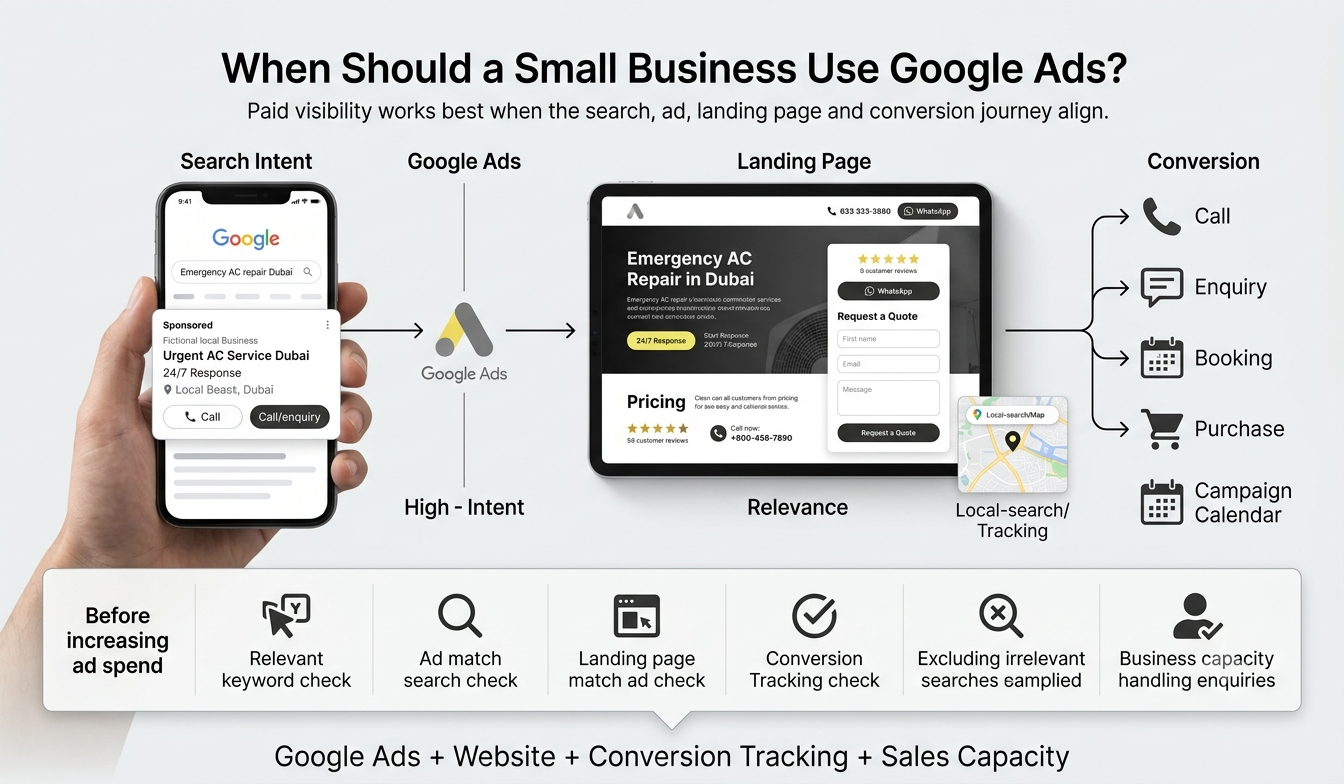
It can support:
Service enquiries
Calls
Bookings
Product sales
Local searches
Time-sensitive campaigns
But Google Ads should not be treated as a substitute for the rest of the marketing system.
Before increasing ad spend, check:
Are the keywords relevant?
Does the ad match the search?
Does the landing page match the ad?
Is conversion tracking working?
Are irrelevant searches being excluded?
Can the business handle the incoming enquiries?
How Can a Small Business Generate Leads Online in the UAE?
A lead-generation system should give visitors a clear reason and easy way to contact the business.
Depending on the business, this could be:
WhatsApp
Phone calls
Enquiry forms
Quote requests
Consultation bookings
Product purchases
Appointment forms
The important part is the connection between traffic and conversion.
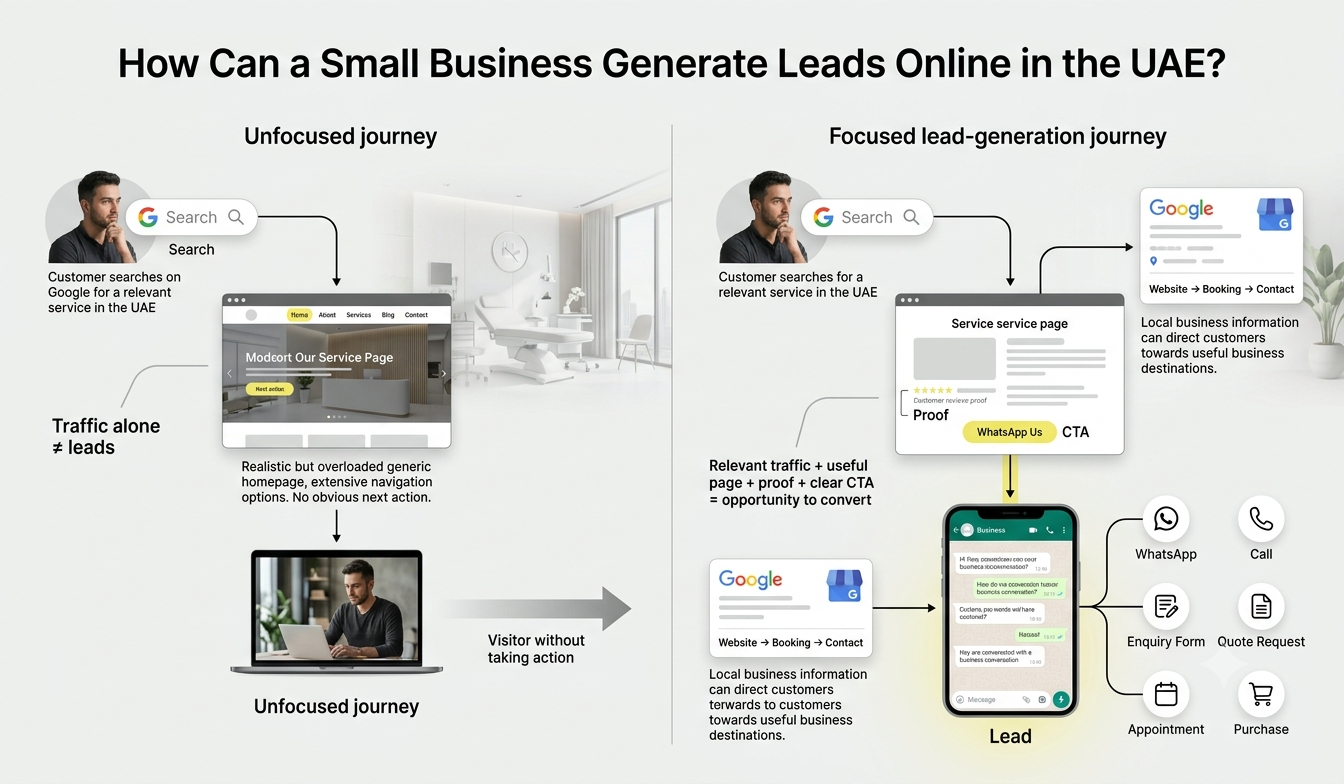
For example:
Google search → service page → proof → clear CTA → WhatsApp enquiry
is more useful than:
Google search → homepage → visitor searches around → leaves
Google's Business Profile guidance also highlights the ability to direct customers to websites, booking links and other business destinations.
How Much Should a Small Business in the UAE Spend on Digital Marketing?
There is no universal AED amount that every UAE small business should spend. A useful starting point is to work backwards from the economics of the business.
For example:
Target customers × conversion rate × average customer value can help establish what acquisition activity can reasonably support.
Suppose a business wants 20 additional customers.
If its website converts qualified visitors at 5%, it needs roughly 400 qualified visits to generate 20 conversions, assuming the traffic is relevant and the conversion rate is stable.
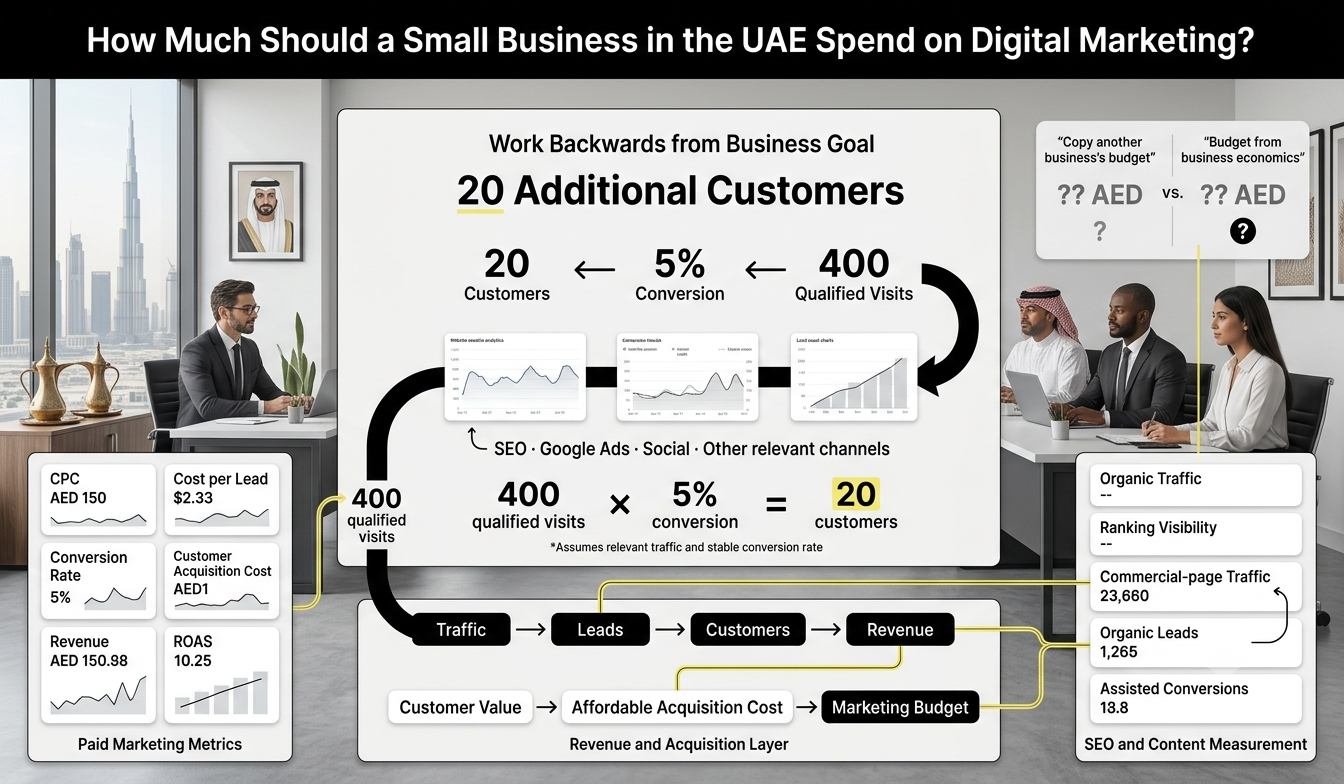
The calculation then becomes:
Traffic → leads → customers → revenue
This is more useful than choosing a budget simply because another business spends a particular amount.
For paid channels, track metrics such as:
Cost per click
Cost per lead
Conversion rate
Customer acquisition cost
Revenue generated
Return on ad spend where appropriate
For SEO and content, also consider:
Organic traffic
Ranking visibility
Commercial-page traffic
Leads from organic search
Assisted conversions
What UAE-Specific Factors Should a Small Business Include in Its Strategy?
A UAE strategy can become more relevant when it accounts for the market rather than simply adding "Dubai" to keywords.
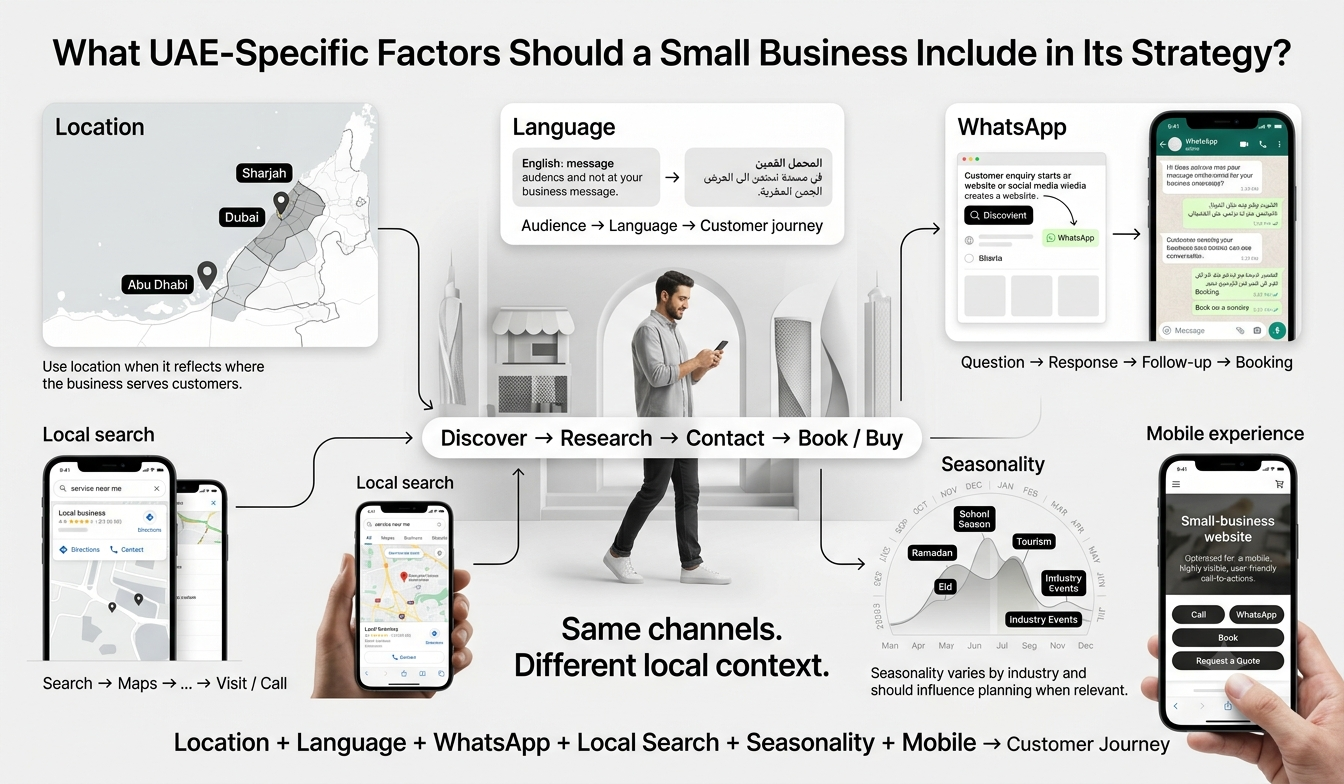
Consider:
Location
Dubai, Abu Dhabi and Sharjah can have different competitive landscapes and customer patterns. Use location only when it reflects the actual service area.
Language
Depending on the audience, businesses may need to consider English and Arabic content, search behaviour and customer communication.
Do not automatically translate everything. Identify which audiences and customer journeys require each language.
For businesses that already receive enquiries through messaging, WhatsApp can form part of the conversion and follow-up process.
Local search
Businesses serving customers in person or within a service area should consider Google Maps and local search visibility.
Seasonality
Marketing plans may need to account for periods such as Ramadan, Eid, school seasons, tourism cycles and other industry-specific demand patterns.
Mobile experience
A customer who discovers a business through search or social media may visit its website on a phone. Important actions such as calling, messaging, booking or requesting a quote should therefore be easy to complete on mobile.
What Digital Marketing Metrics Should a UAE Small Business Track?
Track metrics that connect marketing activity with business outcomes.
Objective | Metrics to monitor |
Search visibility | Impressions, rankings, organic clicks |
Website traffic | Users, sessions, landing pages |
Lead generation | Leads, qualified leads, conversion rate |
Paid advertising | CPC, CTR, cost per lead, conversions |
Sales | Revenue, conversion rate, customer acquisition cost |
Local visibility | Profile interactions, calls, website visits, direction requests |
Social media | Reach, engagement, clicks, enquiries |
Avoid treating follower count, impressions or website traffic as the final measure of success.
Those numbers can help diagnose performance, but a business ultimately needs to know whether digital activity contributes to qualified enquiries, customers or revenue.
What Should a 90-Day Digital Marketing Plan for a UAE Small Business Look Like?
Instead of launching every channel at once, build the system in stages.
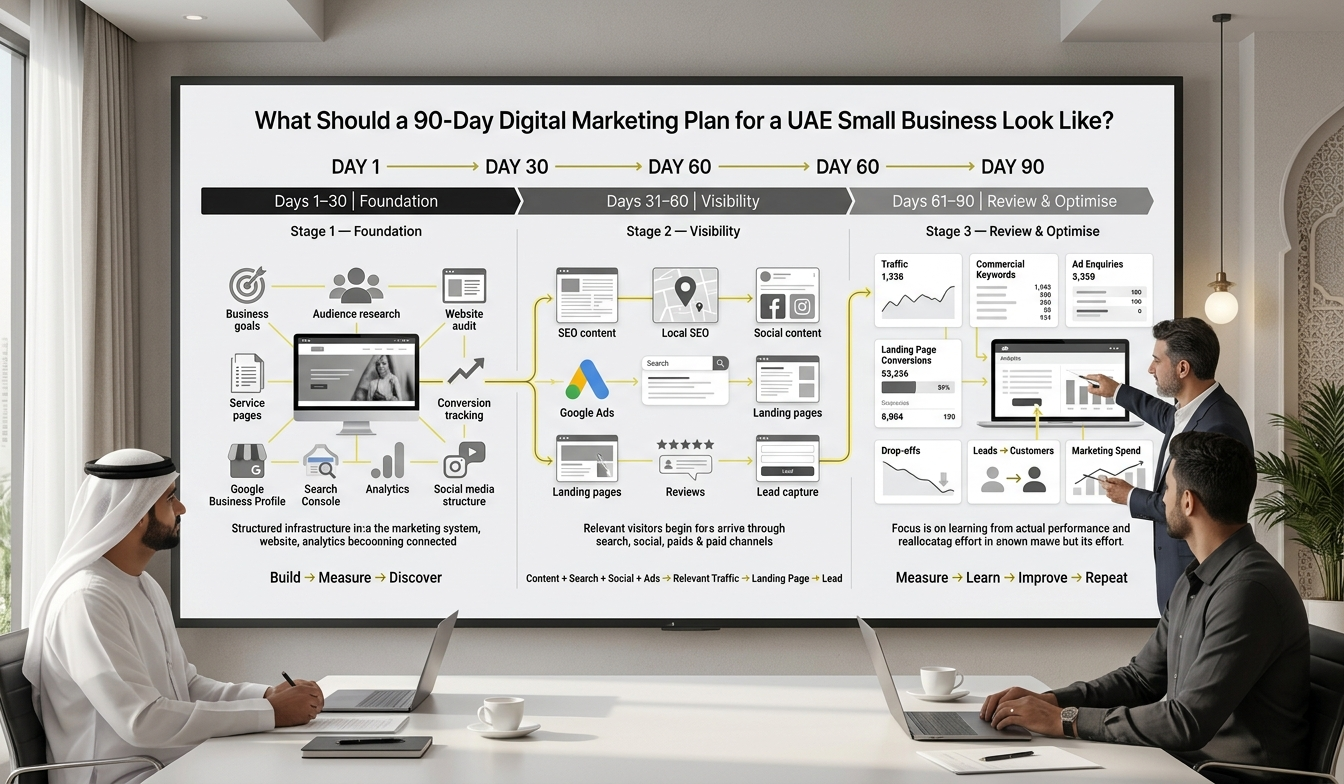
Days 1–30: Build the foundation
Focus on:
Business goals
Audience research
Website audit
Service pages
Conversion tracking
Google Business Profile where eligible
Search Console and analytics setup
Basic social media structure
The goal is to make the business measurable and discoverable.
Days 31–60: Build visibility
Start developing:
SEO content
Local SEO
Social content
Google Ads where appropriate
Landing pages
Review generation
Lead capture
At this stage, the focus is on creating relevant traffic and giving visitors a clear conversion path.
Days 61–90: Review and optimise
Look at:
Which channels produce relevant traffic?
Which keywords attract commercial visitors?
Which ads generate enquiries?
Which landing pages convert?
Where do visitors leave?
Which leads become customers?
Which activities consume budget without producing useful results?
Then adjust the strategy.
“Do not add another channel simply because it is trending. Add it when the existing system gives you a reason to expand.”
What Are the Most Common Digital Marketing Mistakes for Small Businesses?
Several problems repeatedly make digital marketing less effective.
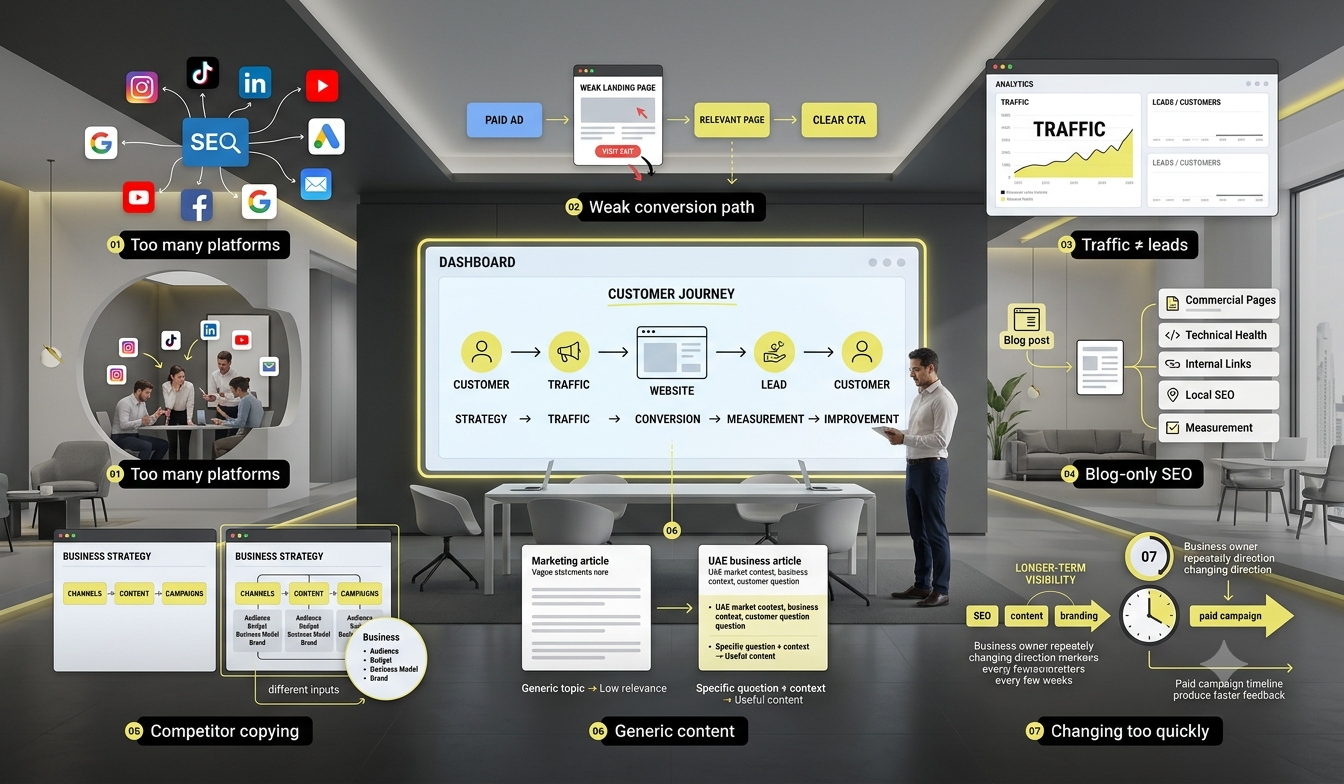
Using every platform
A small team can quickly become overwhelmed by Instagram, TikTok, LinkedIn, YouTube, Google Ads, SEO, email and more. Choose based on customer behaviour.
Running ads before fixing the conversion path
More traffic does not solve a weak website or unclear offer.
Measuring traffic without measuring leads
Traffic is useful only when it helps the business achieve its objective.
Treating SEO as only blog writing
Commercial pages, technical health, internal links, local visibility and measurement also matter.
Copying competitor strategies
A competitor's channel mix may work because of its audience, budget, brand recognition or business model.
Publishing generic content
A UAE small business does not need another article saying that social media is "important". Useful content answers a specific customer question in the context of the business and market.
Changing direction too quickly
SEO, content and brand visibility can take time. Paid campaigns can produce data faster, but that does not mean every campaign should be judged only by immediate sales.
How Can a Small Business Know Which Digital Channel to Prioritise?
Use this simple decision framework:
If the business needs... | Consider prioritising... |
Local enquiries | Local SEO + Google Business Profile |
Existing search demand | SEO + Google Ads |
Immediate paid visibility | Google Ads |
Visual product discovery | Instagram + TikTok |
B2B visibility | SEO + LinkedIn + Google Ads |
Long-term organic growth | SEO + content |
More enquiries from existing traffic | Landing pages + conversion optimisation |
Better follow-up | WhatsApp + email automation |
The right choice depends on where the customers are, what they search for, how they buy and what the business can measure.
How Does a Digital Marketing Course Help Business Owners and Teams?
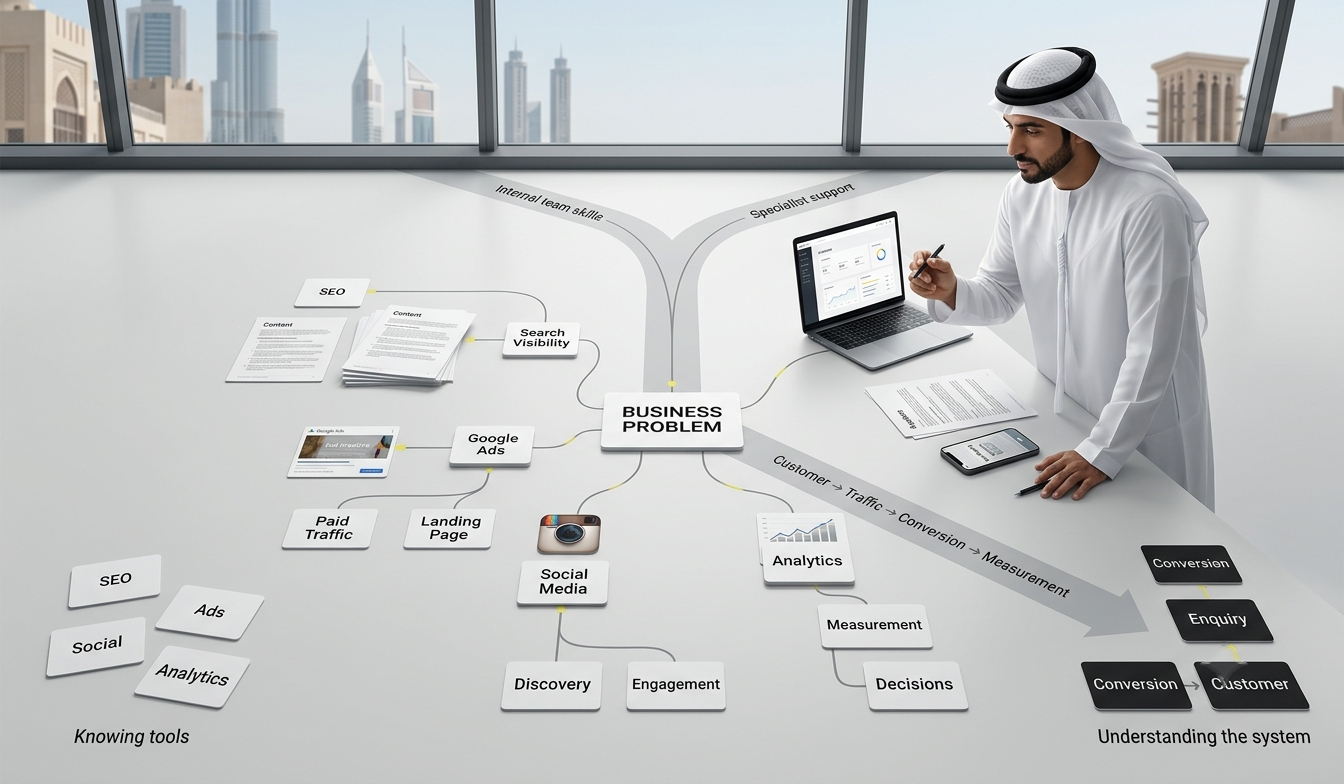
Building a strategy also requires people who understand how the channels connect.
A business owner may manage basic social media or Google Business Profile activity internally. More complex SEO, paid advertising, analytics, content strategy and conversion work may require trained team members or specialist support.
For businesses that want to develop those skills internally, HACA's Digital Marketing Course in Dubai provides a relevant commercial pathway from this topic.
The purpose of learning digital marketing is not simply to know what SEO, Google Ads or social media means. It is to understand how these channels work together to solve a business problem.
A Simple Digital Marketing Strategy Template for UAE Small Businesses
Before launching your next campaign, document these nine points:
Question | Your answer |
What is the business goal? | |
Who is the target customer? | |
Which emirate or areas do you serve? | |
What problem does your offer solve? | |
Which channels reach your audience? | |
What content does the customer need? | |
What action should the customer take? | |
What is the available budget? | |
Which metrics determine success? |
If you cannot answer these questions, adding another marketing channel is unlikely to solve the underlying problem.
Final Takeaway
A digital marketing strategy for a small business in the UAE should not start with Instagram, Google Ads or SEO.
It should start with the business goal and customer.
From there, build the website and conversion path, choose the channels that match customer behaviour, create useful content, establish local visibility where relevant, generate leads and measure what happens.
The UAE's wider digital-economy direction creates a strong environment for businesses investing in digital capabilities, but the practical advantage comes from making those capabilities work together.
For a small business, the objective is not to do more digital marketing. It is to make each marketing activity support the next step in the customer journey.
Start with the foundation, measure the results, and expand only when the data gives you a reason to.