Have you ever wondered why some web pages consistently rank at the top of Google while others struggle to gain visibility even when they cover the same topic? One of the most overlooked reasons is Header Tag Optimization.
What Is Header Tag Optimization?
Header Tag Optimization is the process of structuring H1, H2, H3, and other heading tags to improve content organization, user experience, accessibility, and search engine understanding. Proper heading hierarchy helps Google interpret page topics, improves semantic relevance, and increases the chances of appearing in Featured Snippets and AI Overviews.
Header tags are far more than just larger or bold text. They create a logical structure for your content, helping both search engines and readers understand what your page is about. When used correctly, heading tags improve readability, enhance user experience, strengthen semantic relevance, and make your content easier for Google and AI-powered search systems to interpret.
In 2026, search engines rely on advanced Natural Language Processing (NLP), entity recognition, and contextual understanding rather than simple keyword matching. A well-structured heading hierarchy allows Google to identify the relationships between topics, making your content more likely to appear in Featured Snippets, AI Overviews, and traditional search results.
A properly optimized page generally follows this structure:
H1: Main topic of the page
H2: Major sections
H3: Subsections supporting each H2
H4–H6: Additional levels of detail when necessary
This hierarchy makes it easier for readers to scan content and
In this comprehensive guide, you'll learn:
What header tags are and how they work
The difference between H1, H2, H3, H4, H5, and H6 tags
Why header tags matter for SEO
How Google interprets heading structures
Best practices for optimizing H1, H2, and H3 tags
Common heading mistakes to avoid
How to optimize headings for Semantic SEO, AI Overviews, and Featured Snippets
A practical checklist you can apply to every webpage
Let's begin by understanding the basics.
Why Is Header Tag Optimization Important?
Optimized headings help:
Improve content organization
Increase readability
Strengthen semantic relevance
Help search engines understand page topics
Support accessibility for screen readers
Increase the likelihood of appearing in Featured Snippets
Enhance AI Overview visibility
Improve user engagement and time on page
Simply adding keywords to headings isn't enough. Effective header tag optimization focuses on clarity, logical structure, and relevance.
What Are HTML Heading Tags?
HTML heading tags are structural elements that define the hierarchy of information on a webpage. They range from H1 to H6, with H1 representing the most important heading and H6 the least important.
Understanding HTML heading tags is also an important part of technical SEO because proper HTML structure helps search engines and assistive technologies interpret webpage content.
Each heading level has a specific purpose in organizing content.
H1 Tag
The H1 tag is the primary heading of your page. It tells readers and search engines the main topic.
Every webpage should ideally have one clear H1 that accurately describes the content.
Example:
H1: Header Tag Optimization: Complete SEO Guide
H2 Tag
H2 tags divide your article into major sections.
Examples:
What Is Header Tag Optimization?
Why Header Tags Matter
Best Practices for H1 Tags
Each H2 introduces a significant topic related to the main subject.
H3 Tag
H3 tags break H2 sections into smaller, more detailed discussions.
Example:
H2: H1 Tag Optimization
H3: Include Your Primary Keyword
H3: Keep the Heading Natural
H3: Ideal H1 Length
H4 to H6 Tags
These headings provide additional levels of organization when covering complex topics.
Most blog posts rarely need headings beyond H4 unless they contain technical documentation, research papers, or extensive tutorials.
Understanding Heading Hierarchy
Heading hierarchy is one of the most important aspects of on-page SEO
Imagine reading a book where Chapter 1 is immediately followed by Subsection 1.3 without any chapter headings. It would be confusing for readers.
The same principle applies to webpages.
A logical hierarchy should look like this:
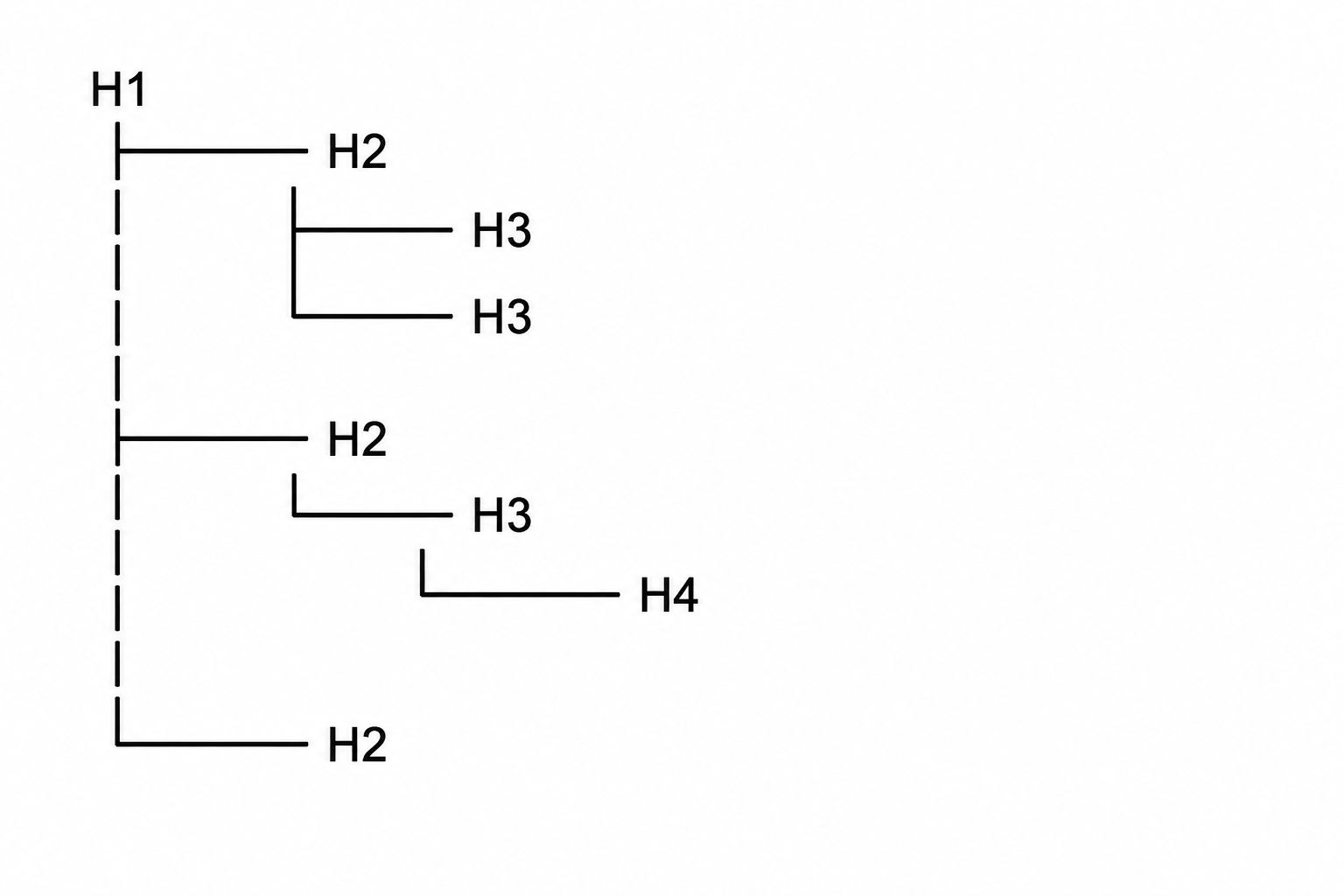
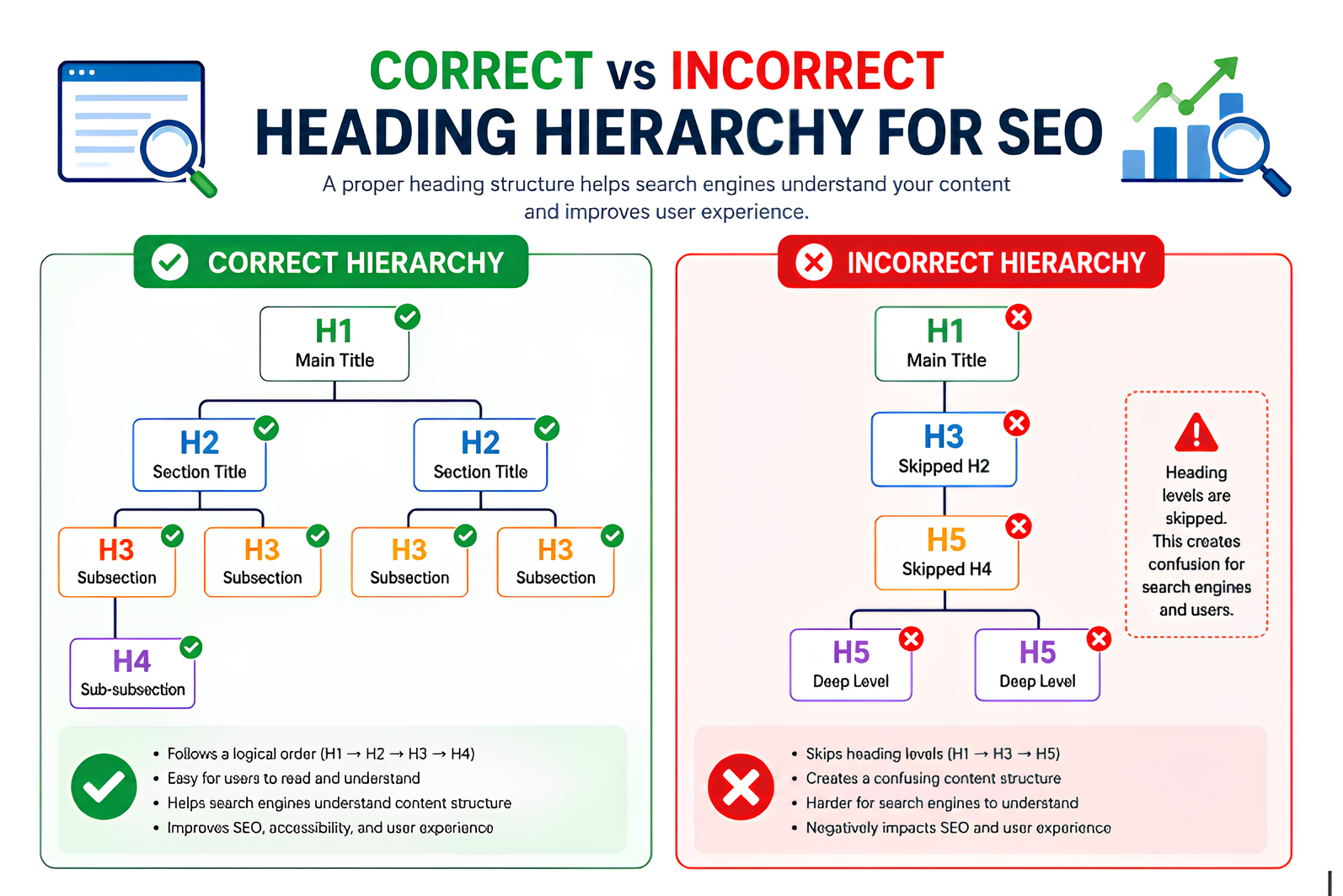
Avoid skipping heading levels unnecessarily. For example, jumping directly from H2 to H5 creates an inconsistent structure that can confuse users and assistive technologies.
Why Header Tags Matter for SEO
Many people believe header tags are a direct ranking factor. While headings alone won't push a page to the top of Google, they play a crucial role in helping search engines understand your content.
Here's why they matter.
1. Improved Content Understanding
Google analyzes heading tags to identify the main topics and supporting ideas on a page.
A clear heading structure makes it easier for search engines to understand the relationship between different sections.
2. Better User Experience
Most users scan webpages before reading them.
Descriptive headings allow readers to quickly find the information they need, increasing engagement and reducing bounce rates.
3. Stronger Semantic SEO
Modern search engines evaluate context rather than isolated keywords.
Well-written headings help establish topical relationships between concepts, entities, and search intent.
Instead of repeating the same keyword in every heading, use related phrases naturally.
For example:
What Is Header Tag Optimization?
Benefits of Proper Heading Hierarchy
Common H1 Tag Mistakes
Optimizing H2 Tags for Readability
This creates richer semantic coverage.
4. Accessibility Benefits
Screen readers rely on heading structures to help visually impaired users navigate webpages efficiently.
Proper heading hierarchy ensures your content is accessible to everyone.
5. Featured Snippet Opportunities
Google often extracts answers from sections with well-written headings followed by concise explanations.
For example:
What Is Header Tag Optimization?
Header Tag Optimization is the process of organizing HTML headings (H1–H6) to improve content structure, readability, and search engine understanding.
This format is ideal for Featured Snippets.
6. AI Overview Optimization
AI-powered search experiences prioritize structured information.
Pages with logical heading hierarchies are easier for AI systems to summarize accurately, increasing the chances of being referenced in AI-generated search results.
Header Tags and Semantic SEO
Modern SEO is no longer based solely on keyword repetition. Search engines now focus on semantic relationships and topical relevance.
Header tags help establish connections between related concepts, making it easier for Google to understand the overall context of a page.
For example, a page about Header Tag Optimization might naturally include related topics such as:
On-Page SEO
Content Structure
Semantic SEO
Search Intent
Accessibility
User Experience
Featured Snippets
AI Overviews
Content Hierarchy
Topic Clusters
Including these related concepts within your heading structure strengthens topical authority and improves content relevance.
Header Tags vs. Title Tags
One of the most common misconceptions in SEO is confusing header tags with title tags.
Although both describe a webpage, they serve different purposes.
Feature | Header Tag (H1) | Title Tag |
Appears on webpage | Yes | No |
Appears in Google search results | Usually No | Yes |
Helps readers | Yes | Indirectly |
Helps search engines understand page structure | Yes | Yes |
Used for page hierarchy | Yes | No |
Example
Title Tag
Header Tag Optimization Guide for Better SEO in 2026
H1
Header Tag Optimization: How to Structure H1, H2 & H3 Tags for Better SEO
Notice how both focus on the same topic but serve different purposes.
How Header Tags Help Content Appear in AI Overviews
As search engines increasingly rely on artificial intelligence to generate answers, content structure has become more important than ever. AI systems don't simply scan webpages for keywords. They analyze how information is organized and connected.
Header tags act as signposts that guide AI systems through your content. A clear heading hierarchy helps search engines identify primary topics, supporting concepts, definitions, explanations, and answers.
Well-structured headings can help:
Improve content understanding by AI systems
Increase visibility in AI Overviews
Enhance content summarization
Improve answer extraction for conversational searches
Strengthen semantic relationships between topics
Support Generative Engine Optimization (GEO)
For example, a heading such as "What Is Header Tag Optimization?" followed by a concise definition gives AI systems a clear answer that can be extracted and displayed directly in search results.
Header Tag Optimization Best Practices Checklist
As part of a broader SEO strategy, it's also important to understand The Difference Between White Hat and Black Hat SEO and make sure your optimization practices follow sustainable, search-engine-friendly principles.
Before publishing any webpage, review this checklist:
Use one clear H1 tag per page
Include your primary keyword naturally in the H1
Organize major sections using H2 tags
Use H3 tags to support and expand H2 topics
Maintain a logical heading hierarchy
Avoid skipping heading levels unnecessarily
Write headings that match user search intent
Use descriptive and meaningful headings
Include related entities and semantic keywords
Optimize headings for readability and accessibility
Structure content for AI Overviews and Featured Snippets\
Avoid keyword stuffing
Good vs Poor Heading Structure
Good Heading Structure | Poor Heading Structure |
What Is Header Tag Optimization? | Introduction |
Benefits of Header Tags for SEO | Important Information |
Common H1 Tag Mistakes | Things to Avoid |
Optimizing H2 Tags for Readability | More Tips |
Header Tags and AI Overviews | Advanced Stuff |
The goal is to make headings descriptive enough that readers can understand the page simply by scanning them.
Conclusion
Header tag optimization is one of the simplest yet most effective ways to improve your SEO. A clear heading structure helps readers find information quickly, makes your content easier for search engines to understand, and supports visibility in Featured Snippets and AI-powered search results. By using H1, H2, and H3 tags strategically, you create content that is organized, user-friendly, and ready for the future of search.
The key takeaway is simple: every heading should have a purpose. A clear H1 establishes the topic, H2s organize major sections, and H3s provide supporting details. When combined with search intent, semantic relevance, and user-focused writing, heading tags become much more than formatting elements, they become strategic SEO assets.
If you'd like to learn more practical SEO techniques and how to apply them in real-world projects, check out our Digital Marketing Course in Calicut. You'll gain hands-on experience in SEO, content marketing, keyword research, and other essential digital marketing skills to help you grow your career or business online.