Python is one of the most beginner-friendly programming languages to learn in 2026. Its readable syntax makes it easier to understand programming fundamentals, while its applications extend to web development, artificial intelligence (AI), data analysis and automation. For beginners, learning Python offers a practical way to explore technology, solve everyday problems and prepare for different career paths.
But learning Python raises several questions. What should you learn first? Which projects help you develop practical skills? Is Python a good career skill in 2026, and should you learn it before JavaScript?
This guide answers these questions with a step-by-step learning roadmap, project ideas and a career-focused comparison. It also explains how to move from writing simple programs to building applications that demonstrate your skills to potential employers.
What Is Python, and Why Should Beginners Learn It?
Python is a general-purpose programming language used to automate tasks, process data, develop applications and build AI-powered solutions. Its straightforward syntax allows beginners to focus on programming logic without getting distracted by unnecessarily complex language rules.
For example, this Python program displays a message:
print("Hello, World!")
You can run this code without writing a long sequence of instructions. That simplicity makes Python approachable, even if you have never written code before.
What makes Python useful for beginners?
Python offers several practical advantages:
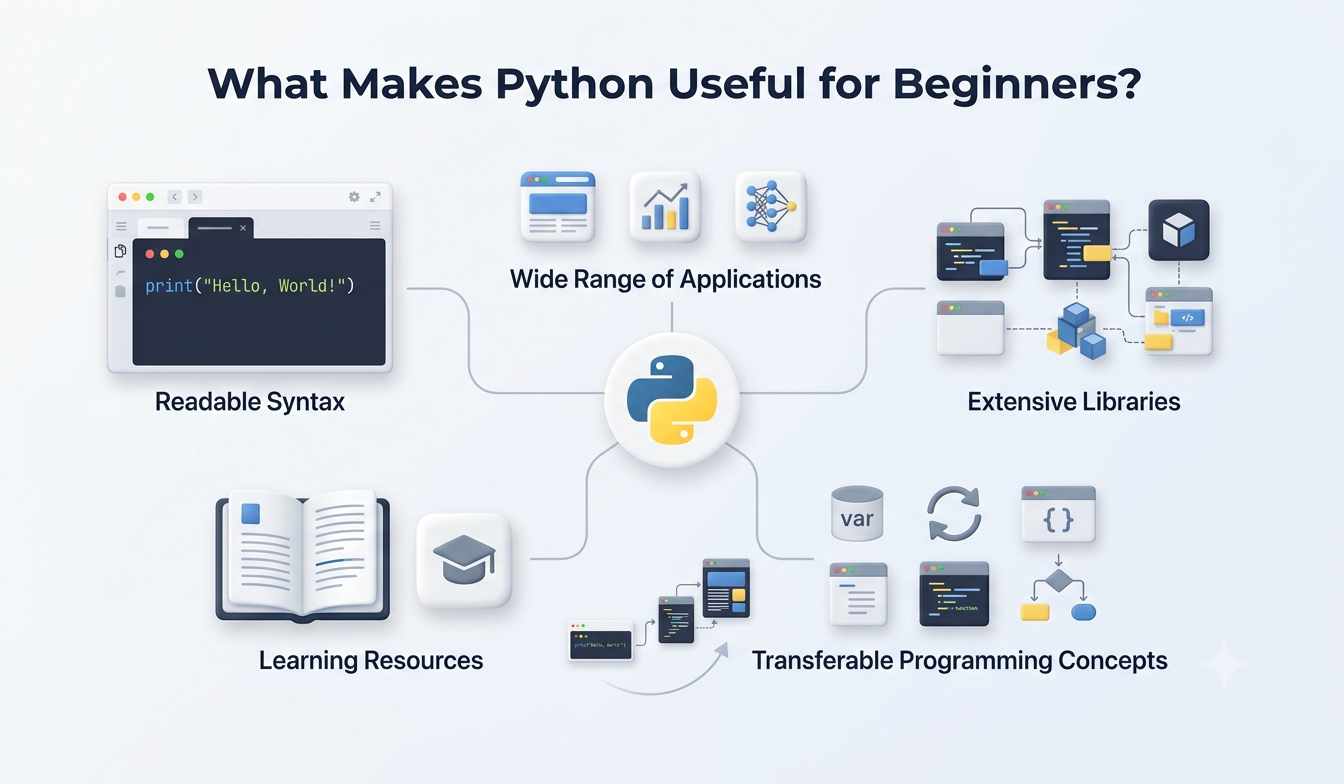
Readable syntax: You can understand many instructions without extensive programming experience.
Wide range of applications: Python supports automation, data analysis, web development and AI.
Extensive libraries: Existing tools help you perform calculations, process information and build applications.
Learning resources: The official Python documentation provides tutorials and reference material.
Transferable programming concepts: Variables, loops, functions and problem-solving skills help you understand other languages.
However, Python's simplicity does not remove the need for practice. You still need to understand errors, debug programs and learn how different components work together.
The real advantage of learning Python is that you can start with small programs and gradually develop the skills needed to build useful applications.
How to Learn Python from Scratch: A Beginner's Roadmap
The most effective way to learn Python is to combine programming fundamentals with regular practice. Instead of trying to memorise every command, learn a concept, use it in a small program and gradually increase the complexity.
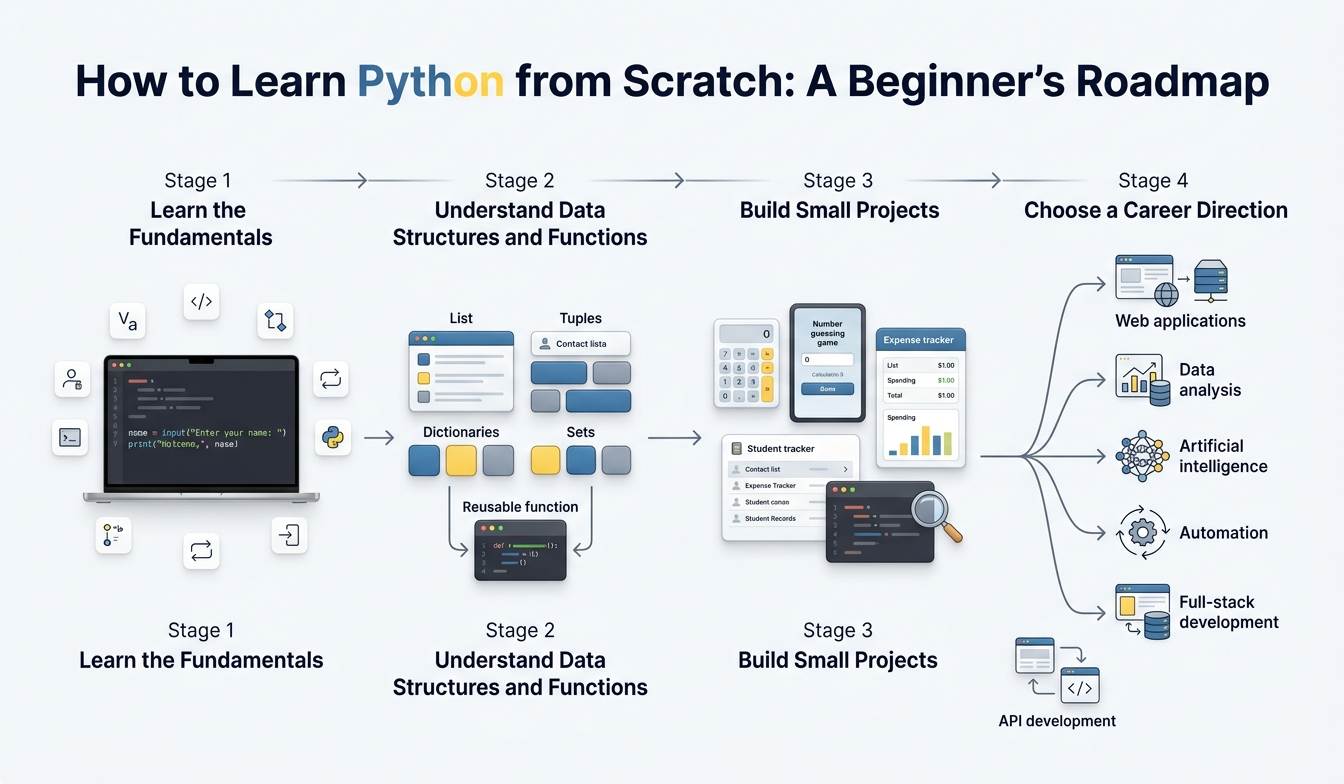
Step 1: Learn the fundamentals
Start with variables, data types, operators, conditional statements, loops and input and output.
For example:
name = input("Enter your name: ")
print("Welcome,", name)
This program accepts a name and displays a personalised greeting. It introduces input, variables and output without requiring advanced knowledge.
Step 2: Understand data structures and functions
Next, learn lists, tuples, dictionaries, sets and functions. These concepts help you organise information and reuse code instead of writing the same instructions repeatedly.
Practise by creating a contact list, calculating expenses or organising student records.
Step 3: Build small projects
Start applying what you learn as early as possible. A calculator, number-guessing game or expense tracker can help you understand how individual programming concepts work together.
When a program fails, investigate the error instead of immediately copying a solution. Debugging teaches you how to identify problems and develop independent problem-solving skills.
Step 4: Choose a career direction
Once you understand the basics, explore a specialisation that interests you.
Your interest | What to learn next |
Web applications | Django, Flask or FastAPI, databases and APIs |
Data analysis | SQL, Pandas, statistics and visualisation |
Artificial intelligence | Mathematics, machine learning and AI libraries |
Automation | File handling, APIs and scripting |
Full-stack development | Python, HTML, CSS, JavaScript and a front-end framework |
You do not need to learn every Python framework. Choose a direction, understand its requirements and develop projects that demonstrate your ability.
Once you understand Python fundamentals, choosing the right framework depends on the applications you want to build. If you are interested in back-end development and APIs, understanding the differences between frameworks can help you make an informed choice. Read our guide to FastAPI vs Django REST Framework to explore their features and use cases.
What Can You Build With Python as a Beginner?
You can build useful programs with Python before becoming an advanced developer. The best first project solves a manageable problem and gives you an opportunity to practise the concepts you already understand.
Six practical Python project ideas
Project | What you can learn | How it becomes useful |
Expense tracker | Variables, lists and file handling | Record and analyse spending |
To-do list | Functions and data storage | Manage daily tasks |
File organiser | File handling and automation | Sort documents automatically |
Data dashboard | Data processing and visualisation | Present information clearly |
Personal blog | Web development and databases | Publish and manage content |
AI-powered chatbot | APIs and AI integration | Build an interactive application |
How Does Python Power AI Development and Applications?
Python has become one of the leading programming languages in artificial intelligence (AI) development. Its simple syntax, extensive libraries, and strong machine learning ecosystem help developers build everything from predictive models to generative AI applications.
How Python Supports AI Development
Python contributes to AI development in several ways:
Data preparation: Developers use libraries such as Pandas and NumPy to clean, organise, and process data before using it to train or evaluate AI models.
Machine learning: Libraries such as Scikit-learn, TensorFlow, and PyTorch help developers build, train, and evaluate machine learning models for tasks such as prediction, classification, and pattern recognition.
Generative AI integration: Python allows developers to connect applications to large language models (LLMs) through APIs and build features such as text generation, summarisation, and question answering.
Natural language processing: Developers can use Python tools to analyse text, identify patterns in language, and develop applications that process human language.
AI application development: Frameworks such as Django and FastAPI help developers build back-end services that connect AI models with websites, databases, and other applications.
These tools serve different purposes. Machine learning libraries help develop or run models, while web frameworks and APIs help make their capabilities available to users.
How Is Python Used in Generative AI?
Python plays an important role in generative AI because it supports libraries and frameworks used to build AI-powered applications. Beginners can start by understanding how Python works with APIs and gradually explore how AI models generate text, images and other content.
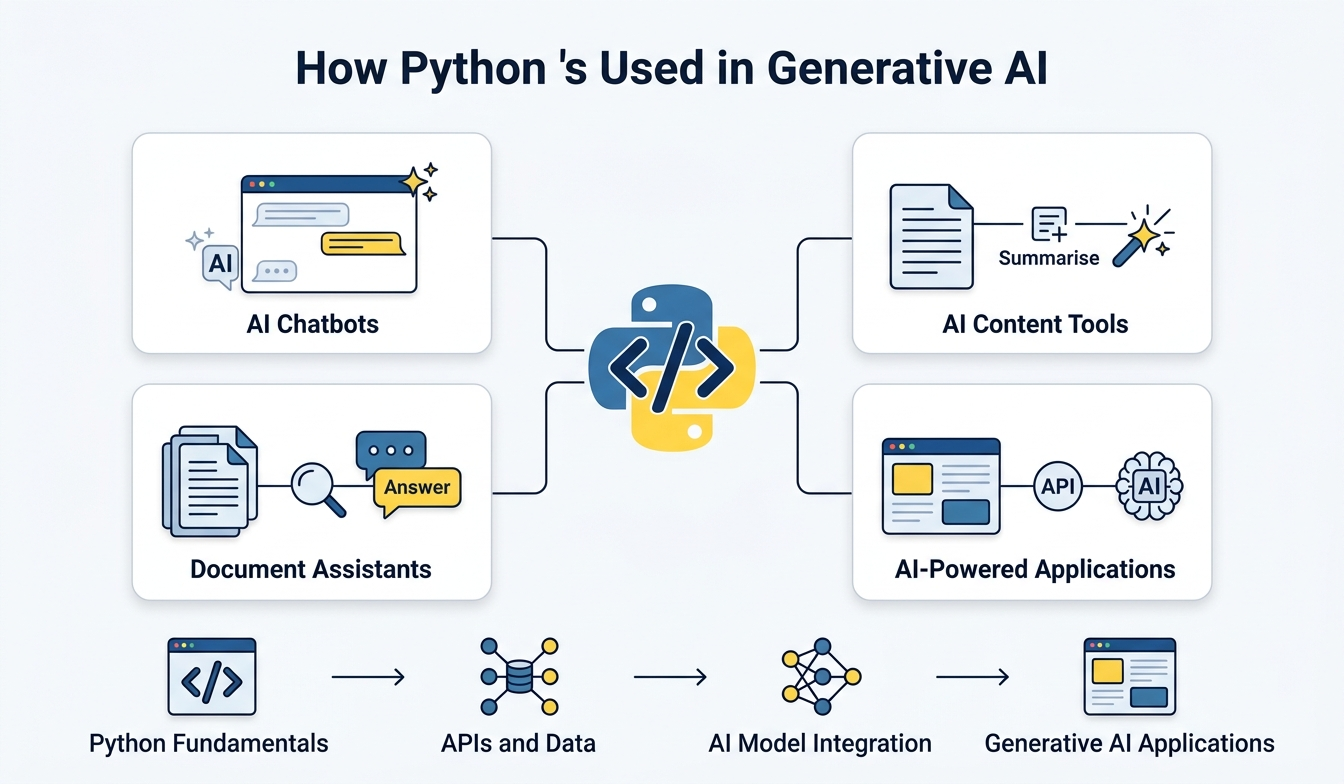
What can you build with Python and Generative AI?
AI chatbots: Build applications that answer questions using generative AI models.
AI content tools: Create tools that generate, summarise or rewrite text.
Document assistants: Develop applications that retrieve information from documents and answer user queries.
AI-powered applications: Integrate language models into websites and other software using APIs.
Python fundamentals provide a useful starting point, but building generative AI applications also requires knowledge of APIs, data handling, model integration and responsible AI use. As you progress, you can explore frameworks and tools that help connect AI models with real-world applications.
To explore practical examples, read our guide to AI Applications Built Using Python.
Is Python a Good Career Skill in 2026?
Yes, Python can be a valuable career skill in 2026, particularly for people interested in software development, data analysis, automation and AI. Its applications across these fields give learners several options for developing specialised skills.
The Stack Overflow Developer Survey 2025 reported a seven-percentage-point increase in Python adoption from 2024 to 2025. The survey identifies Python as an important language for AI, data science and back-end development.
This provides evidence of continued developer interest, but it does not guarantee employment for beginners. Career opportunities depend on the role, location, practical skills and employers' requirements.
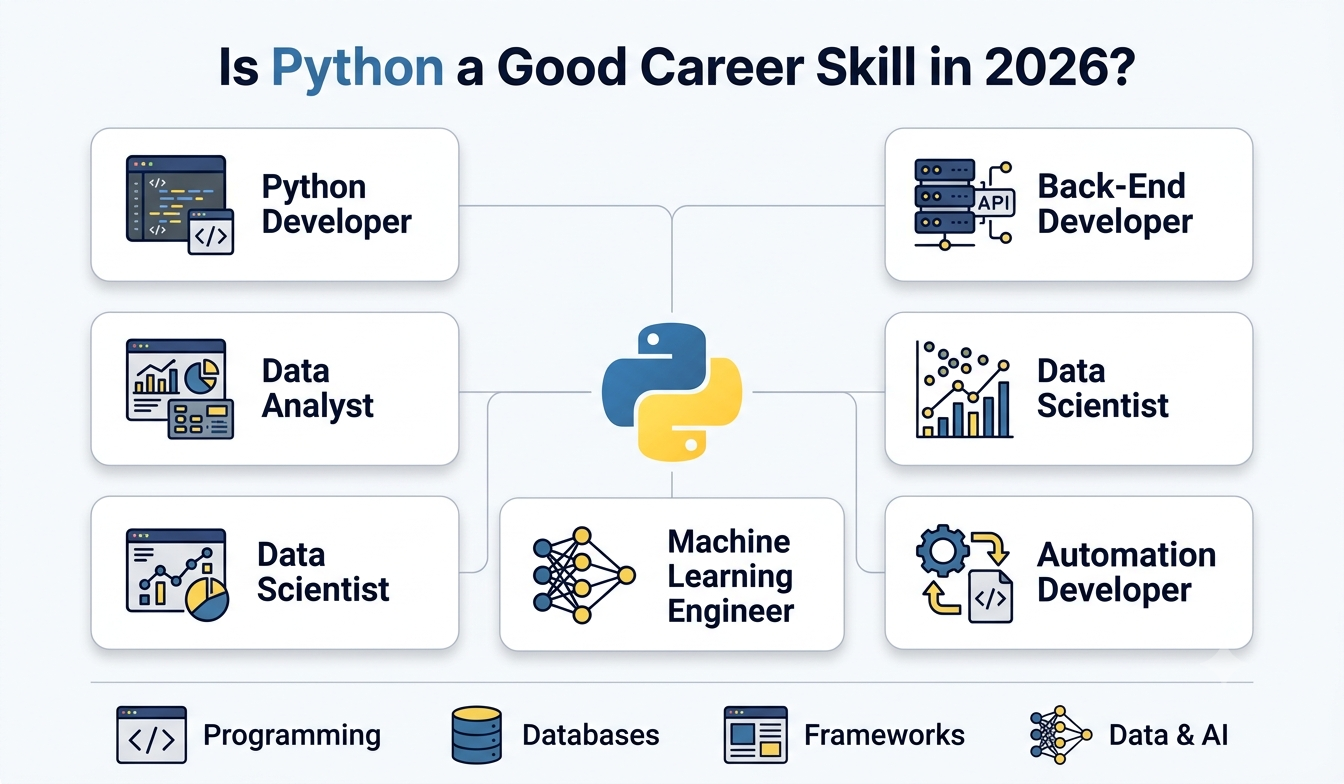
What jobs can you pursue after learning Python?
Career option | Additional skills to develop |
Python developer | APIs, databases, testing and software design |
Back-end developer | Django or FastAPI, SQL and deployment |
Data analyst | SQL, Excel, statistics and Power BI |
Data scientist | Statistics, data processing and machine learning |
Machine learning engineer | Mathematics, model development and deployment |
Automation developer | Scripting, APIs and workflow automation |
These roles require different levels of expertise. Learning Python fundamentals alone does not qualify you for every position on this list.
Is Python enough to get a job?
Usually, no. Python is a foundation, not a complete career plan.
Employers may expect you to understand databases, data structures, version control, testing and application development. They also want evidence that you can solve problems rather than simply reproduce examples from tutorials.
A practical learning plan should include three elements: programming fundamentals, role-specific tools and a portfolio of projects. For a development role, this might mean learning Python, Django, MySQL and REST APIs before building and deploying a web application.
AI coding assistants can help explain unfamiliar concepts and suggest solutions. However, you still need to check their output, understand the code and test whether it works correctly.
Python vs JavaScript: Which Should Beginners Learn?
Python and JavaScript are both useful programming languages, but they support different types of work. Python is widely used for automation, data analysis, AI and back-end development. JavaScript is essential for interactive websites and also supports server-side development through technologies such as Node.js.
Choose Python if you are interested in data, AI or automation. Choose JavaScript if your immediate goal is to build interactive websites.
Python vs JavaScript: Key differences
Factor | Python | JavaScript |
Syntax | Readable and relatively simple | Requires learning its language and browser concepts |
Common applications | Automation, data, AI and back-end systems | Interactive websites and web applications |
Front-end development | Usually requires other technologies | Core technology for browser-based interfaces |
Data science | Extensive ecosystem | Less commonly used for traditional data science workflows |
Beginner projects | Scripts, data tools and simple applications | Interactive pages, browser games and web interfaces |
Which language is easier to learn?
Many beginners find Python easier to read because its syntax is relatively straightforward. JavaScript can also be approachable, particularly when learners want to see immediate results in a browser.
The better starting point depends on your goal. If you want to analyse data or automate repetitive work, Python is a sensible choice. If you want to create interactive websites, JavaScript is the more direct route.
You can learn both eventually. Once you understand programming fundamentals in one language, several concepts transfer to the other, even though their syntax and development environments differ.
How Can You Turn Python Skills into Real-World Projects?
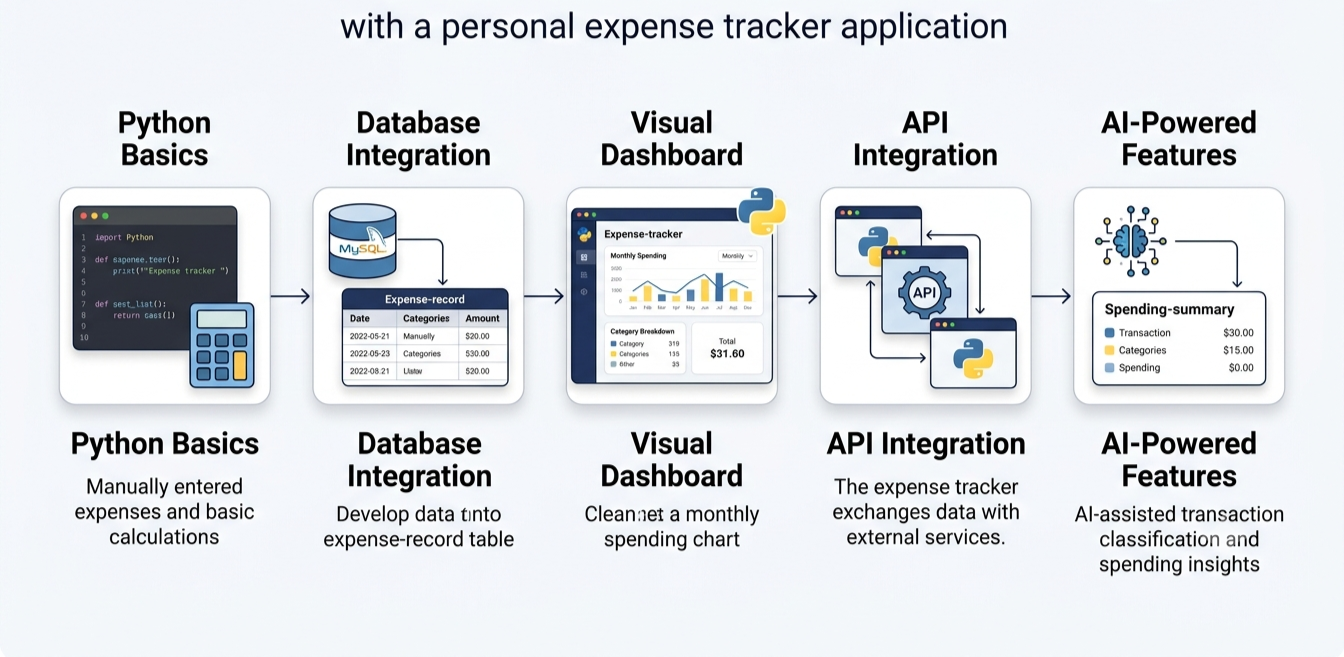
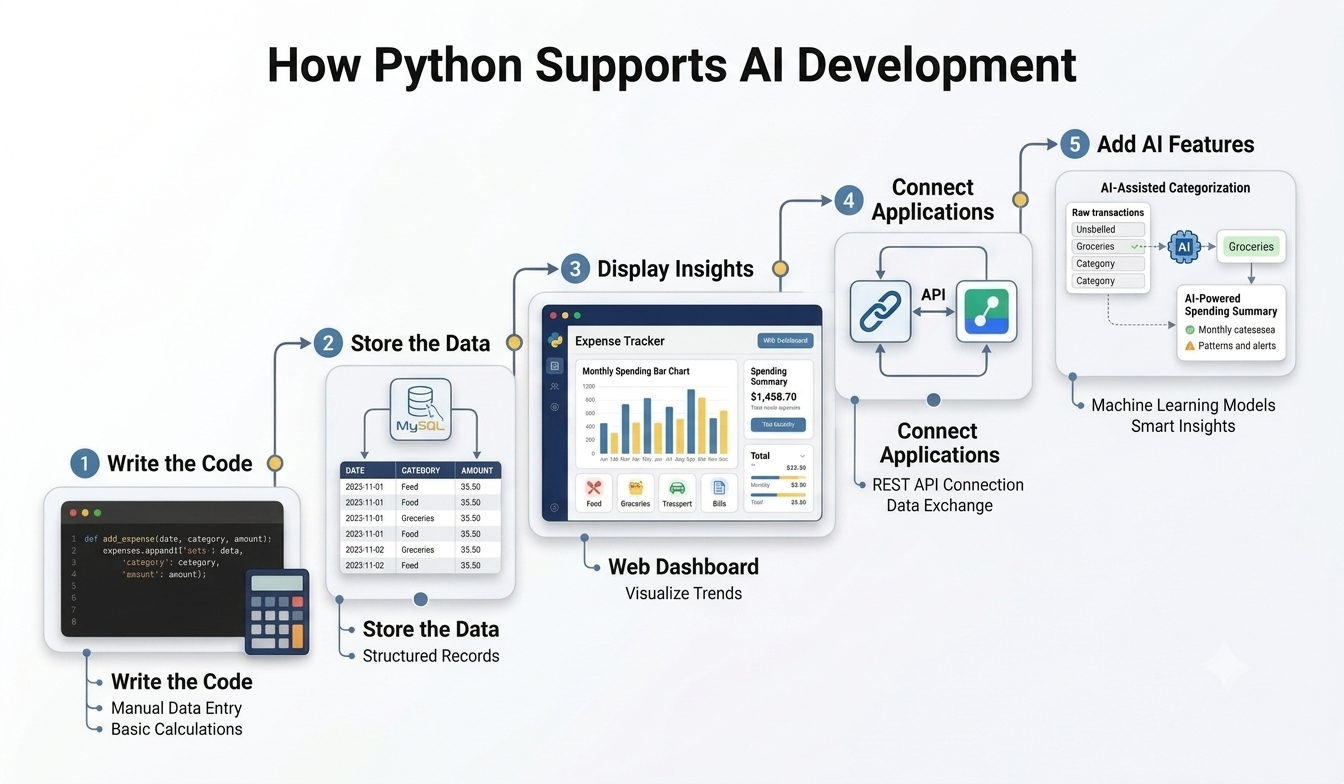
Knowing the syntax is only the first stage of learning Python. The next step is understanding how programs interact with databases, APIs, user interfaces and external services.
Consider a simple personal expense tracker. Its first version might calculate expenses entered manually. A more advanced version could save records in a MySQL database, display monthly summaries and provide a web interface.
You could then add an API to exchange information with another application. If the use case justifies it, you could introduce AI features to categorise transactions or summarise spending patterns.
Each improvement introduces a new skill and moves the project closer to a real application.
How Long Does It Take to Learn Python?
The time required to learn Python depends on your previous experience, practice schedule and career goals. Understanding the basics can take weeks, while building independent applications and preparing for a developer role usually takes longer.
Learning stage | Illustrative timeframe | Expected outcome |
Programming fundamentals | 2-4 weeks | Understand basic syntax and logic |
Beginner projects | 1-2 months | Build small working programs |
Specialised skills | 2-4 months | Learn tools for a chosen direction |
Portfolio development | 3-6 months or more | Build and document practical projects |
These timeframes are planning estimates, not guarantees. Someone practising regularly may progress faster than someone who studies occasionally.
Measure your progress by what you can build independently. Completing ten tutorials is less useful than building one application, understanding how it works and explaining the decisions behind it.
Conclusion
Python for beginners offers a practical starting point for learning programming, building applications and exploring careers in technology. From automating everyday tasks to developing websites, analysing data and working with AI, Python helps you turn programming concepts into practical solutions.
However, learning Python syntax alone is not enough to prepare for a developer role. You need to practise problem-solving, build projects, understand relevant tools and develop the skills required for your chosen career path. While Python is a strong choice for AI, data analysis and automation, JavaScript is more suitable if your primary goal is interactive web development.
The best way to learn Python is to start small, build real projects and keep expanding your skills. Learners who prefer structured training can explore HACA Tech School's Python course in Calicut. The programme is designed for beginners and combines programming fundamentals with application development.
Our curriculum covers Python, Django, React, MySQL, REST APIs, data libraries and generative AI technologies. It also includes a five-month learning period followed by a one-month project phase.
This learning route is relevant to people who want to progress beyond basic Python scripts towards full-stack development and AI-integrated applications.
You can also explore HACA's Tech School to understand its wider technology learning options.